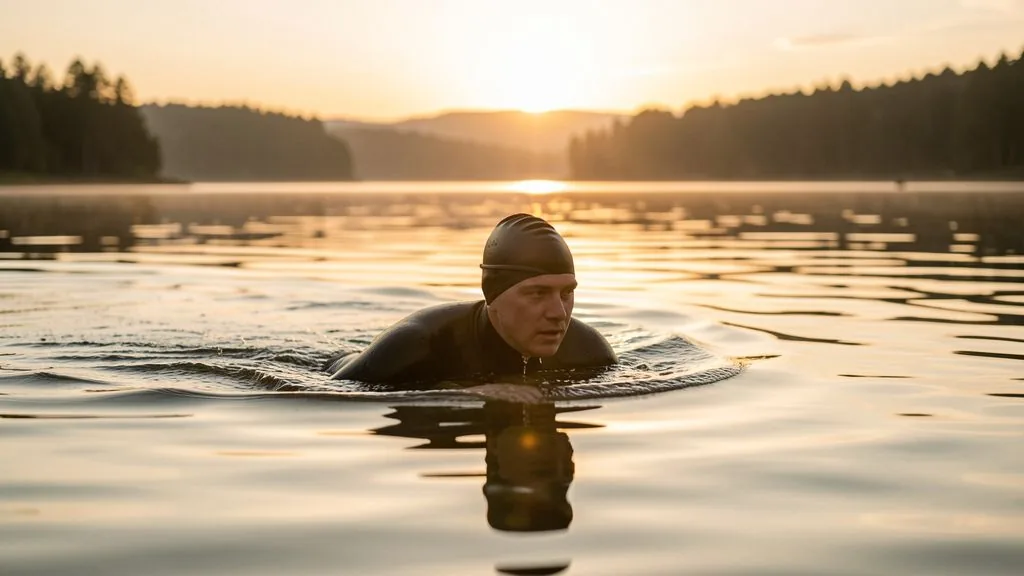
Swimrun is the only endurance sport where you never change your suit — because you never take it off. You run across rock, jump into the water, swim through a lake with your shoes on, climb out on the far side and keep running. No transition zone, no seconds lost at the bike rack, no fresh start. That is exactly the appeal: one continuous flow of movement across two very different types of load.
What swimrun is — and why it is not a triathlon without a bike
The idea came out of a bet: in 2002 four Swedes swam and ran across the Stockholm archipelago, and in 2006 that became the race Ötillö ("island to island"). Today a World Series runs races in Sweden, Italy, Switzerland, Portugal and the USA. The rules are similarly strict everywhere: all equipment is carried on the body from start to finish, wetsuit and shoes stay on. Only goggles and cap may come off briefly.
That separates swimrun fundamentally from a triathlon with its transition zones. In triathlon you optimise the handovers — in swimrun there are none. Instead you optimise the state in between: how quickly do you find a clean swimming rhythm in a full suit and heavy shoes, and how quickly do you get back into a relaxed running stride?
The distances are more manageable than the name suggests. Beginner races sit at 12 to 18 km total with 1 to 3 km of swimming spread across six to twelve water sections. Long-distance classics such as Ötillö Sweden come to 75 km with around 10 km of swimming in more than 20 sections — there it is not swimming ability that decides, but the capacity to get dry twenty times.
The real appeal: the constant switch
First-time swimrunners underestimate two things. First, water resistance: trail shoes cost 20 to 30 percent more pulling force in the water depending on the model, and the buoyancy of the wetsuit changes your body position. In open-water swimming you normally streamline — in swimrun there is a package hanging off your feet acting like a brake flap.
Second, the circulatory switch. Jumping into cold water drops your pulse briefly, breathing goes shallow, the legs feel numb. After 200 metres that is over — but only if you deliberately keep the first strokes calm. Anyone who sprints into the water pays for it on the next running section. Those switches — 15 to 25 per race — are the training stimulus no other sport provides.
Gear: less really is more here
Because everything has to be carried, every equipment decision is a weight decision. What actually matters:
- Wetsuit: a swimsuit rather than a fullsuit — short-sleeved, with thinner material (2–3 mm) on the legs so you can run in it without overheating. A pure triathlon suit works, but it gets too hot on running sections and is too stiff at the knees.
- Trail shoes with drainage: light, grippy, with mesh that releases water quickly. No waterproof membranes — they fill up and stay full. Half a size larger than your road shoe, because wet feet need more room.
- Pull buoy: fixed to the thigh, it adds buoyancy for heavy legs and stabilises your position. Some models integrate a small pocket.
- Hand paddles: small and short (around 15 × 20 cm), fixed to the hands — they lengthen the stroke and protect you from sharp rock when landing.
- Partner tether: a 2 to 3 m rope on the belt keeps the team together and saves pulling force in the water. Only relevant for races with a team classification, but in training the best drill for even pacing.
What you deliberately leave at home: hydration pack (aid stations on land are usually enough), spare clothing, spare goggles during the race. Rule of thumb: anything you do not need to keep moving stays behind. Every kilogram on your body costs you more later in the day than it gives you early on.
Training in three blocks
Swimrun does not need its own season plan — it needs a shift in weighting. Three blocks cover everything:
1. Open-water swimming in gear. Once or twice a week, at least one session with shoes and pull buoy. Start with 4 × 200 m and short running breaks on the shore so the body adapts to the switch. Technically important: a higher stroke rate (55–65 strokes per minute instead of 40–50) and a shorter glide phase, since the resistance at your feet brakes you. Anyone working on freestyle technique in the pool should deliberately practise longer strokes without a glide pause there.
2. Running with wet legs. The underestimated block. Wet shoes weigh 300 to 500 g more and chafe differently. Train it specifically: 60 to 90 minutes of trail with two or three short water crossings (stream, lake shore), then keep running straight away. That is how you learn to avoid blisters — merino or polypropylene socks instead of cotton, no talcum powder (it clumps).
3. Combined sessions ("brick swim-run"). The backbone of race preparation. An example for the start: 10 min warm-up run, 500 m swim, 3 km run, 400 m swim, 3 km run, 300 m swim, 2 km cool-down. Around 70 minutes in total. Two such sessions per week are enough to train the circulatory switch.
A sample week for beginners (7–9 hours)
- Monday: rest day or 30 min easy shakeout.
- Tuesday: 50 min open water in shoes: 6 × 200 m, 60 s rest on the shore.
- Tuesday/Wednesday: 45 min strength: single-leg deadlift, lunges, step-ups, calf raises, anti-rotation core work.
- Thursday: 75 min trail with two water crossings, last 15 min at target race pace.
- Friday: rest day.
- Saturday: 90 min combined session: 3 rounds of 400 m swim + 2.5 km run.
- Sunday: 90 to 120 min long run, easy, hilly if possible.
That is six sessions with a clear focus: two water sessions, two land sessions, one combined session, one rest day. If you already train for triathlon, simply replace one bike session and one swim session with combined and trail sessions — the rest stays.
Controlling intensity: the switch as a load trap
The classic beginner mistake is going too hard in the water sections. Water feels cool and "neutral", the effort is underestimated — and on land your heart rate explodes. A pragmatic control: swim at a level where you can breathe calmly again within 60 seconds of landing. If that fails, the section was 5 to 10 seconds per 100 m too fast.
For the running sections the same logic applies as in polarised training: most of it belongs in zone 2, only the short climbs and the last two kilometres of a race are allowed to hurt. Because heart rate in water is not comparable due to cold, suit pressure and a horizontal body position, heart rate zones are only partly usable here — breathing rhythm and the question of whether you could still talk after 30 seconds are more telling.
Common beginner mistakes
- The suit is too warm. A fullsuit from triathlon leads to overheating at 18 °C water temperature with running sections. A swimsuit or a thin short-sleeve suit is the right call.
- Starting in road shoes. They soak up water, weigh double afterwards and offer no grip on wet rock. A light trail shoe with drainage is not an equipment question but a safety question.
- Carrying too much. Hydration pack, gels in hand, spare goggles — anything not fixed to your body costs force and gets lost. Nutrition belongs in the integrated suit pocket or comes from the aid station on shore.
- Training alone, racing in a team. In most races the team must stay together. Anyone who has never trained with a slower or faster partner loses more on race day through waiting and closing gaps than through missing fitness.
- Underestimating the entry. Going from the shore straight into the first water section without a warm-up is the most common reason for panic at the start. With anxiety in open water one thing helps above all: keep the first 200 metres deliberately slow and keep looking forward.
Race day: what actually counts
The race strategy differs clearly from a triathlon. Because there is no transition zone where you can recover, fuelling is the critical point: you have to eat and drink while running, and the water sections are no break. What has proven itself is one gel or half a bar every 30 to 40 minutes on the running sections, plus 150 to 250 ml from the cup at the aid station — not more, or it sloshes on the next jump into the water.
Team dynamics decide more than individual performance. The stronger partner sets the pace on climbs and in the water, the weaker one sets it on technical sections. Agree beforehand: who navigates, who carries the map, who gives the signal to wait. A team losing 20 seconds per switch loses almost seven minutes across 20 switches.
For an overview of distances, demands and race formats, the Peakora triathlon pages are worth a look — half Ironman, Olympic distance and sprint distance are compared there with their training volumes. Anyone wanting to look up terms such as aerobic threshold, TSB or running economy will find them in the Peakora glossary.
How Peakora slots swimrun into your plan
Swimrun is essentially combined training with a very high muscular load. In the Peakora engine a combined session is therefore not counted as "swimming plus running" but as a single session with an elevated TSS value: the load of both disciplines adds up, but recovery time does not scale proportionally. In practice that means after a 90-minute swimrun session the next hard stimulus needs 48 hours of distance — not 24, as after a pure run.
Because the recovery monitor tracks CTL, ATL and TSB, after two weeks of swimrun you can see in black and white whether the build is holding or whether the combined load is rising too fast. In that case the adaptive plan pushes intensity sessions back rather than cutting volume — the most common reason swimrun beginners drop out after four weeks with a tendon irritation is a build of combined load that is too fast, not a swimming volume that is too high.
Frequently asked questions about swimrun
What exactly is swimrun?
Swimrun is an endurance sport that alternates trail running and open-water swimming with no transition zone — all gear stays on your body. Most races are run in pairs of two who must stay together.
How long is a swimrun race?
Sprint distances cover 12 to 18 km in total with 1 to 3 km of swimming; long-distance classics such as Ötillö Sweden reach 75 km with around 10 km of swimming across more than 20 sections. Beginners should start at 12 to 15 km.
Why do you swim in shoes during swimrun?
Because taking them off and on costs time and energy, and the ground between swim sections is rocky and slippery. Shoes add roughly 20 to 30 percent water resistance but protect your feet and give grip on rock.
How should I train for swimrun?
With three blocks: open-water swimming in shoes and pull buoy, running with wet legs and shoes, and combined sessions that link both disciplines without a break. Two combined sessions per week are enough to start.
Do I need a partner for swimrun?
In most races, yes. Teams must stay together from the start and may only separate briefly. So train with partners of different strength and practise waiting and closing the gap.
Plan your combined training with Peakora
Combined sessions, training-load control and adaptive planning for triathlon, duathlon and swimrun. Start for free, no credit card required.
Start for free