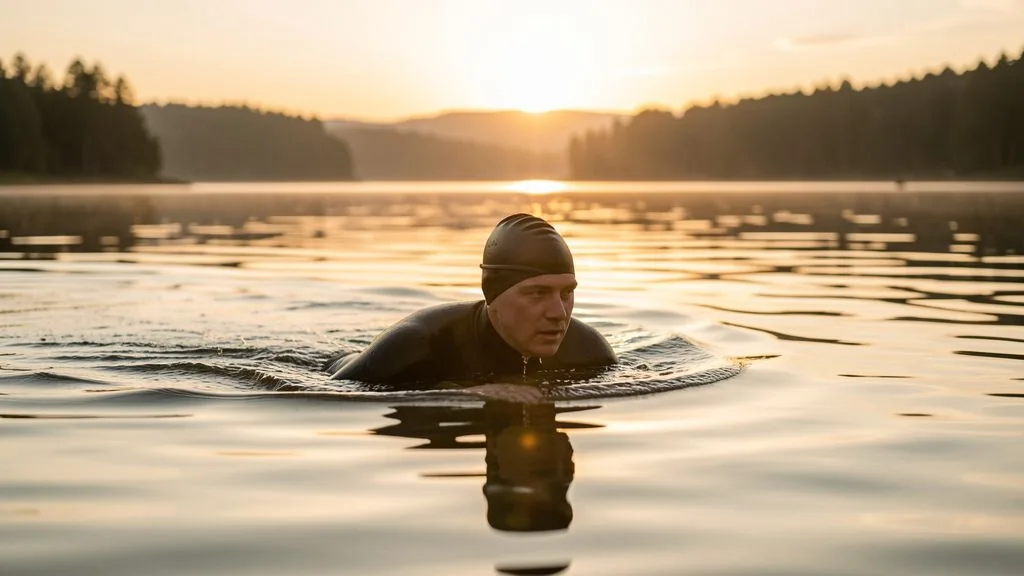
A triathlon is not won by whoever has the fastest individual splits, but by whoever combines the three disciplines most intelligently. Swim 40 seconds faster than planned and you will easily lose three minutes on the bike and the run — because the swim conditions tempt everyone into overcooking it: waves, other athletes, sighting, start-line adrenaline. This article lays out the tactics for each segment, from the start line to the finish arch.
The time is not in the swim, it is in the distribution
A triathlon is won in the order in which the load is applied: the disciplines are not equivalent, because their fatigue carries over. A swim that is too hard costs you primarily on the bike (a 5 to 10 percent power drop at the same perceived effort); a bike that is too hard costs you almost exclusively on the run. So the first rule for every segment is: the opening kilometres belong to the plan, not to the feeling.
The second principle is the split. For most age-group athletes an even to slightly negative run split is the most economical option: the second half of the run at or just under goal pace. Anyone who tries to chase down the field with sprints at the swim start pays for it in the last third of the run — exactly where the legs are already suffering most from the ride.
Swim: start in control, use the feet, avoid sprints
The swim start is psychologically the hardest situation of the whole day: crowding, adrenaline, no pace display, no watts. That is exactly why the tactic here is “enter slowly, accelerate later”.
- The first 200 metres deliberately easy. If your target pace is 1:50 per 100 metres, swim the first 200 at 2:00 — it costs around 20 seconds and saves considerably more. Heart rate and breathing rhythm need 90 to 120 seconds to settle.
- Look for feet instead of fighting. The draft in the water is stronger than on the bike: sitting on someone's feet saves 10 to 25 percent of energy at practically the same speed, depending on the gap. For beginners, working through the technique in triathlon swimming for beginners pays off particularly well.
- Take the buoy wide. The classic mistake is turning too tightly. In the turn your heart rate jumps by 10 to 15 beats, you get kicked and lose your technique. Five metres further out costs almost no time and saves the chase afterwards.
- Target time, not target position. In the swim you follow your own pace, with a watch that beeps every 500 metres. Anyone who keeps watching their age-group position almost always swims too fast.
Bike: the first 20 km decide the run
On the bike there are two tactics — and only one of them works. The first is to chase: ride at the front, close gaps, sit in the slipstream of the fastest riders. The second is to distribute: even power, a controlled first 20 km, then increasing load. Under the draft ban that applies in practically all age-group racing, the first tactic is an illusion — there is no slipstream, only air resistance.
The target values are physiologically well defined. As a percentage of your threshold (FTP):
- Olympic distance (40 km): 80 to 85 percent of FTP on average. Peaks up to 90 percent are fine on climbs, but they have to be paid back on the descents.
- Half distance (90 km): 70 to 78 percent of FTP. Consistency matters more than the absolute number here — a first bike segment 5 percent too high costs three to five minutes in the half marathon.
- Long distance (180 km): 65 to 72 percent of FTP. Over the long distance the bike becomes fuelling practice: whatever you do not eat and drink here will be missing at the end.
Control by power, not by heart rate: in the heat and after the swim your heart rate is 5 to 10 beats higher, which under heart-rate control automatically produces too little power. How to determine these zones properly is explained in FTP testing for cyclists. For putting the load into a weekly context, see TSS, CTL, ATL and TSB: a taper that lifts form (TSB) to plus 5 to plus 15 is the best tactical preparation there is.
T1 and T2: routine beats haste
Transition times get underestimated because they look small. Across two transitions, 30 to 60 seconds each easily adds up to two or three minutes — more than some athletes gain in half a year of training. And a good transition costs no energy, only order.
- Shoes mounted sideways. Fix the bike shoes to the pedals with elastic bands, slip into them while mounting and only close them after the mount line. This saves the standing-up struggle and works on any terrain.
- A fixed order, no searching. From wetsuit through helmet, glasses and race number to running shoes: always the same sequence, always out of the same bag. Anyone who has to think at the transition rack loses the time they were trying not to lose in the swim.
- Elastic laces on running shoes. No knots — an unspectacular detail worth 5 to 10 seconds per transition, so 10 to 20 seconds across the day.
- The first running kilometres are not running. After the bike, legs and circulation need 1 to 2 kilometres to adapt. Run the first kilometre deliberately 15 to 20 seconds per kilometre slower, then settle into goal pace — that is not lost time, it is drawing on the reserve.
For all the details of transition layout, gear arrangement and rehearsal sessions, see T1 and T2 in triathlon — the sequences described there can be called up one to one on race day.
The run: negative split and controlled fuelling
The run is the segment where every tactical mistake shows up — but also the segment where you can still win. Triathlon run distances range from 10 kilometres (Olympic) and 21 kilometres (half distance) up to the final marathon on the long distance.
- First 2 kilometres deliberately moderate. Goal pace plus 15 to 20 seconds per kilometre, then gradually build. The physiological reason: only from about kilometre 3 does your heart rate settle back to the level that matches your actual running performance.
- Plan in kilometres, not minutes. In heat and wind, time is not a reliable control value; perceived exertion (RPE) on a 10-point scale is more practical: target 7 to 8 over the last 5 kilometres, not 9.
- Fuelling is part of the tactic. Small amounts of fluid from the start; drink on the bike, and at every second aid station on the run. The classic misjudgement: drinking only when thirsty, then realising three kilometres later that the deficit can no longer be corrected. Concrete amounts and electrolyte content are in electrolytes for runners.
- Head: when plan and body disagree. If nausea, a stitch or stomach pressure appears, no tactic helps — slow down by 10 to 15 seconds per kilometre, drink, digest. Five kilometres of endurance are worth more than a broken pacing plan.
The five most common race-day tactical mistakes
- Swimming too hard. The most expensive mistake, because it only shows up 80 kilometres later. Anyone who overcooks the water loses power on the bike without noticing — perceived effort on the bike is skewed anyway after the swim.
- An unrealistic bike target. A power value you have never held for more than 90 minutes in training will not suddenly work in a race. Race tactics may only be derived from sessions you have actually completed.
- No fuelling in the first hour. Eating nothing for two hours and then trying to catch up with 80 grams of carbohydrate per hour while your stomach rebels — that does not work. Digestion needs training and an even rhythm.
- Panicked transitions. Rushed, disorganised transitions cost more time than a calm, careful routine — searching for the helmet, untied laces, a race number lying the wrong way.
- Starting the run too fast. The opening kilometres of the run are run too quickly in almost every race because the legs feel “hungry” after the bike. Anyone 10 seconds per kilometre too fast there loses several times that in the second half.
How Peakora prepares your tactics
Tactics are not a race-day idea but the result of preparation that models the whole day. Peakora plans all three disciplines in one shared load curve: swim, bike and run sessions are converted into a TSS value, and over the weeks that produces fitness (CTL), fatigue (ATL) and form (TSB). From that you can see whether your planned race week will deliver you fresh or overloaded to the start line.
The race tactics themselves are derived from your own test data: bike target watts from FTP, run goal pace from a real running test, swim target pace from a 400 or 1,000 metre time. The plan also models the effect of heat and elevation so that your targets on race day do not depend on an ideal line. Because the calculation is deterministic, you can read back where every number comes from. For the overall structure of your build, see the triathlon training plan for beginners, and the triathlon-specific sessions are covered in swim training sets.
Frequently asked questions about triathlon tactics
How should I pace a triathlon?
With an even to slightly negative split: swim in control and without sprints, ride at constant power instead of a fast first 20 km, and run the second half at or just under goal pace. Anyone who overcooks the swim loses several times over on the bike and the run.
How many watts should I ride in a triathlon?
As a guide, 80 to 85 percent of FTP for the Olympic distance and 70 to 78 percent for the half distance. The first section must not be above target, even if it feels easy — the first 20 km decide how much running you have left.
How fast do triathlon transitions need to be?
A safe transition takes 1:30 to 2:30 minutes; the fastest athletes go under a minute. The real gain comes from routine rather than haste: shoes mounted sideways on the bike, elastic laces and a fixed order of steps.
How do I fuel a triathlon correctly?
Drink from the start, take small amounts every 15 to 20 minutes on the bike from kilometre 20, and let the last 10 bike kilometres digest. For the half distance plan 60 to 90 grams of carbohydrate per hour — all tested in training, nothing new on race day.
Plan your race week with Peakora
Peakora calculates bike target watts, run pace and your form curve from your own data — for Olympic, half and long distance. Start for free, no credit card required.
Start for free