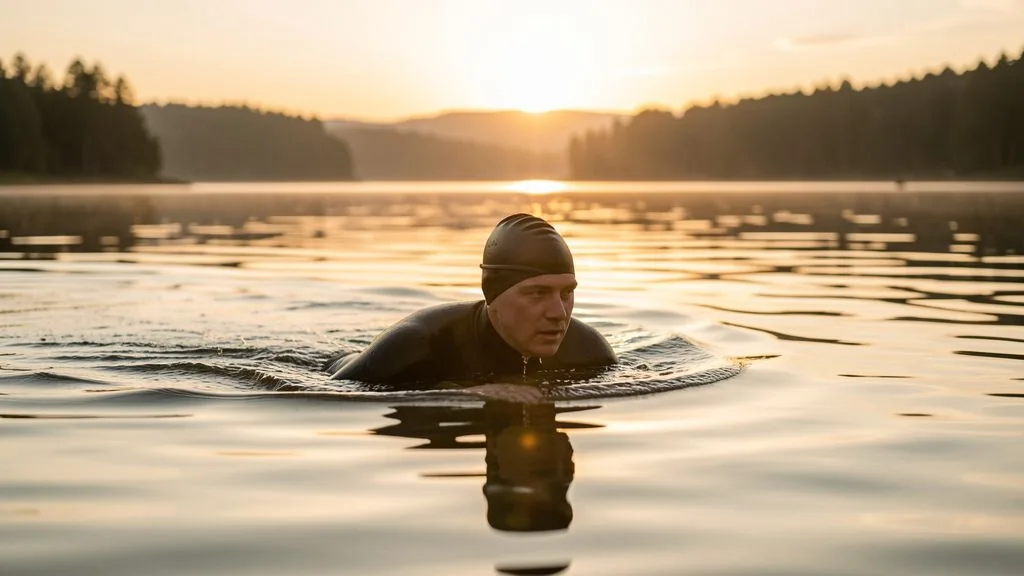
Swimming is the biggest hurdle for most triathlon newcomers: 750 metres in a sprint, 1,500 metres at Olympic distance, 1,900 in a half — often in cold open water, surrounded by hundreds of other athletes. The good news: swimming is the discipline where technique matters more than strength. Master the five core building blocks and you will exit the water faster and, above all, fresher — with plenty left in the tank for the bike and the run.
Why technique decides everything in the water
Water is roughly 800 times denser than air, and drag increases with the square of your speed. Swimming twice as fast therefore means four times the resistance. That is why powerful gym athletes regularly lose in the pool to lighter, technically clean swimmers. Every improvement in body position beats any strength training — a body that creates ten percent less drag saves more energy than ten percent more pulling power could ever deliver.
For triathletes there is a second factor: the swim is only the start of the day. Anyone who exhausts themselves in the water because they fight the resistance instead of reducing it pays the bill on the bike. Economy in triathlon is not an end in itself — it is resource management across three disciplines.
The five technique building blocks at a glance
1. Body position: horizontal like a plank
The most common beginner mistake is a sinking hip: the body hangs in the water like a bathtub with the plug out, legs and glutes dragging behind. The solution is at the front, not the back: look straight down at the pool floor (not forward) and press your chest lightly into the water — like a seesaw whose front end you load so the back end rises. The head is the rudder: lifting it by just two centimetres makes your legs sink noticeably.
2. Breathing: exhale underwater
Most beginners hold their breath underwater and then try to exhale and inhale in the short breathing window. The result is a frantic gasp for air. The correct way is the opposite: as soon as your face is in the water, exhale continuously through nose and mouth — the roll to breathe then serves only the inhale. Start by breathing every second stroke to your strong side, but work towards bilateral breathing on a three-stroke rhythm: it evens out your rotation and is worth gold in open water when waves or competitors come from one side.
3. The kick: balance, not propulsion
In triathlon the kick has one main job: keeping the body balanced. Around 80 percent of propulsion comes from the arm stroke. A hard six-beat kick burns oxygen and carbohydrates that your legs will urgently need on the bike two hours later. For most age groupers the calm two-beat kick is ideal: driven from the hips, knees softly bent, feet relaxed — more a gentle flutter than a whip.
4. The arm stroke: catch first, then pull
The critical phase is the “catch” at the start of the stroke: hand and forearm set up like a paddle while the elbow stays high. Imagine reaching over a barrel in front of you and pulling yourself past it — do not push the water backwards, pull your body past the anchored water. The recovery above the water runs relaxed with a high elbow, the hand re-enters in front of the shoulder. Useful drills: fist drill (swimming with clenched fists to feel the forearm), catch-up (the next stroke starts only when the hands meet in front) and single-arm freestyle.
5. Sighting: the sixth sense for open water
In open water there is no black line on the bottom. Every six to eight strokes, briefly lift your eyes above the surface (“crocodile eyes”), orient yourself on the next buoy and drop your head straight back down. Practise in the pool first: swim a length while checking the far wall twice. Anyone who never sights typically swims ten to twenty percent extra distance in a race — time you could have had for free.
How to structure your swim training
Two to three sessions of 45 to 60 minutes per week are entirely sufficient for sprint and Olympic distance — what matters is the structure of each session. The 1,500-metre continuous swim that many beginners call “training” is the opposite of structure: under fatigue you cement your worst movement patterns. Intervals with rest allow quality from start to finish.
A proven basic framework:
- Warm-up (200–400 m): easy, mixed strokes, finding your body position.
- Technique block (400 m): drills like fist, catch-up or side glide — fresh and focused, before fatigue sets in.
- Main set (800–1,200 m): intervals such as 8–10 × 100 m with 15–20 seconds rest. Goal: even splits, not the fastest first rep.
- Cool-down (200 m): very easy, consciously reviewing the day's technique cues.
Intensity in the water follows the same rules as running: the bulk stays easy and aerobic, only a small share is deliberately fast. Why this distribution works is explained in our article on the 80/20 principle in endurance sports — the physiology is identical, only the medium differs.
Occasional video analysis (a training partner's phone underwater is enough) shows you more than ten hours of swimming by feel: the gap between perceived and actual body position is almost always dramatic for beginners.
From pool to open water: the decisive step
The first open-water start feels like a different sport: no visibility, cold water, physical contact with other swimmers. Build the transition into the final six to eight weeks before your race — you should get at least four to six open-water sessions.
- Test the wetsuit: the buoyancy of a wetsuit noticeably changes your position — usually for the better, as the legs ride higher. Still: swim in it several times beforehand, apply skin lubricant around the neck and practise taking it off (T1!).
- Approach the mass start strategically: as a beginner, position yourself at the side or the back of your wave. Swim the first 200 metres deliberately easy — the field thins out quickly, and you avoid the dreaded “washing machine” in the middle.
- Train orientation: before the start, memorise the buoy sequence and a landmark behind the finish (a tree, a house, a tower). Sight every six to eight strokes during the race.
- Prevent panic: cold water on the face triggers a breathing reflex in many people. Acclimatise for 30 seconds before the start, let some water into the wetsuit and focus on exhaling — calm exhalation is the most effective anti-panic switch.
- Use drafting: swimming behind the feet or at hip level of a slightly faster swimmer saves up to 20 percent of energy according to studies — and it is within the rules.
Common mistakes triathlon beginners make in the water
- Only swimming continuous distances instead of intervals. 1,500 metres non-stop mainly trains one thing: your poor technique under fatigue.
- Kicking too hard. It devours oxygen your legs will miss on the bike.
- Head too high. Looking forward makes the legs sink — the most expensive body-position mistake of all.
- Breathing to one side only. One-sided rotation makes the stroke asymmetric and leaves you half blind in open water.
- First open-water swim on race day. Cold, darkness and body contact belong in training, not in your debut at the start line.
- Technique only in spring. Winter is technique season: short, drill-heavy sessions beat long base mileage with old form.
Swimming in the bigger picture: one of three disciplines
For most age groupers the swim accounts for only 10 to 20 percent of total race time — it is not worth moving half your training week into the pool. A smarter distribution serves all three sports: two to three swims, three rides, three runs and two short strength blocks per week. What such a weekly structure looks like in detail is shown in our triathlon training plan for beginners.
Frequently asked questions about triathlon swimming
How often should a triathlon beginner swim per week?
Two to three sessions of 45 to 60 minutes per week are ideal. Consistency beats volume: three short, technique-focused sessions deliver more progress than one long swim in which fatigue ingrains poor movement patterns.
Which swimming stroke is best for triathlon?
Freestyle (front crawl) is the standard in triathlon because it is the fastest and most energy-efficient stroke. The rules generally allow any stroke, but breaststroke or backstroke costs significantly more time and energy that you will miss later on the bike and the run.
Do I need a wetsuit for my first triathlon?
It depends on the water temperature: most organisers allow wetsuits up to around 24 degrees Celsius, and in colder water they are often mandatory. A wetsuit adds buoyancy and warmth — always test it in open water beforehand, never for the first time on race day.
How do I get faster at swimming?
Through better technique, not more strength: water resistance grows with the square of your speed, so a horizontal body position and a clean arm stroke deliver more than extra pulling power. Intervals with a technique focus and occasional video analysis produce the fastest progress.
Peakora plans all three disciplines for you
Swimming, cycling, running, strength — Peakora builds your triathlon training plan with the right weekly structure for your distance and your level. Start for free, no credit card required.
Start for free