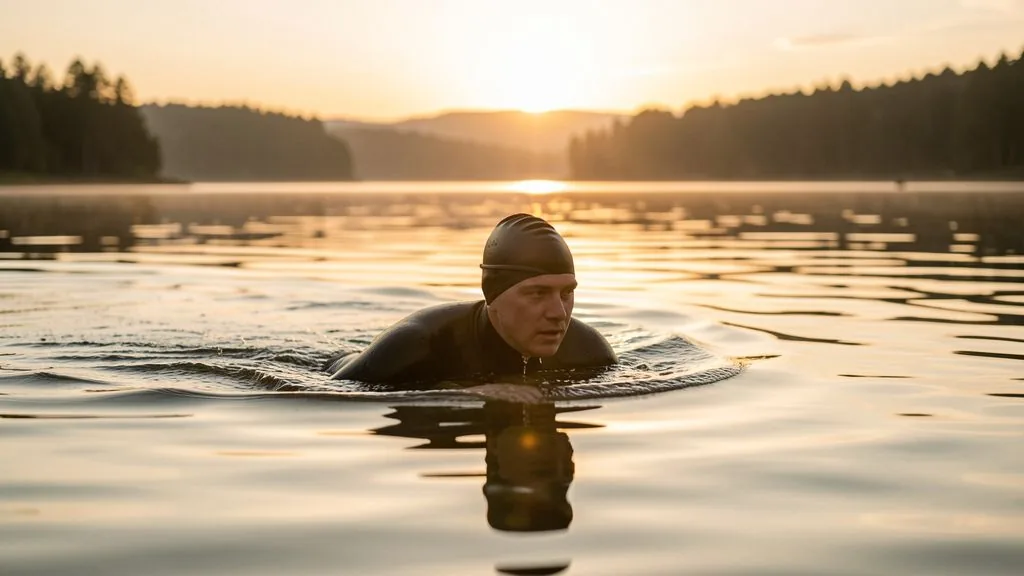
You swim well in the pool — but at the lake your stomach tightens before the water even reaches your knees. Fear of open water swimming is the most common reason triathlon beginners hold back or skip the race entirely. The good news: this fear is not a character issue but a trainable response of the nervous system. With seven strategies and four to six short acclimatisation sessions, most people can reduce it to the point where starting in open water becomes routine.
Why open water triggers panic
Panic in open water has three physical triggers, and none of them has anything to do with a lack of fitness. The first is the cold shock: when cold water hits your face and chest, the brain activates a protective response via the dive reflex — heart rate and breathing spike, and breathing turns shallow. If you then put your head under as you would in the pool, you reflexively inhale instead of exhale. That exact moment feels like drowning, even though physically everything is fine.
The second trigger is the darkness. In a lake you often cannot see further than thirty centimetres underwater. The brain processes movement heavily through the eyes; when the visual anchor disappears, the balance system reports uncertainty — a dizzy feeling that drives tension even higher. The third factor is the missing pool wall: there is no edge to reach in two strokes and no ground under your feet. The nervous system registers: no escape route. Add the contact with other swimmers during a race — arms, legs, a foot in your face. All of it is new, and the body answers novelty in the water with alarm.
Strategies 1–3: The entry starts at the shore
Getting used to open water works like any form of exposure: in small, controlled doses. Three strategies form the foundation before any swimming happens at all.
- 1. Familiar water, familiar conditions. The first session belongs at a small, manageable lake in calm weather with water above 20 °C — not at the race venue and certainly not in the sea. Start by standing hip-deep in the water for five minutes without swimming. The goal of this session is not distance but presence: the body learns that cold water and missing ground are not dangerous. General technique tips for the transition from pool to open water are in the article Open water swimming: technique and training.
- 2. Never alone. A companion — on the shore, in a kayak or swimming alongside — measurably changes the nervous system's response: the escape route is back, and the alarm level drops. For the first four to six sessions this is not an option but a requirement, also for safety reasons. Many swim and triathlon clubs offer guided open water sessions; that is the fastest way into a protected environment.
- 3. Breathing before pace. The most important tool against panic is exhaling underwater. Putting your face in the water and exhaling continuously through mouth and nose prevents the CO₂ build-up that creates the tightness in your chest. Practise at the shore in knee-deep water: face in, blow for ten seconds, come up, repeat — twenty repetitions before every session. Only once that is solid do you actually swim. The details of a proper breathing rhythm are in the article Freestyle breathing: technique and rhythm.
Strategies 4–7: Building confidence in the water
- 4. The wetsuit as an ally. A wetsuit lifts the legs, softens the cold shock and gives a feeling of support through its snug fit. For many anxious swimmers it is the single most important factor. Two conditions: the suit must fit (too tight at the neck creates unease instead of security), and it must have been tested in the water beforehand — a new wetsuit on race day is a risk, not a help. Buying and fitting tips are in Wetsuit for triathlon.
- 5. Make sighting a fixed part. A large part of the uncertainty comes from not knowing where you are. Practise sighting from day one: lift your head briefly every six to eight strokes, fix on a buoy or a landmark on the shore, keep breathing. Knowing where you are and that the shore is within reach makes you swim noticeably calmer. The technique behind it is explained in Sighting and orientation in open water.
- 6. Short doses, rising frequency. Four fifteen-minute sessions over four weeks beat a single sixty-minute session. Acclimatisation happens between sessions, not during them. Structure every session the same way: ten minutes of shore breathing, then short swims parallel to the shore in standing depth, only then out into deep water.
- 7. Breaststroke as a fallback. Having an honest alternative to freestyle removes the feeling of being trapped. Breaststroke with your head above water is slower but unconditionally safe — and allowed in races. Swimmers who know they can switch at any time almost never need to.
The emergency plan: what actually helps when panic hits
Panic in the water follows a fixed pattern: breathing becomes faster and shallower, strokes shorten, the legs sink. The way out is equally fixed and should be rehearsed at the shore beforehand so it is available when it matters.
- Roll onto your back. Spread your arms and legs; your face comes out of the water. Buoyancy carries you even completely motionless — that is the most important sentence against mortal fear: you cannot sink as long as you lie calmly.
- Exhale slowly. Panic drives the heart rate up via inhalation; the antidote is a long, deliberate exhale. Count internally: inhale for two, exhale for six. After about thirty seconds your pulse drops measurably.
- Only then swim on. Once your breathing is calm again: breaststroke with your head above water towards the shore or the nearest safety boat. In a race, raising a fist calls the water rescue — that is no disgrace, it is exactly what the boats are there for.
Race day: managing the start despite residual nerves
Even after good preparation, some residual tension remains on race day — that is normal and does not need to disappear; it only needs to be planned for. Three things make the difference. First: get in early. If the organiser allows a warm-up swim, use it. Five minutes in the race water, face in, blow twenty times — that way the cold shock is done before the start gun fires. Second: choose your position. Line up at the edge or in the back row of the start wave, never in the middle. Swim the first two hundred metres on the outer arc around the pack — a few seconds slower, but without a single collision. Third: deliberately slow the first twenty strokes. The most common race-day panic happens because everyone starts far too fast and their breathing cannot keep up inside the wetsuit. If you reach the first buoy in control, you win everything back afterwards.
The mental side of race day — handling pre-race nerves, routines before the start gun — is its own topic; see the article Managing pre-race anxiety. And when your first triathlon as a whole comes closer, you will find the complete structure on the pillar page Triathlon training.
Common mistakes when starting open water
- Treating the first session as a full workout. Trying to swim a thousand metres on day one overloads the nervous system and confirms the fear instead of reducing it. The first session ends after fifteen minutes, no matter how well it goes.
- Going into open water alone. Apart from the fear factor, it is a genuine safety risk. Cramps, currents or a buoy in the wrong place — without company, every small issue becomes a problem.
- Ignoring the cold shock. Jumping straight in is the classic mistake. Taking two minutes to acclimatise face and neck to the water leads to relaxed swimming afterwards; skipping it means fighting your own breathing for the first five hundred metres.
- Talking the fear away. "Just toughen up" does not work because the response does not originate in your thinking. What works: name the fear, understand the physical reaction and confront it in small doses.
- Quitting after the first setback. A bad session — chop, cold water, a moment of panic — is part of the process. The acclimatisation curve is not linear; the fifth session is almost always better than the fourth.
Anchoring open water training in your plan
Open water acclimatisation rarely fails because of the fear itself — it fails because the sessions get lost in the training week. If your first triathlon is in June, you need the first open water sessions no later than six weeks out, once a week, firmly scheduled. In Peakora these acclimatisation blocks are part of the swim preparation: the plan raises the open water frequency in the final weeks before the race and mixes sighting and start practice into the sessions instead of just counting metres. If you also want to improve your pool technique, see the article Improve your freestyle technique.
Frequently asked questions about open water anxiety
Is fear of open water swimming normal?
Yes. Even experienced triathletes report unease during the first open water sessions of the season. Cold water, darkness below the surface and no ground under your feet trigger a protective response from the nervous system. With four to six acclimatisation sessions it disappears for most people.
What triggers panic in open water?
Cold water on the face activates the dive reflex and speeds up heart rate and breathing. Add poor visibility, no pool wall to rest at and body contact with other swimmers in a race. For the nervous system this is a new situation — the panic response is normal, not a character flaw.
How many sessions until the anxiety fades?
Most swimmers need four to six short sessions of ten to twenty minutes at a familiar body of water before the tension drops noticeably. Consistency matters most: once a week over six weeks works better than one long day at the lake.
Does a wetsuit help with the anxiety?
Yes, noticeably for many swimmers. The buoyancy lifts the legs, the material softens the cold shock and the snug fit gives a feeling of support. The suit must be tested in the water beforehand, though — a brand-new wetsuit on race day tends to increase the feeling of constriction rather than relieve it.
What do I do if panic hits me in the water?
Roll onto your back, spread arms and legs, exhale deliberately. Buoyancy carries you even without any movement, and a long exhale measurably lowers your heart rate. Only when your breathing is calm do you swim on — breaststroke to the nearest boat or shore if needed.
Your first triathlon — to the water with a plan
Peakora builds open water acclimatisation, technique blocks and race-day preparation directly into your training plan. Start for free, no credit card required.
Start for free