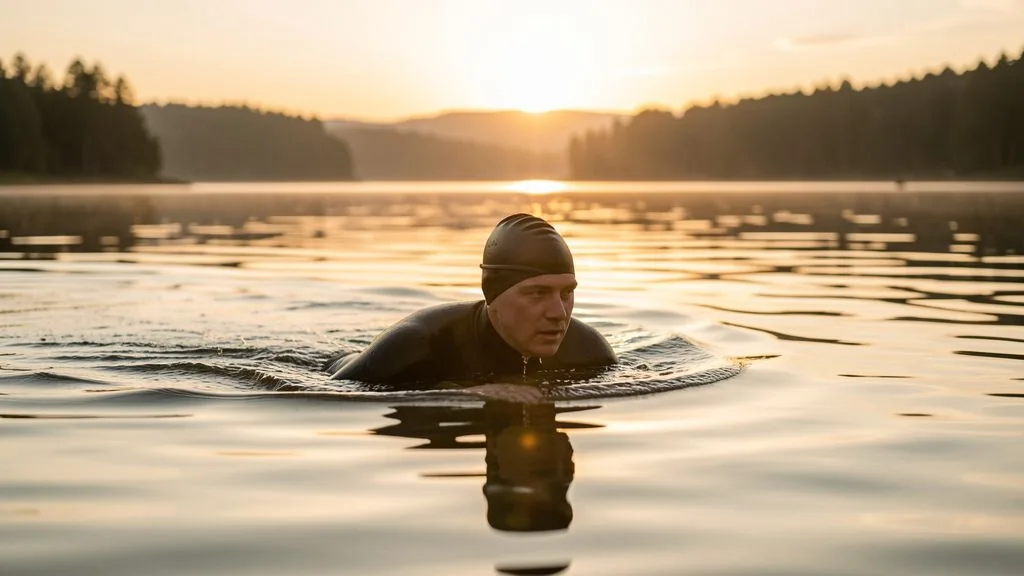
You swim 1:40 per 100 metres in the pool — and suddenly 1:55 in the lake? Welcome to open water. No line on the bottom, no wall to push off, visibility often under a metre, plus cold, waves and hundreds of arms around you. The good news: almost everything that costs you time in open water is trainable. Here are the techniques that make the difference.
Why open water is different from the pool
The pool is a laboratory: 25 or 50 metres straight ahead, a black line for navigation and a wall every 50 metres that gifts you a push-off. In open water all of that disappears. Your efficiency drops for three reasons: you rarely swim exactly straight (detours), your body position worsens without the lane rails (more drag), and interruptions from sighting, waves or contact break your rhythm.
Then there is temperature: a lake at 18–21 °C cools the body noticeably, costs energy and changes your breathing — many underestimate how strongly cold water on the face spikes the heart rate. And finally the mental factor: limited visibility and contact with other swimmers trigger stress in many beginners, sending the heart rate through the roof in the opening minutes. If you know this and practise it, you have already half defeated the open water swimmer's biggest enemy: panic in the first stretch after the start.
Navigation: sighting without losing speed
The most important open water technique is sighting: briefly lifting your head to aim at a buoy or landmark. The technique: as your lead arm enters the water, lift your head only enough for your eyes to clear the surface ("crocodile eyes"), take in the target within a tenth of a second and submerge immediately — your kick keeps going, otherwise your legs sink and brake you.
Frequency is decisive: sighting every 6 to 8 strokes is the proven guideline. Sighting only every 20 strokes means swimming arcs — and a drift of just 10 % adds a full 150 extra metres over a 1,500 m leg. Sighting every 3 strokes, on the other hand, bleeds speed with each look and strains your neck. By the way: sighting can be built into pool-based swim technique training as a fixed element.
A second navigation lever is buoy strategy: don't blindly "follow the pack", swim the ideal line from buoy to buoy. Before the start, study the course: where are the turn buoys, which landmark on the shore (church tower, mast, house) sits behind the finish? A large landmark is more reliable against the glare of the sun than a small buoy.
Mass starts: position, contact, staying calm
The start often decides how pleasant your swim will be. The golden rule: seed yourself where your ability level is. If you are not a front-pack swimmer, line up wide or towards the back — you may lose 10 seconds but gain a clean start without kicks and being swum over. Seed yourself too far forward and you get rolled, losing far more through panic and oxygen debt.
The first 200 metres are the critical stretch: many sprint off the start line, blow into anaerobic debt and have to back off after 150 metres — exactly where the chaos is worst. Better: start deliberately controlled, dial up to race pace only after the first buoy. Contact, by the way, is normal and rarely malicious — an arm on your back, a hand on your foot. Swimmers who have practised it in training (close-quarters group swims, for example) stay calm instead of hyperventilating.
For deep-water starts, practised treading water with calm breathing helps. And if stress does creep in: briefly roll onto your back or switch to breaststroke, three deep breaths, re-orient, continue. That costs 15 seconds — a panic attack costs minutes.
Wetsuits: buoyancy, fit, drawbacks
A wetsuit is more than a warmth package: it lifts your hips and legs, improves body position and lowers the energy cost per metre — studies quote 3–5 % time gains over short distances, often more for weaker swimmers. That is why it pays to train regularly in the suit whenever wetsuits are legal: it changes how swimming feels — your torso rotates differently, shoulders fatigue faster over long sets, and a tight collar can restrict breathing.
Three practical points: First, fit — the suit must be snug but must not constrict chest and shoulders; when in doubt, try a size in a specialist shop instead of ordering blind online. Second, chafing: apply anti-chafe balm or vaseline to neck and armpits before the start. Third, practise removal: getting the suit off is part of the first transition — if you don't train it, you give away a minute there. More in the article on T1 and T2 — triathlon's fourth discipline.
Wind, waves and current
- Adapt your breathing: In chop coming from one side, breathe bilaterally — and prefer the lee side, away from the waves. Being able to breathe to both sides pays off twice in open water.
- Raise your stroke rate: In rough water a shorter, quicker stroke with a higher arm recovery over the waves wins. The long, gliding pool style sinks in the chaos.
- Use the current: In rivers, swim against the current close to the bank (where it is weakest) and with the current in mid-channel. Lakes have shoreline currents too — the organiser's course description often reveals them.
- Head for shore in heavy swell: If it gets too much, the fastest way out matters more than the ideal line. No time loss outweighs a safety risk.
Training plan: how to practise deliberately
Open water competence is built 70 % in the pool and 30 % in the lake. Concretely:
- Sighting interval (pool): 8 × 100 m with 2 sightings per length, 15 seconds rest. Progression: sighting with a pace drop under 2 seconds.
- Blind swimming (pool): In the middle of the lane, swim 6–8 strokes with your eyes closed, then check where you end up. You will feel your natural drift — almost every swimmer pulls to one side.
- No-wall sets (pool): Once a week, 400–800 m without pushing off at the turn (open turn, feet never touch the wall). Simulates the lake's missing wall bonus.
- Lake session (every 1–2 weeks): 20–40 minutes with start simulation (5 × 100 m brisk from the shore), a buoy course for sighting and a slow-motion wetsuit removal to finish — accompanied and in a supervised area.
Common open water mistakes
- Training pool-only and being surprised at the lake. At least every two weeks during the season, an open water session belongs in the plan — otherwise you pay the tuition fee right at your race.
- Starting too fast. Swimming the first 200 m controlled is not cowardice but physiology: an early anaerobic deficit ruins the rest of the leg.
- Blindly following the group. The swimmer ahead of you may navigate just as badly as you do. Own sighting routine beats herd instinct.
- New wetsuit on race day. As with shoes: nothing untested in a race. Every wetsuit needs at least three training outings until it sits right and you master taking it off.
- Underestimating the cold. After 10 minutes in cold water your hands tremble — the wetsuit rules of the federations (mandatory below 16 °C, usually banned above roughly 24.6 °C) exist for a reason.
How Peakora supports your swim training
In Peakora, swimming is not an add-on but a fixed part of triathlon planning: the engine distributes your swim sessions across the week so that technique and open water blocks land before your A-race — and balances them against bike and run volume. The recovery monitor detects when total load gets too high, and adaptive planning moves hard sessions instead of letting you swim yourself into exhaustion. Beginners get the right entry point via the triathlon training plan for beginners.
Frequently asked questions about open water swimming
Do I need a wetsuit for open water swimming?
Below about 21 °C water temperature a wetsuit is advisable, below 16 °C practically mandatory — in triathlons the organizer's wetsuit ruling decides. A wetsuit pays off beyond the rulebook too: it adds buoyancy, saves energy and keeps you warm.
How often should I sight while swimming in open water?
Sight briefly every 6 to 8 strokes: lift your head only enough for your eyes to clear the water, fix a buoy or landmark, and swim on immediately. Sighting too rarely costs detours; too often costs speed and energy.
Is open water swimming dangerous for beginners?
No, as long as you follow basic rules: never swim alone, choose supervised waters or marked swim zones, wear a wetsuit in cold water and stay visible with a bright swim buoy. First open water sessions belong in shallow, calm water.
How can I practise sighting in the pool?
Build sighting into pool sessions: for example 8 × 100 m, lifting your head every 50 m to aim at a target on the pool ceiling. Swimming 6–8 strokes with closed eyes in the middle of the lane also helps you feel your natural drift.
Train for your triathlon with Peakora
Swim, bike, run — one plan that connects all three and adapts to your form. Start free, no credit card required.
Start for free