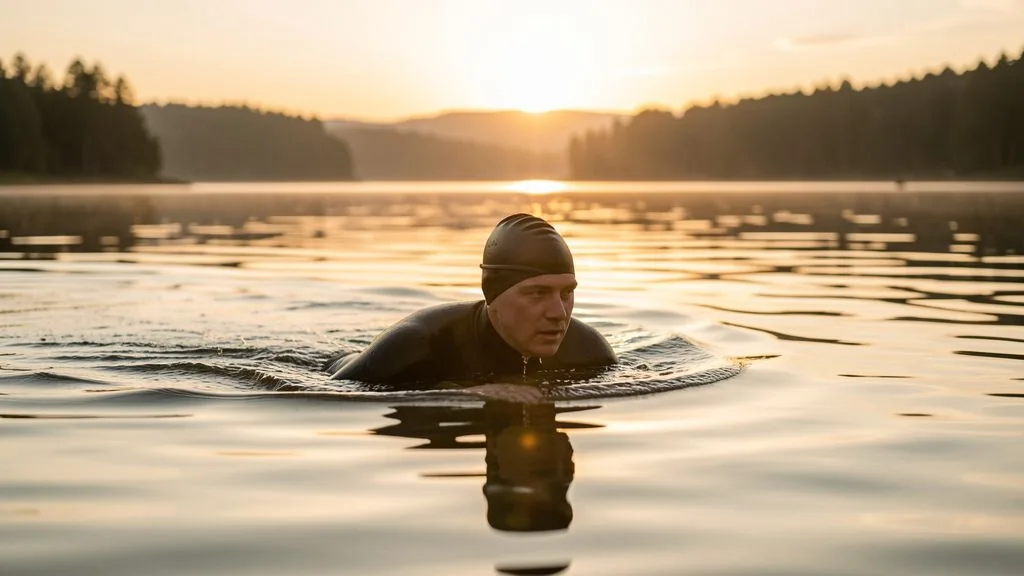
In the water it isn't force that decides your speed — it's form. Water is roughly 800 times denser than air, so every brake your body creates costs you more speed than a stronger pull could ever win back. That is exactly why freestyle technique is the fastest route to more pace: not more strokes, but better ones. Six core points decide whether you glide through the water or fight against it.
Why technique beats force
When swimmers slow down, they almost automatically grab harder. That's the wrong direction. In a well-trained freestyle swimmer, around 70 percent of propulsion comes from the arms, the rest from the kick and rotation — yet the kick also burns an enormous amount of oxygen, especially with poor technique. A restless kick that produces little propulsion is a pure energy drain.
On top of that comes water resistance, and it grows with the cross-sectional area your body presents to the water. If you lie flat and long, that area is small. If your hips and legs hang low, your body becomes an anchor. You can't fight physics with willpower — only with technique. A swimmer who covers 25 metres in 16 strokes instead of 22 produces far more propulsion per stroke and saves seconds over the full distance.
Core point 1: the horizontal body position
Everything starts with body position. The head is the lever: even a slightly lifted head pushes the hips and legs down, and the body tilts like a seesaw. Keep the head neutral so you look almost straight down at the pool floor and only break the surface at your hairline.
- Neutral head: Don't look forward. The gaze points almost straight down.
- High hips: Imagine a rope pulling your navel upward. The hip is the highest point of your body line.
- Flat chest: Don't arch into a hollow back — the spine stays long, the shoulders relaxed.
- Legs in the wake: The feet stay just below the surface, not deep in the water.
A simple test: if you feel a pull in your lower back after a length, you are fighting your own body position. That is the classic sign of sagging hips.
Core point 2: rotation around the long axis
Freestyle is not a flat prone position — it's a roll around your own long axis. With each arm extension, the shoulder line rotates 30 to 45 degrees toward the opposite side. This rotation lengthens the pull, brings the large back and torso muscles into play and lowers the shoulders deeper into the water — exactly where the pull is strongest.
Important: the rotation comes from the torso, not the head. Anyone who turns the head with it loses body position and starts to wobble. Think of an axis running from the head down the spine to between your feet — the body rolls stably back and forth along that axis.
Core point 3: the high elbow
The pull decides propulsion. Instead of pulling the hand flat backwards — which only presses water downward — you catch with a high elbow. The hand stays slightly inward, the elbow points to the side, and you sweep the water backwards as if over a barrel. That way the whole palm works as a paddle, not just the fingertips.
A common fault is the "dropped elbow": the hand pulls back while the elbow gives way. You lose contact with the water and row through nothing. Make sure the elbow stays the highest point of the arm throughout the pull phase — until the hand passes the hip and the arm is ready for the recovery.
Core point 4: breathing
Swimming means breathing to a fixed rhythm. Many beginners lift the head too far, because they turn to breathe instead of rolling with the stroke. The right way: breathing uses the rotation. You turn only the head with the torso until the mouth is just above the surface, breathe in, and rotate back.
- Don't turn, roll with it: The head follows the shoulder rotation instead of rotating away from it.
- Breathe on a rhythm: Every two to three strokes — always to the same side, or alternating.
- Exhale underwater: Breathe out slowly through nose and mouth. If you postpone exhaling, you have no time to inhale when you surface.
- Breathe bilaterally: Breathing every three strokes keeps the rotation symmetrical and prevents a one-sided pull.
Bilateral breathing especially helps in open water: you can adapt your breathing side to waves and sight lines instead of being fixed rigidly to one side.
Core point 5: the kick
The kick produces less propulsion than often assumed, but burns the most oxygen. With good technique you kick from the hip, not the knee. The thighs stay close together, the feet loose and slightly pointed, the motion flat and starting from the top.
For triathletes and open-water swimmers the rule of thumb is: don't churn on long distances. A two-beat kick — one kick per arm stroke — is energetically cheap and enough to balance the body. In sprints six kicks per cycle make sense, but then the load is high. Consistency matters: a stuttering or too-deep foot brakes more than it propels.
Core point 6: the timing of the pull
The catching arm begins its pull before the other arm has fully given up its extension. This overlap — the "catch" — creates steady propulsion with no pause between strokes. Beginners often leave a gap because both arms end up at the body at the same time. The trick is the glide: the front arm stays extended until the other arm catches.
A good rhythm is therefore not hectic but flowing. Some swimmers overdo it and let the catching arm extend too long — that costs pace and stroke rate. The target is a pull that begins the moment the last one ends.
Drills that improve every core point
- Fingertip drill: Drag your fingers along the water on the recovery — trains the high elbow.
- Head-down drill: One length without breathing, gaze on the pool floor — cements body position.
- Single-arm drill: One hand extended long, the other pulling — shows how much rotation supports the pull.
- Kick set without a board: Swim with extended arms and just the kick to isolate rotation and pull.
- Sculling: Trace figure-eights with your hands in front of the body — sharpens your feel for water pressure.
- Video: One underwater recording a week shows more than any description. Comparing stroke counts makes progress measurable.
A clean rhythm: two technique sessions a week, each with a 20 to 30 minute drill block and a short tempo set at the end. Do technique work before fatigue — not after.
Common mistakes
- Head too high: The classic beginner mistake. It destroys body position and brakes hard.
- Grabbing too hard: More force with poor form only makes you tired faster, not faster.
- Short pull: Anyone who bends the arm under the body loses propulsion. The arm extends fully forward again.
- Churning legs: A hectic kick churns a lot of water but barely pushes you forward — and costs valuable oxygen.
- Technique after tempo: Working on form at the end of a session in an exhausted state cements errors instead of correcting them.
Connecting technique with training load
Good technique is the foundation, but it doesn't stand alone. Only when load and recovery are balanced can you actually call up the improved stroke pattern — especially over longer distances, when fatigue sets in. Anyone who plans their swim week systematically and keeps an eye on total load — for instance via the metrics CTL, ATL and TSB — quickly sees whether a technique block fits the current week or whether recovery comes first. Since swimming is a focus for only a few athletes, integrating it into an overall plan that accounts for training load is especially important.
The bottom line
Freestyle technique is not talent but a set of learnable movements. Anyone who masters body position, rotation, high elbow, breathing, kick and pull timing swims more efficiently — and that shows at every distance, from a pool sprint to the Ironman. The path there is unspectacular: two technique sessions a week, clear drills, video feedback and patience. One or two tenths of a second per 100 metres per month add up over a season to several minutes — the gain you would never reach through force alone.
Frequently asked questions
How can I improve my freestyle technique fastest?
The fastest gains come from technique work on body position and the pull — not from more force. One or two short technique sessions with drills a week, plus video or coach feedback, deliver more in eight to twelve weeks than months of tempo swimming with poor form.
What is the most important point in freestyle technique?
The horizontal body position. If your hips and legs sit low, your body creates a brake that no stronger pull can offset. A high hip position, a neutral head and slight rotation are the foundation for everything else.
How many strokes per length are normal in freestyle?
Recreational swimmers usually take 18 to 22 strokes per 25 metres; experienced swimmers get by with 14 to 18. Fewer strokes per length means more propulsion per pull. If you cover the same distance with two or three fewer strokes, your technique has improved.
Why do I tire so quickly when swimming freestyle?
It's usually not fitness but technique: a head held too high, a restless kick or a pull that catches nothing. All of that burns oxygen without producing propulsion. Once your body position is right, the load evens out and becomes sustainable.
Can I train freestyle technique on my own?
Yes — with underwater video, clear drills and a fixed sequence. You don't need a coach, but you do need regular outside feedback. A phone at the poolside, one recording a week and an honest comparison of your stroke count are enough for steady progress.
Plan your training with Peakora
Swim, bike and run sessions with real technique and load management — start free, no credit card required.
Start free