
Explainable engine
Every session has a written rationale in plain language: why it's scheduled today, what it does for you and how it fits into the week. You don't have to trust the plan blindly — you can read it.
AI training coach for endurance sports
Peakora is an AI coach for marathon, triathlon, duathlon and gran fondo. Every session comes with a rationale — from a deterministic training engine, not a black box. Built and hosted in the EU.
GDPR-compliant Servers in the EU No data sharing
Differences
Every session has a written rationale in plain language: why it's scheduled today, what it does for you and how it fits into the week. You don't have to trust the plan blindly — you can read it.
Your training data lives locally on your device. AI requests run through an EU proxy that removes personal data before anything reaches a language model. No trackers, no ad networks.
€149 per year for everything — no tiered pricing, no hidden limits, well below the price of established training platforms. The pricing logic is laid out openly on this page.
Features
This is what a rationale in the plan reads like: "Tuesday, 60 min bike in zone 3 — after your easy 3-hour ride at the weekend, today is the intense session of the week. It keeps your threshold stable without raising the weekly load by more than 10 %." Numbers from your training, not from a textbook.
Your training plan follows a clear periodization — base, build, peak, taper — and manages load via the Training Stress Score (TSS). The intensity distribution follows the 80/20 principle: 80 % easy, 20 % intense.

A battery indicator instead of a bare number: Peakora combines your form (TSB), your sleep and the time since your last session — and tells you concretely what makes sense today.
The score is made up of three components: 65 % form from the TSB model, 35 % sleep factor from last night — plus a recovery bonus when enough time has passed since your last hard session. Less than six hours of sleep pushes the score down noticeably, and the daily recommendation comes out correspondingly more cautious.
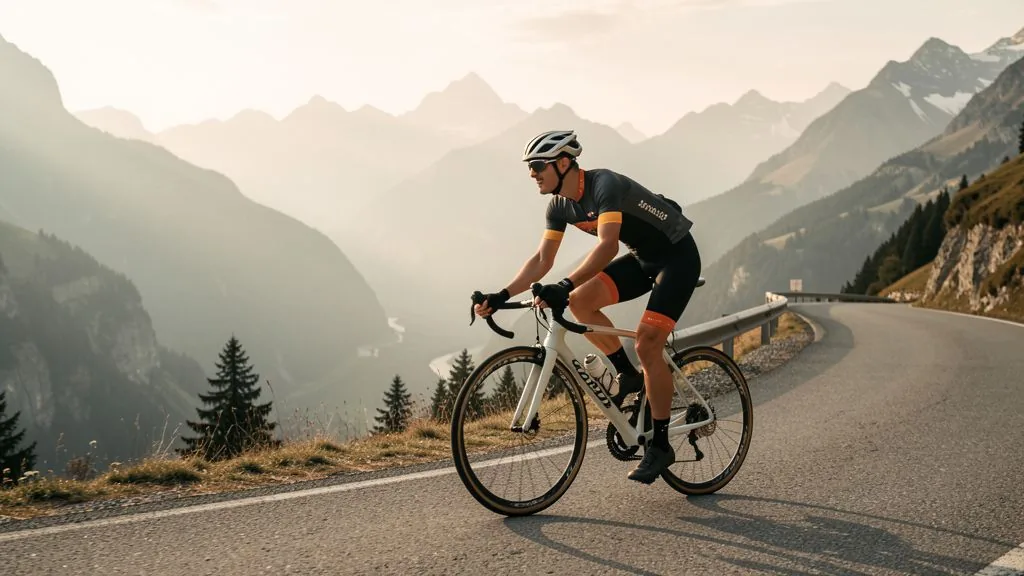
The fueling calculator works out carbohydrates, sodium and fluids per hour — matched to the estimated race time of your target event. Plus recipe ideas that fit your eating preferences.

Endurance isn't built on the road alone. Peakora ships with an exercise library with video demos — either for home (bodyweight & band) or for the gym (machines & free weights). The AI coach answers training questions and adjusts your plan directly in the chat — always with your confirmation.

Peakora notices when the week didn't go as planned. The weekly check analyses adherence, load and sleep and suggests exactly one small adjustment — at most ±15 %, only with your confirmation, never silently.
Inside the app
No walls of numbers, just clear charts: weekly calendar by sport, zone distribution and your form curve — all straight from the training engine.
Every sport has its colour, every session its zone. Rest days are part of the plan.
The zone distribution shows whether the 80/20 rule is being kept — 80 % easy, 20 % intense.
80 % easy (Z1–Z2) · 20 % intense (Z3–Z5) — heart-rate and power zones included.
Fitness, fatigue and form over twelve weeks — the Banister model, made visible.
Filled in automatically: Syncing with Strava, Polar and Suunto works directly — completed sessions land in the calendar on their own. Garmin users import their sessions via FIT/GPX file or connect Garmin through the Strava bridge; native Garmin integration will follow as soon as Garmin issues new API access again.
Reports
Export your training plan and fueling plan with one tap as coloured landscape PDFs: weekly load as a bar chart, phases colour-coded, fueling with an hourly schedule. Here are two real examples from the app:
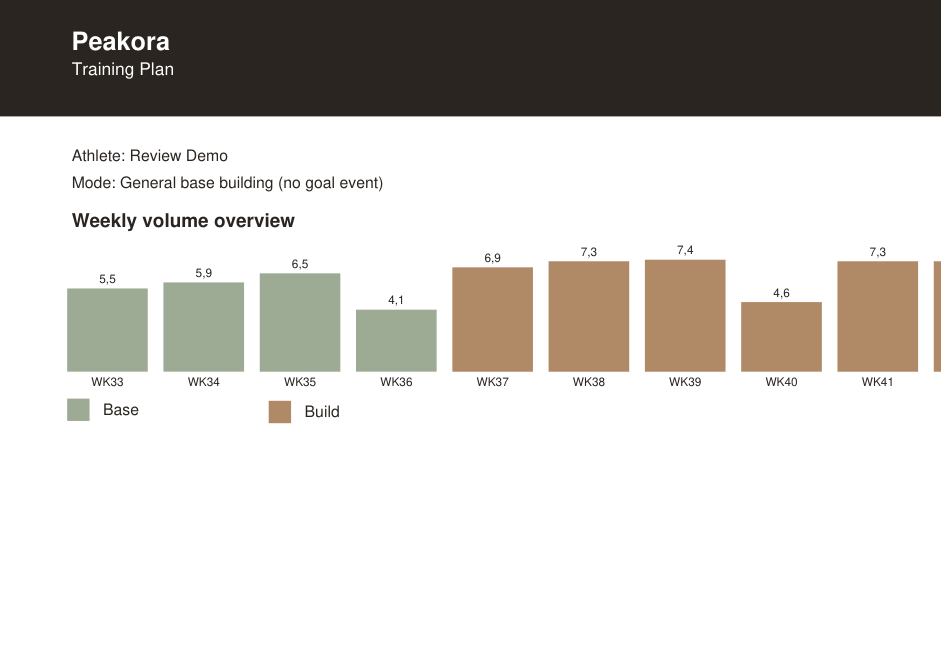
Open example PDF → Weekly load bars by phase, sport chips in colour, every session with zone, duration and TSS.
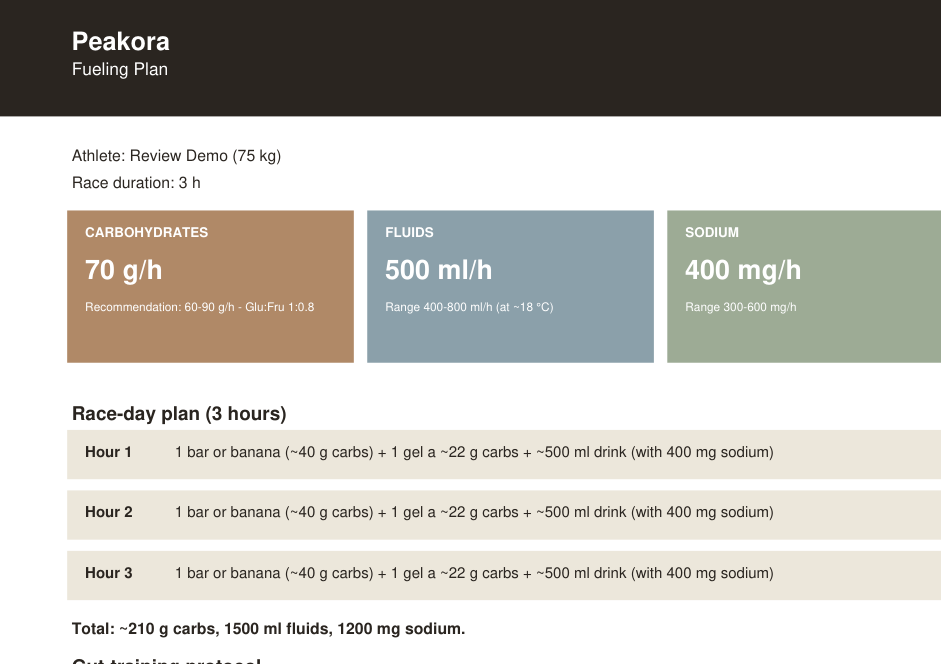
Open example PDF → Gauge cards with recommended range, race-day hourly schedule, gut-training protocol.
PDF export from the Athlet plan upwards. On Android the share menu opens — save, print or pass it on directly.
Technology
The difference from a human coach: a flesh-and-blood coach knows your daily life, but cannot recalculate every night — and costs several times more. Peakora does not replace technique coaching, but takes over the number work: the deterministic engine recomputes your load every day and backs every session with a written rationale — no black-box LLM improvising a plan. Developed in Austria, GDPR-compliant, servers in the EU.
Open-source engine principles: Training Stress Score, 80/20, supercompensation.
Concrete
An example from a build week of marathon training (goal time 3:45 h, week 8 of 16):
| Day | Session | Duration | Intensity |
|---|---|---|---|
| Monday | Rest day — recovery is training | — | — |
| Tuesday | Tempo run with threshold blocks | 60 min | Z3 |
| Wednesday | Strength training (legs + core) | 35 min | — |
| Thursday | Easy endurance run | 50 min | Z1–Z2 |
| Friday | Stretching & mobility | 15 min | — |
| Saturday | Intervals 6 × 1000 m | 55 min | Z4 |
| Sunday | Long run | 120 min | Z2 |
Every session comes with a written explanation — why it sits on that day, what it does and how it fits into the weekly load (TSS). If a day doesn't work, you move the session via chat with the AI coach — the plan recalculates the week.
Evidence
Peakora doesn't reinvent exercise science — the engine implements established, peer-reviewed concepts:
Comparison
| Peakora | TrainingPeaks | 2PEAK | Garmin Coach | |
|---|---|---|---|---|
| Explainable engine (every session justified) | ✔ | ✘ | ✘ | ✘ |
| Available in German | ✔ | ✘ | ✔ | Partly |
| GDPR-compliant, servers in the EU | ✔ | ✘ (US) | ✔ | ✘ (US) |
| Fueling calculator (carbs/sodium/fluid) | ✔ | ✘ | ✘ | ✘ |
| Recovery monitor (TSB + sleep) | ✔ | ✔ (PMC) | ✔ | ✘ |
| AI coach chat that adjusts the plan | ✔ | ✘ | ✘ | ✘ |
| Usable without a personal coach | ✔ | Partly | ✔ | ✔ |
| Price per year | from €0 (Elite €149) | from ~$125 | from ~€99 | €0 (Garmin watch required) |
An honest comparison: TrainingPeaks is strong for coach workflows, Garmin Coach is free but tied to a watch and without explanations. Peakora is the explainable, European flat-rate alternative — try it for free.
Guide
Pricing
€0
free forever
€59/year
or €6.99/month
€149/year
or €14.99/month
All prices incl. 20 % VAT. Cancel any time. Payment via Stripe or in-app purchase (Google Play / App Store).
FAQ
No — Peakora works without a smartwatch. You log sessions manually or use the app on its own. Optionally you can connect Strava, Polar or Suunto directly; from Garmin you import sessions via FIT/GPX file or through the Strava bridge.
On your device and encrypted on servers in the EU — GDPR-compliant and in sync across all your devices. AI requests run through an EU proxy that removes personal data before passing anything to the language model.
Nothing extra — the AI coach is included in the Athlet and Elite plans. There are no token costs and no per-request surcharges.
Yes, for the most part. Training plan, sessions, recovery monitor and fueling calculator run offline on your device — the engine computes locally. You only need internet for the AI coach chat, Strava sync and route suggestions.
Yes — Athlet costs €6.99 per month, Elite €14.99 per month. The annual plan is cheaper and can be cancelled at any time.
Yes for Android — and Peakora also runs as a web app in the browser. The iOS version is in preparation.
Directly in the app settings or by email to support@peakora.at — with no minimum term. Your subscription runs until the end of the paid period and then ends automatically.
Yes — the Start plan is free forever, with no time limit. You can use the training plan, basic fueling calculator, 1 stretching/core exercise per category and the base-building mode, and upgrade later when you need more. Recipes, route suggestions and PDF export are included in the Athlet or Elite plan.
Peakora uses a deterministic training engine — no language model builds your plan. The engine calculates your load with the Banister model (TSS), distributes intensity using the 80/20 principle and periodises into base, build, peak and taper. The AI (Mistral, EU) explains every session and answers questions — the plan logic stays transparent and reproducible.
Start is free forever. Athlet costs €59 per year (or €6.99 monthly), Elite €149 per year (or €14.99 monthly) — all prices incl. 20% VAT, cancel anytime, no hidden extras.
Yes. Peakora is GDPR-compliant: your data stays on your device and encrypted on EU servers. There are no trackers, no ad networks and no data selling. AI requests pass through an EU proxy that removes personal information before anything reaches the language model.
Running (5K to marathon), triathlon (sprint to Ironman), gran fondo and road cycling, duathlon and swimming. Every plan also includes strength, core and mobility sessions — endurance doesn't work without stability.
TrainingPeaks is a platform for coaches and athletes with black-box analytics. Peakora explains every session in writing (explainable engine), hosts GDPR-compliantly in the EU, is fully available in German and English and costs a flat rate from €59 per year — no coach required.
Whether you're targeting a marathon in under 3 hours, 3:30 hours, 4 hours or 4:30 hours — the engine adjusts intensity, long-run duration and tapering to your goal time. A 5K under 20 minutes needs different intervals than a 10K in 50 minutes or a half marathon in 1:45 hours. Enter your goal time and Peakora calculates the right pace zones and training weeks.
For triathlon: sprint distance in 1:15 hours, Olympic distance in 2:30 hours or 70.3 in 5 hours — discipline ratios and brick sessions adapt accordingly. Gran Fondo under 5 hours or 6 hours → same logic for cycling.