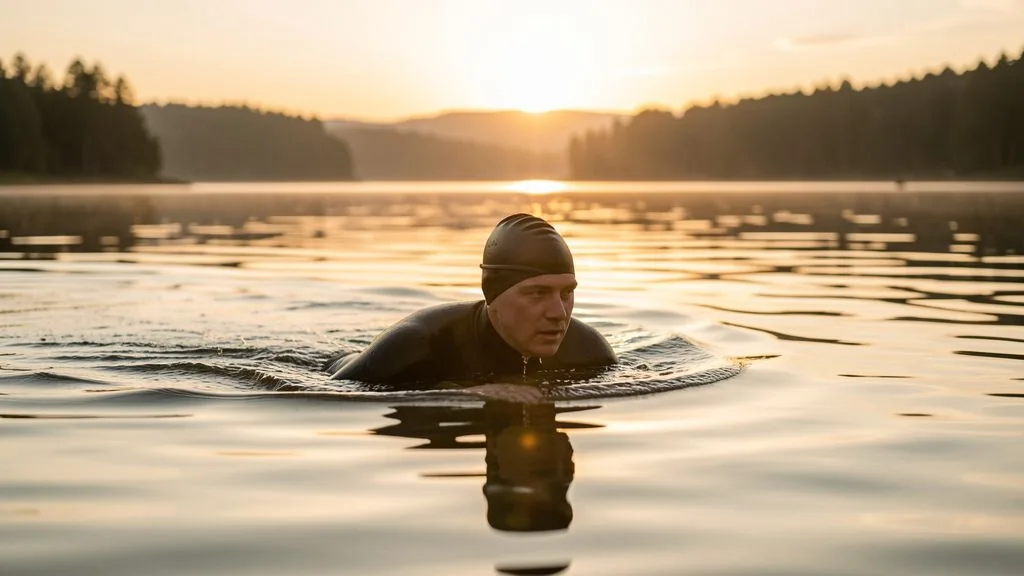
Most swimmers look for the fault in their arm stroke or leg kick when things don't flow in the water — yet breathing is the most common limiting factor. If you don't exhale fully underwater and lift your head for air, you wreck your body position with every single breath. A clean breathing rhythm, by contrast, costs almost no energy and carries you through every length more relaxed — and through every race distance.
Why breathing decides your body position
Freestyle is a sport built on a calm, horizontal position in the water. The head is the heaviest lever in the entire body: the moment you lift it forward or up to breathe, your hips and legs drop, your frontal area grows and drag rises noticeably. So a single breath taken with the wrong head position doesn't just cost energy — it slows you down for several metres and forces you to work harder for the next breath too.
The correct move is therefore not an upward head movement but a rotation around the body's long axis, exactly like the one that drives your arm stroke. You roll the body to the side — one shoulder dips, the other rises — and the head simply rotates along with it. That leaves one nostril and one corner of the mouth just barely above the surface, enough for air to enter. The head never steers the movement; it only follows it.
Once you understand this, you quickly find the core: the problem is not the inhale but the moment of the exhale. The head only comes up to breathe in — a fraction of one stroke cycle. The reason so many swimmers tense up here is something we'll get to below.
The golden rule: don't lift the head, rotate it
Many beginners try to look "up" from a prone position to avoid the water. That is the classic head-up error. Test it easily: lie stretched out face down and rotate the head only around the long axis — the mouth stays to the side. That is what correct breathing looks like. In practice you check it against three control points:
- Gaze direction: When breathing, you look sideways over your shoulder and slightly upward — never forward. The tip of your nose stays almost level.
- Head position: A crown's width of water over the forehead, one eye can stay closed underwater. At best only half your face is out of the water.
- Roll axis: The rotation starts in the upper body, not in the neck. If your neck strains, the head is doing too much work and the torso too little.
These three control points correct each other. If you want to work on your body position more systematically, the fundamentals are in the article on improving your freestyle technique.
The breathing rhythm: the 3-stroke pattern as standard
In freestyle there is no rigid breathing pattern — but there is a very sensible one. The 3-stroke rhythm, one breath every three arm strokes, alternates the breathing side and is ideal in the base phase. It forces you to breathe bilaterally and builds a symmetrical roll. At this intensity, one breath every three strokes is plenty — permanently.
At higher intensity — such as in a triathlon race or hard swim sets — you switch to the 2-stroke rhythm, breathing on every second stroke cycle. That clearly raises your oxygen supply because you breathe more often. Some swimmers deliberately use a 5- or 7-stroke rhythm for breath control in training, but that is a specific drill, not a default setting. A rough guide: the harder the set, the more frequent the breath. Misguided ambition ("I only breathe every five strokes") can quickly ruin your technique.
The exhale: the underestimated part
When things get tight in the water, most beginners exhale only halfway and then breathe in too often. The result is shallow, frantic breathing with a residue of air always left in the lungs. That is exactly the trap: a novice with the wrong breathing rhythm becomes short of breath even though their fitness is not really the issue.
The fix is as simple as it is effective: exhale continuously underwater, in a calm, long stream. Don't force it, don't wait — breathing out is a passive release, like a sigh. By the time your head rotates to breathe, your lungs are already empty, and a short, relaxed inhale refills them. The rule is: the exhale lasts longer than the inhale. Only then can the exhalation phase be calm and complete.
A practical test: count in your head while you exhale underwater. If you still feel pressure in your lungs after turning your head, you didn't exhale enough. Practise on land: exhale long, like blowing out a candle — without forcing.
Why you run out of air in freestyle
If you gasp for air mid-length or hold your breath by the last round of a set, it almost always comes down to one of these causes:
- Incomplete exhale: You blow out too little air underwater, so only a shallow remnant is left to breathe in above. Breathing becomes fast and shallow — you hyperventilate. The key point: only those who exhale fully can inhale fully.
- Head too high: You lift your head forward to breathe, your hips drop and you brake yourself. The added drag costs more air than necessary.
- Breathing too shallowly: An inhale into the upper chest brings in only a little air. You need a deep, calm breath down into the abdomen.
- Neck pulled tight: If you turn the head instead of rolling, the neck strains, and a tense neck hampers breathing. Head and shoulder belong together.
On top of that, beginners often simply believe they need to breathe more than they actually do. Freestyle is a rhythmic, aerobic effort — even if you can't swim long distances yet, you should never rush across the pool in oxygen-debt mode. Technique first, then pace. For getting started in swimming and the right basic order, the article on triathlon swimming technique helps.
How to learn to breathe: three drills
Breathing technique improves not through more repetitions but through targeted progressions. These three drills build on each other and fit into any session:
- 1. Standing exhale drill: Stand in hip-deep water, breathe in and blow the air out slowly in a stream without lifting your head. Repeat 8–10 times. Goal: make the exhale rhythm an automatic habit.
- 2. Freestyle with breathing-on-sight: Swim easy and breathe only on the side you roll well to — e.g. every three strokes. Then deliberately switch to the other side. This gets you used to bilateral breathing.
- 3. Superman swimming with the breath roll: Swim half a length with a short catch, breathe, and roll back with your torso. Practise the rolling motion without tensing your arms at the surface.
For advanced swimmers, one element of breath training belongs in every week: a set with controlled breathing (e.g. 5 strokes in, 5 out) plus a speed set in which the pattern doesn't fall apart. A swim interval in which your breathing rhythm stays clean delivers more than a fast time with collapsing technique.
Bilateral breathing: benefits and limits
Symmetrical breathing is a building block of good technique, but not dogma. Using a 4-stroke rhythm in swimming series trains the balance of the breathing sides and stops one side from withering. In open water — wind, waves, sun, rivals — flexibility is a real advantage: you breathe on the side away from the wind to avoid swallowing water, and you can adapt your side to your sighting line. That matters especially in triathlon, where you also have to navigate while swimming.
One note on a widespread misconception: bilateral breathing does not guarantee a faster time. Studies show that performance does not change significantly when you breathe on both sides. The benefit lies in the symmetry of the movement and in race-day flexibility — not in raw speed. If one breathing side is hard for you, train it anyway; a single breath per length on the weak side is worth more than a rigid rule.
Breathing in open water and triathlon
In open water, every breathing problem gets worse, because waves, spray and fellow competitors distract you. Three points help:
- Breathe early: Breathe calmly and regularly from the very first 100 metres. If you only find your rhythm after 200 metres, you've lost a sense of safety — the tension drives your breathing up.
- Separate sighting and breathing: Don't look forward while you breathe. Sighting and breathing are two separate movements; combine them and both fall apart.
- Breathe to your own side, or away from the wind: In a race, pick the breathing side that keeps your neck relaxed and avoids water. Switching sides in open water costs nothing, because there is no lane line to follow.
In triathlon there is the added factor that you swim floating in a wetsuit and in a large start group. So open-water training in a wetsuit belongs in your race preparation — not just breathing technique. The article on the T1 and T2 transitions shows how the end of the swim fits into the race.
Common breathing mistakes
- Breathing too rarely to be "efficient". Rare breathing is not a sign of fitness but an oxygen deficit that costs pace. Breathe as often as you need to.
- Lifting the head instead of rolling. The classic that destroys your body position. The head follows the roll; it doesn't lead it.
- Breathing on one side only. One-sided breathing shortens the roll in one direction and stops you being flexible in open water.
- Tension in neck and jaw. A clenched jaw makes breathing shallow. Loose tongue, soft jaw, calm breath.
- Stopping the breath when it gets hard. In hard sections your oxygen demand is highest — those who abandon technique and gasp frantically lose the set.
Anchoring breathing in your training plan
Breathing technique improves fastest when you make it a training goal in its own right — not a side effect of counting metres. Add one technical swim block per week with targeted breathing drills, and integrate an interval in which your rhythm stays stable as the pace rises. A sober comparison of your swim pace before and after a few weeks shows: those who work regularly on the exhale swim not only more relaxed but also more efficiently. Breathing's role as a limiting factor often only becomes visible once you train it deliberately.
Frequently asked questions about freestyle breathing
How do I breathe correctly in freestyle swimming?
You exhale continuously underwater and breathe in as your head rotates to the side with your mouth just above the surface. The exhale lasts longer than the inhale and happens without forcing. You never lift your head forward; you simply rotate it along the body's long axis.
How often should I breathe in freestyle?
For beginners, one breath every three strokes (3-stroke rhythm) is ideal because it stays symmetrical. At high intensity you breathe on every second stroke cycle (2-stroke rhythm) for more oxygen. Train both patterns — bilateral breathing improves your body position and makes you more flexible in open water.
Why do I run out of air when swimming?
It usually comes down to an incomplete exhale: if you don't empty your lungs underwater, you can only take a shallow breath above and fall into a hyperventilation trap. The second cause is lifting your head to breathe, which sinks your hips and raises drag. Both cost more oxygen than necessary.
Can I learn to breathe on both sides in freestyle?
Yes, and it is worth it. Start with breaths every three strokes on your stronger side, then shorten the series step by step. Bilateral breathing stabilises your body roll, prevents one-sided shoulder load and lets you dodge waves and spray in open water.
Plan your swim training with Peakora
Structured plans for triathlon and endurance sports — with technique blocks that fit sensibly into your week. Start for free, no credit card required.
Start for free