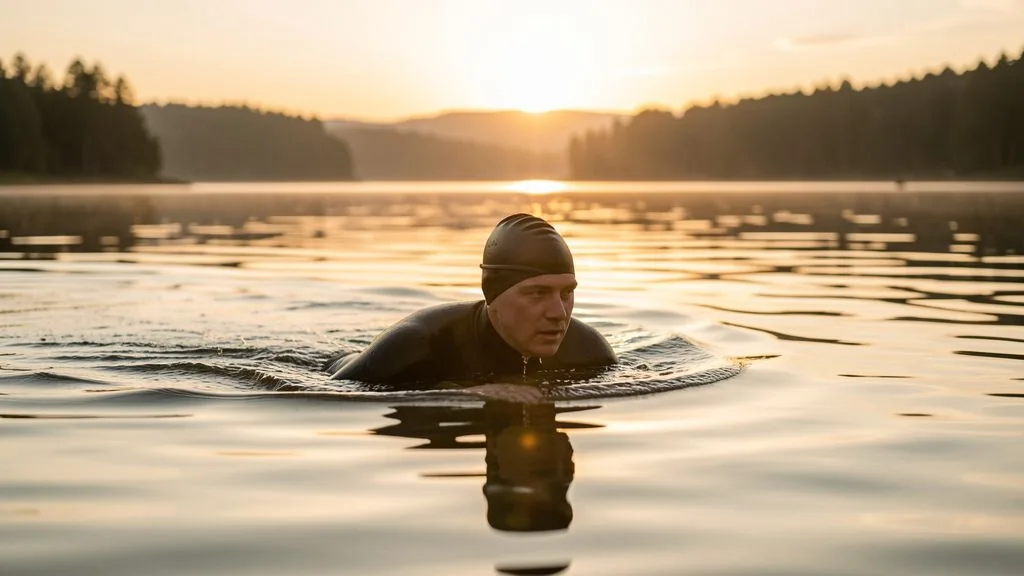
Open water swimming is rarely decided by the arm stroke — it is decided by the line you swim. An athlete who swims 1:45 per 100 metres in the pool can easily lose a minute or more in open water, not for lack of strength, but because they zigzag, spot the buoy too late and lose speed every time they sight. The good news: navigation is a learnable skill like any other. This article explains why swimming straight is so hard in open water, how to sight without ruining your rhythm, and the five course-line mistakes most athletes make week after week.
Why swimming straight is so hard in open water
In the pool you don't have to navigate: the black line on the bottom leads the way and the wall stops you at every length. In open water both disappear. Swimmers who track dead straight in a 25-metre pool drift in wide arcs in a lake — GPS-tracking studies show average deviations of one to three metres per 50 metres in athletes without technique training. Over an Olympic 1,500-metre swim that adds up to 30 to 90 extra metres.
Three mechanisms drive the drift:
- Missing reference: Without the pool floor and lane line, the brain loses the visual feedback that instantly corrects small asymmetries in the stroke. A slightly stronger right hand, a marginally lopsided body roll — invisible in a pool, fatal in a lake.
- Sideways head turns: Anyone who only turns the head to breathe rotates the body axis a little to the side each time. Over many strokes that becomes a steady curve.
- Current and chop: Wind, waves and water currents push you sideways even if you swim perfectly straight. Without sighting you notice it only when a buoy suddenly appears beside you.
The effect is measurable: a runner who takes a 5 % detour feels it at the end of the race. A swimmer who takes a 5 % detour loses the same percentage in time — except water resists every metre with far more force. For an athlete swimming 1,500 metres in 30 minutes, a 5 % detour means roughly 90 seconds. That single minute often decides the age-group placing in a triathlon.
The sighting technique: crocodile eyes, not a full head lift
The classic beginner mistake is the full head lift: the swimmer presses the torso up like a whale, looks over the water surface and then drops the legs into a sinking angle. The result is a braking manoeuvre of two to three seconds — speed gone, rhythm gone. Do that every ten strokes and you lose more than half a minute over 1,500 metres on sighting technique alone.
The efficient version is "crocodile eyes": you lift only your eyes just above the waterline without pressing the whole head out of the water. The chin stays low, the neck stays long, the forehead nearly touches the water. For a fraction of a second you see the buoy or landmark, then you put the head straight back into neutral. The spine stays in line, the hips don't sink, the rhythm keeps running.
Sighting is perfected by tying it to your breathing: you don't turn the head forward as an extra movement, you sight in the moment you would breathe to the side anyway — on the next stroke you lift your eyes for half a beat. That way no additional movement cycle is created. This technique is a core part of open water training and builds directly on the basics in our article Triathlon Swimming: Technique Tips for Beginners.
Choosing landmarks correctly
Sighting only helps if you know what you're looking for. Buoys are small, sit low in the water and regularly vanish from view in chop and low sun. So never rely on them alone. The trick experienced open water swimmers use is to pick a large, immovable object behind the buoy that you can recognise even in poor visibility, and to aim over it.
- Ideal landmarks: a high-rise, a church tower, a single big tree on a shoreline slope, a distinctive rock formation or a striking building corner. These objects are large, fixed and project above the horizon.
- To avoid: clouds, boats, sailing vessels, shadows on the water and anything that moves or shifts with the current. Even the buoy itself works only as a near target, not as a long-range bearing.
- Two points instead of one: aim along a line made of a near and a far object. If one is obscured by waves or the sight line, the second corrects you. That cuts error noticeably.
Plan the landmarks before the start: stand on shore, look along the course direction and memorise two or three features per turn. Many races have multiple buoys and direction changes — on the return leg you need different points than on the way out. Skip that and you swim the second half blind, where you lose the most.
Sighting strategy and rhythm in a race
The right sighting frequency is roughly every six to ten strokes. Sighting more often costs speed and breaks the stroke; sighting less lets you drift before you notice. The rhythm to aim for looks like this: three to four strokes of full reach and full breathing, then a glance to the side, then a look forward — the forward look with the eyes only, if the landmarks are easily visible.
In a pack you can reduce sighting. Don't swim alone, but use the feet and legs of the athletes ahead as an additional reference — your sighting interval can stretch to ten or fifteen strokes as long as the group holds a clear line. But beware: a pack does not automatically pull you straight. Never rely blindly on the person in front; check regularly whether the group is actually on course. In the chaotic start whole fields regularly drift to the wrong side together.
A very effective but rarely used technique is sighting backwards: when breathing to the side, look slightly behind rather than forward to check whether there are still athletes behind you and whether your line matches the group. This is especially valuable after the turn and in the second half, once the field has spread out.
For triathletes who combine pool and open water training anyway, a look at freestyle technique in detail is worthwhile — a clean arm stroke and a stable body position are the prerequisite for sighting to work cheaply. Another link leads to our overview of triathlon training with the full distance and periodisation logic.
Five course-line mistakes that cost time
- Sighting too late: Anyone who first looks after 20 strokes has already drifted 10 to 20 metres. Set the sighting interval before the start and stick to it.
- Head lift instead of crocodile eyes: The full head lift costs two to three seconds per sight. Tying it to your breathing solves the problem.
- Aiming only at the buoy: It is small and often invisible. Always find a fixed far target behind it and aim over that.
- Blindly following the pack: Most wrong lines are created in groups where everyone follows the person in front. Check the course yourself regularly.
- No landmarks prepared: Anyone who looks for the course direction only in the water swims the first 200 metres blind. Memorise the points from shore before the start.
How to build sighting into your training
Navigation is like running form: you have to train it deliberately, or it stays a weak spot. The simplest method is pool sighting with your eyes closed. Swim some lengths deliberately with closed eyes (mind safety, best in a quiet lane and with a lane neighbour) and open your eyes every eight strokes for a quick look at the wall. Your brain learns to hold the line with minimal information — exactly the skill you need in open water.
In open water practise with two buoys or fixed points: set yourself a target and try to hold it directly over 200 to 400 metres without intermediate sighting, then check how far you drifted. Repeat with shorter sighting intervals and watch your line improve. Many athletes gain 30 to 60 seconds over an Olympic distance from this drill alone.
Deliberately practise sighting in the second half of a session, when you are already tired. That is exactly when course errors happen in a race, because concentration and technique fade. A sighting drill at the end of a hard session under realistic conditions prepares you for race day better than any technique exercise while fresh.
Frequently asked questions about sighting in open water
How often should you sight in open water swimming?
Every six to ten strokes, roughly every eight to twelve seconds. Sighting more often costs speed and rhythm, sighting less lets you drift significantly off course. In a pack a glance every ten to fifteen strokes is often enough, because the athletes around you serve as an extra reference.
How do you sight without losing speed?
Lift only your eyes just above the waterline ("crocodile eyes") instead of rotating the whole head, and tie the look to your breathing. Put your head back down before the forward glance ends, keep the arm stroke going and don't stop your legs. The rhythm stays intact and the loss is around one second per sight.
What are good landmarks for open water sighting?
Large, immovable objects behind the buoy: a high-rise, a church tower, a big tree on the shoreline or a distinctive rock formation. Buoys are small and often invisible in chop, while clouds and boats move. Two points at different distances improve accuracy. Pick them from shore before the start.
Why do triathletes swim in a zigzag?
Because symmetrical arm strokes only track straight in a pool. In open water the lane line and the pool floor are missing as references, so every sideways head turn and every asymmetry in the stroke adds up. Current and chop also push you sideways. Without regular sighting a clear curve develops.
Plan your open water training with Peakora
Peakora controls swim, bike and run volume against your fitness curve and places technical and endurance sessions at the right point in the plan. Start for free, no credit card required.
Start for free