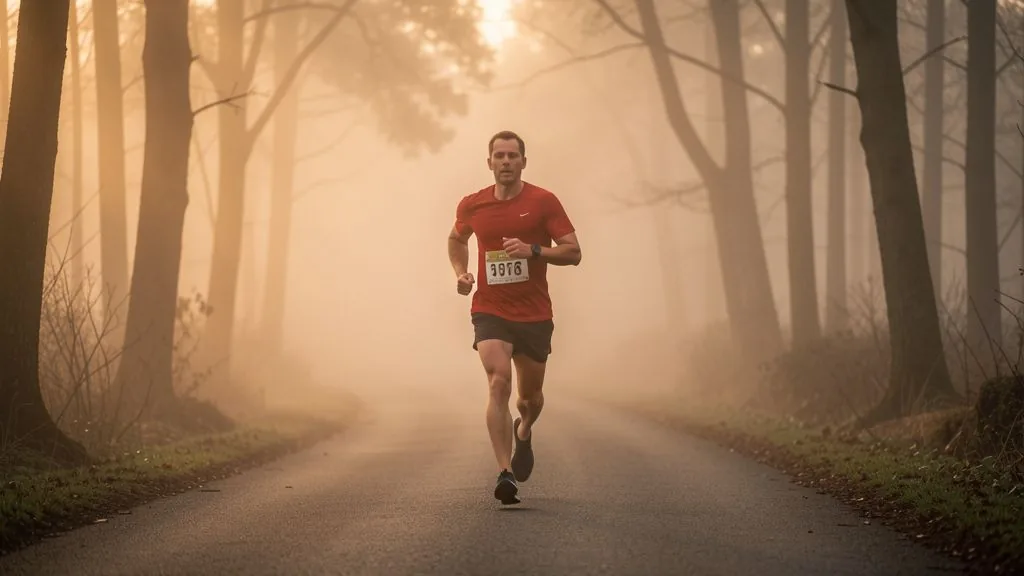
Two weeks of tapering done, everything tested, legs fresh — and three minutes before the gun your hand is shaking at the start line, your heart rate sits at 120 while standing still, and you are heading for the toilet for the third time. Every endurance athlete knows this state. The good news: pre-race nerves are not a sign of weakness but the physiological preparation for a peak performance. What makes the difference is not whether you are agitated, but what you do with that agitation. This article explains what happens in the body, why "just relax" is the wrong advice, and which concrete techniques get you through the last sixty minutes and the critical moments of the race.
What actually happens in your body before a race
The feeling goes by many names: butterflies, race nerves, stage fright. Physiologically it is one single thing — sympathetic activation, the stress axis of the nervous system. It releases adrenaline and noradrenaline, the heart beats faster, breathing becomes shallower, digestion shuts down, muscles tense up. The very same processes run thirty seconds before you trip over something, which is why the state does not feel like preparation. It feels like threat.
From a performance perspective, though, this state is exactly what you want. Adrenaline mobilises glucose, raises the contractile readiness of muscle and sharpens attention. An athlete with no arousal at all rarely starts well — they feel sluggish over the first kilometre and never quite find the rhythm. So the real question is not "how do I get rid of this?", but "how do I stay in control while carrying this energy?".
- Heart rate already elevated while standing: resting rate plus 30 to 50 beats before the start is normal and no indication of poor freshness.
- Shaky legs: muscle tone goes up, not down — which is why the first kilometre so often feels uncontrollably fast.
- Urge to urinate and stomach pressure: digestion is shutting down, the sensation is normal. Do not drink less because of it — dehydration costs you more during the race than one toilet stop.
- Rumination and self-doubt: also part of the stress response. The brain produces threat scenarios because it is looking for a way to act.
One important nuance: a moderate amount of tension raises performance. Too little makes you sluggish, too much blocks the movement. For amateur athletes the tipping point almost always lies much further up than they assume. Most athletes are not too agitated — they are too busy dealing with the agitation.
Reappraisal beats relaxation
The best-known and best-evidenced approach is called arousal reappraisal. It comes out of anxiety research and has been tested repeatedly in sport studies: participants who interpreted their elevated arousal as "my body is getting me ready" outperformed those who tried to calm themselves down. The mechanism is simple. You cannot lower your heart rate by willpower, but you can change the story your brain tells about it.
In practice it sounds like this: instead of "I am far too nervous, this will go badly", you say "my heart rate is high because my body is ready to work — exactly what I need in the first kilometres". This is not positive thinking and not a motivational slogan, it is a reinterpretation of a real physiological signal. The decisive difference: with a calming strategy you fight your own body. With reappraisal you work with it.
A second technique works surprisingly well alongside it: do not think about what you must not do. "I must not start too fast" plants exactly the wrong image. A target image in the present tense works better: "I run the first mile controlled at my goal pace, my legs are quiet, my shoulders loose". Repeated three or four times before the start, the self-doubt does not disappear — it simply gets less room. On the vocabulary side, Peakora's training glossary has related entries (in German).
The last sixty minutes: a concrete sequence
Peak pre-race tension sits between arriving in the start area and the gun. That is exactly where a fixed protocol beats willpower, because routines give the brain a sense of safety.
- T minus 60 — arrival and kit: put everything on in a fixed order (bib, chip, shoes, gels). Order instead of creativity: improvising in this phase creates uncertainty. The race day checklist removes that thinking work entirely.
- T minus 40 — warm-up: 10 to 15 minutes easy, including two or three strides of 20 seconds. Strides are the best antidote to the feeling of shaky legs — they prove to you that the fitness is still there.
- T minus 20 — breathing anchor: four minutes sitting or standing still, deep belly breaths with the exhale longer than the inhale (roughly four seconds in, six out). It will not drop your heart rate to resting values, but it makes you capable of acting.
- T minus 10 — target image: two sentences in your head — your pace for the first five minutes and an image of a relaxed posture. No finish time, no placing.
- The gun: deliberately hold back one gear. The first ninety seconds often decide the last twenty kilometres — anyone swept along by the start crowd pays for it later.
If-then plans: decide before you have to
Nerves cost you one thing above all during a race: cognitive capacity. Someone who has to make decisions under tension decides worse. That is why if-then plans are so effective — you write down before the start what happens in which situation. During the race you no longer weigh options, you simply execute.
- If the pack goes past me in the first two kilometres, then I hold my planned pace — no more than five seconds per kilometre faster.
- If I get a stitch, then I shift my breathing into the belly for sixty seconds, open up my arms slightly and run a touch slower without walking.
- If my legs turn heavy at kilometre 30, then I shorten my stride, hold my cadence, drink and eat to plan — and do not suddenly speed up.
- If I get stomach pressure, then I pause the gels for twenty minutes and switch to water.
- If the thought "I cannot do this" shows up, then I run the next 500 metres without re-evaluating anything. Feelings are snapshots, not facts.
That last point is the most important and the most underestimated. Feelings of exhaustion arrive in waves, and metrics like TSB or your current form can give you an estimate but they cannot run the race for you. Someone who thinks "500 metres to the next aid station" instead of "twelve kilometres to go" holds their rhythm far more reliably.
Weeks ahead: train mental skills like you train technique
Mental training is not an emergency tool for race day, it is a skill like running technique. Apply it for the first time at the start line and you have no chance. Ten to fifteen minutes a week over the final four weeks is realistically enough:
- Race simulation: create pressure on purpose in training — a tempo run with a time announced in advance, or a test race over half the distance. Race tactics for runners then get ticked off internally instead of being debated on the day.
- Course visualisation: walk the course in your head, including the hard sections: the hill at kilometre 25, the windy stretch, the final corner. Knowing what is coming makes it feel far less threatening.
- Feel the race pace: if you have run your goal pace over long stretches in training, race day is no leap into the unknown. Uncertainty about your own pace is one of the strongest drivers of pre-race fear — race time prediction from real training data removes that residual risk.
- Rehearse the routine: fuelling, clothing and the start-area procedure belong in training too, not in the race.
And one point on load management: nerves almost always come bundled with a question about form. Someone who hangs three hard sessions onto the week before a race during their taper is not only muscularly tired, they are cognitively tired. Clean periodisation with a visible TSB trend removes a large part of the real foundation underneath race anxiety.
The four most common thinking errors
- "I need to relax." Wrong. The body is ready to work — relaxation would slow it down. The goal is the ability to act, not calmness.
- Setting negative goals. "Whatever happens, do not blow up" creates exactly the tension that invites the blow-up. State what you will do.
- Outcome goals instead of process goals. You cannot directly control a time or a placing. You can control your pace over the first 10 kilometres, fuelling to plan and your breathing rhythm.
- Hiding the nerves. Performing calmness for others raises internal pressure. Say it out loud — one sentence to a training partner often does more than an hour of self-talk.
How Peakora works with stress data
Peakora contributes to the mental side by removing the uncertainty that generates most race stress. The form monitor shows your CTL/ATL/TSB trend right up to race day, so you can see you are fresh instead of having to convince yourself. Race time prediction from your real training data gives you a range rather than a wishful number. And because tapering, fuelling and race week are structurally planned, a large part of the rumination that normally fills the last forty-eight hours simply disappears. What the engine cannot replace is the moment at the start line — but it can make sure you stand there with a clear conscience.
Frequently asked questions about race anxiety
Are pre-race nerves normal?
Yes, for practically every athlete — from the weekend runner to the Olympic champion. A raised heart rate, shaky legs and a sudden need for the toilet are normal stress responses of the nervous system. What matters is not whether the tension is there, but how you read it and use it.
Should I try to calm down before the start?
No — calming down is the wrong target. A raised heart rate, adrenaline and shaky legs are exactly the state in which you can perform at your best. Trying to force yourself down means fighting your own body, which usually makes you more restless. Reappraisal works better: the same arousal is read as readiness instead of fear.
How do I deal with nerves during the race?
With a breathing anchor and if-then plans. Take three to four deep belly breaths with a longer exhale — that lowers your heart rate immediately. If-then plans decide in advance what you do about a stitch, stomach pressure or cramps. When the plan is already in your pocket, you no longer have to decide mid-race, and that saves energy.
Does mental training really improve race performance?
Yes. Studies show that techniques such as reappraisal, breathing regulation and if-then planning measurably stabilise performance — mainly by preventing collapses under pressure. Your peak potential barely changes, but you access far more of it on race day. Ten to fifteen minutes of preparation per week is enough.
Start race day with a clear conscience
Peakora shows your form right up to the start, plans your taper and race week, and predicts a realistic goal time from your training data. Start free, no credit card required.
Start free