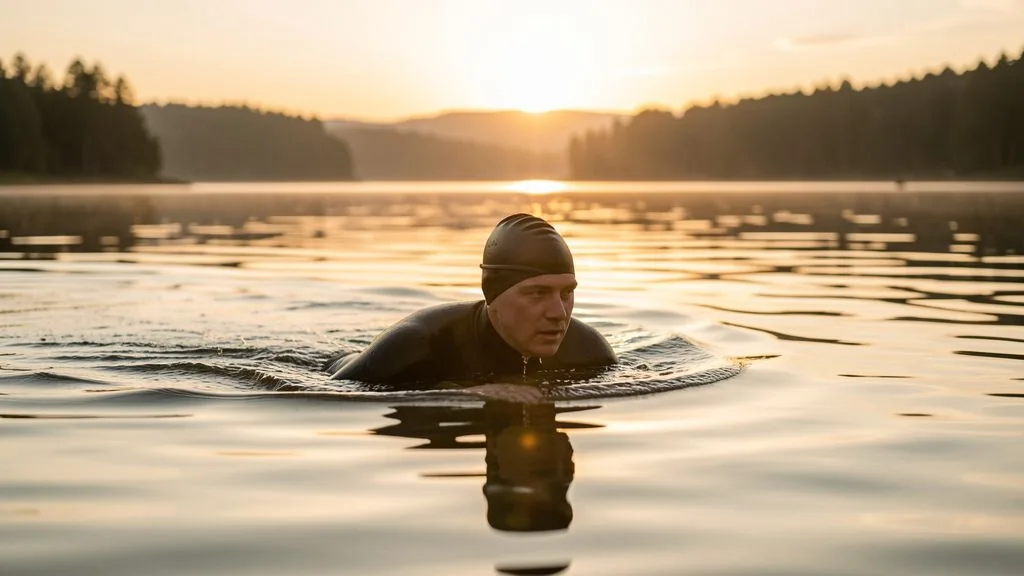
The wetsuit is the only piece of triathlon kit that buys you time without any training. Buoyancy lifts your legs to the surface, less wetted surface means less drag — and that combination produces the largest legal time gain available in the water. It is also the most expensive neoprene you will ever buy, and the most commonly misused: bought too large, never test-swum, and turned into a time trap in transition.
When you actually need a wetsuit
Whether neoprene is allowed, banned or mandatory is not your decision — it is the race organiser's, and it hinges on the water temperature measured on race day, usually 60 minutes before the start.
- World Triathlon / national federations (age group): Mandatory below 16 degrees Celsius, forbidden above 22 degrees (above 23 or 24 on longer distances). In between, the choice is yours.
- Ironman: Allowed up to 24.5 degrees, mandatory below 16. Start with neoprene outside that window and you are disqualified.
- Open water training sessions: Usually unregulated, but temperature and safety still apply. Below 14 degrees it gets genuinely risky for beginners without a suit, because your arms stiffen within minutes.
One detail most people underestimate: swimming in a wetsuit is its own skill. A suit you only wear on race day costs you seconds instead of gaining them — tight arms, blocked shoulders and a breathing rhythm that no longer works. Plan at least three or four open water sessions in a wetsuit during the four weeks before your race; Triathlon Swimming Technique for Beginners covers the technique blocks for the switch from pool to open water.
What the suit actually does
Neoprene is a closed-cell foam: tiny gas pockets sit between the polymer walls and never fill with water. That makes the material lighter than water and turns it into an air cushion — hence the buoyancy.
- Buoyancy: Human legs are denser than the torso. A suit with 4 to 5 mm panels on the legs lifts them to the surface and makes your body position horizontal. That is the biggest lever, especially for athletes whose legs sink.
- Drag: Neoprene reduces form drag and the surface friction of clothing. In a suit you can draft in someone's wake without your legs acting like a sea anchor dragging behind you.
- Warmth: Neoprene insulates because it keeps cold water from flushing directly across the skin. Cold water costs performance — it pulls blood away from the limbs, stiffens the shoulders and leaves your arms numb after 800 metres.
- Limits: The material produces no propulsion. A wetsuit improves poor body position, but it does not turn anyone into a good swimmer. The gain sits around 3 to 5 percent over 1,500 metres, and the worse your position was before, the bigger it gets.
Wetsuit types: not every suit is an Ironman suit
On the invoice neoprene all looks the same; in the water three very different products are swimming.
- Sleeveless: Full shoulder freedom, easier entry, usually cheaper — but less buoyancy in the arms and less warmth. Ideal for strong swimmers, hot races, and anyone who feels pressure in the shoulders or forearms after two minutes in the water.
- Full sleeve with variable panel thickness: The age-group standard. 1.5 to 2 mm at shoulders and forearms for freedom of movement, 3 to 5 mm at chest and legs for buoyancy. The good models combine that with a stretchy shoulder panel that does not brake the stroke.
- Suits for poor body position: Not a separate category but a tuning question. If your legs sink, you benefit from the thickest possible panels at legs and hips. If you already swim very high, thick leg panels tip your position backwards and you should float flatter.
- Limestone-based neoprene: A genuine alternative since 2022 — softer and slightly more fragile. Not a performance factor in the end, but gentler for sensitive skin and easier to travel with.
Fit is the entire purchase: four criteria
Too tight feels too tight, too loose does nothing. So there is only one sensible buying method for wetsuits: try it on and swim in it, never buy on a hunch.
- Torso and shoulders: The suit should fit like a second skin, but you must be able to raise both arms over your head simultaneously and still breathe freely. If a deep breath pinches, the suit is too small or the cut does not match your body.
- Neck panel: Too loose and the collar scoops water; too tight and it presses on your throat. Dry test: if you can turn your head without the collar choking you, it sits correctly.
- Leg length: Ending about 5 cm above the ankle is standard — the lower legs are ridged because they no longer need to compress. Calf size or narrow ankles can tip a suit at that point.
- Back zip and pull cord: The long back zipper is part of the technical spec — the short "lifestyle" front zipper gives you no leverage when stripping the suit off. A 30 cm pull cord on the back is mandatory.
Check the manufacturer's size chart first, then customer reviews about body shape. Between two sizes, go to the larger one if the shoulders still fit. Suits bought too tight end up on the second-hand market and cost you 200 to 300 euros.
Buy or rent?
The economics are simple: a good age-group wetsuit costs between 250 and 800 euros. Renting for one race runs 60 to 150 euros per day, plus a deposit.
- Renting makes sense: First race, one or two starts per season, or if you are still unsure about your size. Rental stands at the race venue let you try and take one within minutes.
- Buying makes sense: Three or more starts per season, at least two years of use, or open water training in spring and autumn. A well-cared-for suit lasts five to eight seasons.
- The middle path: Buy online, test-swim within a week, return it if it does not fit. Note that swimming in a wet suit is not a legal return reason, but a dry fitting at home with full arm circles is enough to sort out the obvious mismatches.
A second suit is not a must. Triathlon Gear for Beginners sorts the rest of your kit in the order in which it genuinely buys you time or safety.
Ten minutes to put on, fifteen seconds to take off
Putting it on starts before you enter transition: never pull neoprene over bare or lotioned skin, always over dry skin, and use plastic bags on hands and feet as a lubricant. Then work your way up, gripping and stabilising the suit from the ankles upward so the legs are not left under tension. Finally have someone close the zipper — a zipper pulled too high costs you breathing room.
Taking it off is a choreography you learn once and then resent every second it does not work:
- Open the zip on the last swim straight: Grab the cord in the final 50 to 100 metres and open the zip while still swimming. You then hit land with a free upper body.
- Start with the upper body in shallow water: Pull your arms out of the sleeves as you exit. The water carries the suit — the same movement on land costs four times the effort.
- Legs from a crouch, not standing: Sit down and pull both legs out at once from a flat crouch. Standing on one leg, balancing, loses both stability and time.
- Strip the suit completely before you go to the bike: Jogging to your rack with the suit still around your shoulders is the classic mistake — the wet bundle cools your legs and gets in the way when you put on your cycling shoes.
The whole of transition is worth studying — T1 and T2: The Fourth Discipline covers order of operations at your spot and exactly what to lay out in advance.
Care: how to make a suit last five to eight seasons
- Rinse after every swim: Rinse the neoprene with lukewarm fresh water, inside and out. Chlorine and salt attack the glued seams and make the material brittle.
- No washing machine, no dryer: Hand wash only, no detergent, no fabric softener, no spin cycle. Heat is what kills the material — including a hot car boot in summer.
- Dry on a hanger: Hang it wide across the hips on a clothes hanger, let it dry inside and out, in the shade, never in direct sun. Do not stuff a suit into a bag to dry.
- Look after the zipper: Treat the zipper with silicone spray at the end of the season. A zipper that jams in the water is a safety issue, not just an annoyance.
- Storage: Store flat or over a wide hanger, not on a narrow hook — the material loses elasticity at the shoulder.
Common mistakes
- Wearing the suit only on race day. Neoprene changes body position, breathing and stroke. Without a test you lose expensive time — plan at least three sessions in advance.
- Buying by body weight instead of fit. Between two sizes the fitting decides, not the number on the scale.
- Vaseline in the wrong place. Vaseline helps against neck chafing but damages neoprene. Use silicone lubricant or a neoprene-compatible balm instead.
- Confusing compression with too tight. A pinching suit restricts your stroke, and a too-tight collar costs more time in the first minute of breathing than the suit ever saves.
- Ignoring water temperature. A 5 mm suit at 24 degrees is a legal self-experiment in heat collapse. Above 22 degrees, pick the thinner or sleeveless option.
Where Peakora fits in
The wetsuit is not a training plan topic, but it connects to your plan in two places. First, the switch to open water in a wetsuit belongs in the last four weeks before your A race, where the engine cuts your race-pace sessions to the exact race distance and schedules the wetsuit test swims as fixed dates. Second, race-day water temperature belongs in the Race Day Checklist, because zipper, suit size and a backup plan in case of a wetsuit ban should be sorted before the start, not at it.
Peakora's plan treats swimming as part of the whole structure anyway: 80/20 intensity distribution, TSS load management and your fatigue curve decide whether you arrive at the lake with fresh shoulders — and fresh shoulders are worth more in neoprene than two extra millimetres of panel thickness.
Frequently asked questions about triathlon wetsuits
When is a wetsuit mandatory in triathlon?
The race organiser decides, based on water temperature. Under World Triathlon rules a wetsuit is mandatory below 16 degrees Celsius and forbidden above 22 degrees (up to 24 on longer distances). Ironman allows it up to 24.5 degrees and requires it below 16. Always check your race's rules.
How much time does a wetsuit actually save?
Studies show gains of roughly 3 to 5 percent over 1,500 metres, and more for swimmers with poor body position. Nearly all of it comes from buoyancy lifting the legs to the surface, plus reduced water resistance from the smooth neoprene surface.
Should I buy or rent a triathlon wetsuit?
For one or two races per season renting is cheaper; a suit costs 250 to 800 euros. If you race regularly or train in open water, buying pays off — but only after a test swim, because fit is the only thing that counts.
How do I get out of a wetsuit fastest?
Open the zip, take off cap and goggles, free your upper body, then pull both legs out at once from a flat crouch. Athletes who jog to the bike with the suit still around their shoulders lose 20 to 40 seconds in transition.
Plan your triathlon with Peakora
Swim, bike and run sessions from a single periodisation, including the open water phase and race-pace blocks. Start free, no credit card required.
Start free