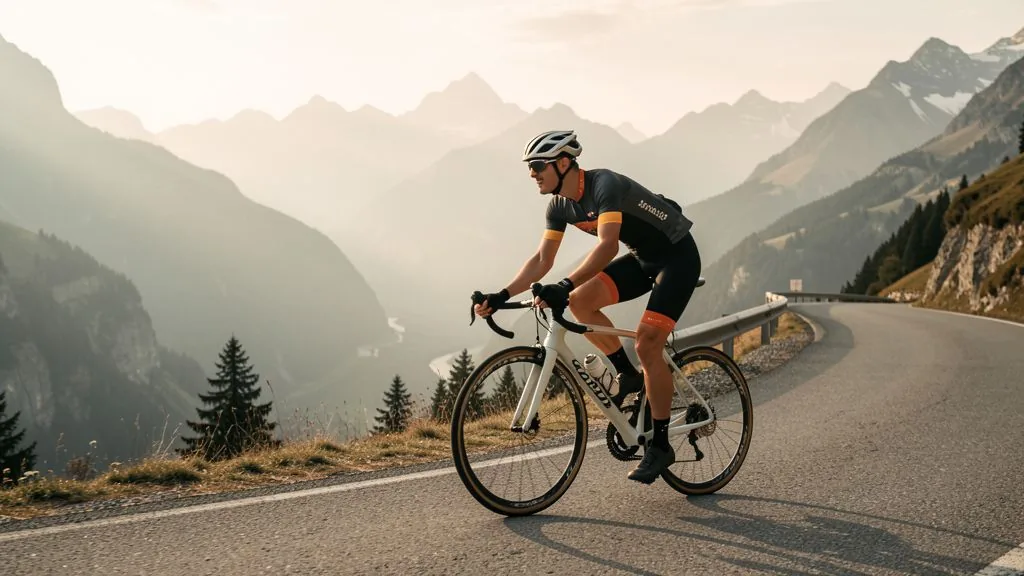
Wind is the factor most cyclists underestimate — and on a single ride it can cost more time than ten kilos of system weight. Not because a headwind feels hard, but because of a physical asymmetry: what you lose into the wind is not given back by the tailwind. Once you understand that, you plan windy days differently — not with less ambition, but with a different distribution of effort.
Why a headwind costs in cubes
Above roughly 25 km/h, air resistance dominates a bike; at 30 km/h it accounts for about 80 percent of total resistance. Rolling resistance, bearing friction and gradient become side shows. What matters is not your ground speed but your air speed — the speed at which you cut through the air mass. Resistance grows with its square, and the power required with its cube.
A worked example makes the scale clear. You ride 30 km/h in still air. Now a 15 km/h headwind arrives: your air speed rises to 45 km/h, air resistance to 2.25 times, the power needed to roughly 3.4 times. Reverse the wind to a 15 km/h tailwind and your air speed drops to 15 km/h — resistance falls to a quarter, power to about one eighth. The same wind, once with a factor of 3.4, once with 0.125. That is the whole story in two numbers.
In practice this makes speed useless as a training or racing metric on windy days. A section ridden at 24 km/h into a headwind can be considerably harder than a section at 38 km/h with the wind behind you. If you steer by kilometres per hour, you train either too hard or too easy on a windy day — usually both, depending on direction.
The out-and-back calculation: why the turnaround hurts
The most common misjudgement: "headwind out, tailwind home — it evens out." It does not. Take a 60-kilometre loop, 30 km out, 30 km back, constant power. In still air at 30 km/h you need 2:00 hours. With a 15 km/h headwind, your speed at the same power drops to about 20 to 21 km/h — the outward leg takes around 1:27. With the wind behind you on the way home, the same power takes you to roughly 43 to 45 km/h — that is only 0:41. Total: 2:08 instead of 2:00.
Eight minutes over two hours sounds bearable — but your average drops from 30 to 28.1 km/h at identical effort. If you insist on holding a 30 km/h average, you need 12 to 20 percent more power for the whole ride, depending on wind strength. This is exactly why time trial and gran fondo results on windy days are not comparable with still days, and why power (or heart rate, see pace vs heart rate) belongs at the centre of your steering rather than the speed readout.
Body position: where the last watts live
In a headwind it is not cadence that decides, it is frontal area. The difference between the hoods and the drops at 30 km/h is roughly 15 to 20 percent of air resistance — the equivalent of 25 to 35 watts at race pace. Those watts are free on a windy day; you just have to collect them.
- Drops instead of hoods. Once you are riding into the wind for more than two or three minutes, go to the drops. From gusts above 40 km/h it becomes a safety factor: the grip is more stable and your centre of gravity lower.
- Elbows in. The most common unnoticed waste: wide elbows open the chest and increase frontal area by 5 to 8 percent. Elbows narrow, shoulders low, head between the arms.
- Head low, eyes far. In an upright position the head is the single biggest source of drag. Chin towards the stem, but keep looking 20 to 30 metres ahead — safety before aerodynamics.
- Close-fitting clothing. A flapping jersey costs 10 to 15 watts; at 40 km/h into a headwind, more than a new wheelset. Jersey tucked in at the back, rain jacket only when you need it.
- No out-of-the-saddle work into the wind. Standing nearly doubles frontal area. A headwind is ridden seated with a round pedal stroke; standing is for ramps.
Gearing and cadence in a headwind
The rule is simple: one or two gears easier than it feels, cadence 85 to 95 rpm. In a headwind most riders shift too big a gear because it feels like "work". The result: cadence drops below 70, load per stroke rises, and after 20 minutes of headwind the fatigue sits in the thighs while the cardiovascular system is underused.
High cadence at moderate force is the better strategy for sustained efforts — it moves work from the muscle to the cardiovascular system and spares glycogen. How cadence affects sustained power is covered in the article Cycling cadence. In practice: if you notice you are going "push – push – push" instead of pedalling smoothly, your gear is one step too big.
Uphill it is the other way round: there a headwind quickly becomes a gradient, and cadence may drop in favour of force. But even uphill, one gear easier beats burning half a kilometre out of the saddle — the details are in Climbing technique on the bike.
Crosswind: the underestimated danger
Crosswind is technically more demanding than headwind because it is not steady. It pushes you sideways, and the moment a hedge, embankment or lorry stops acting as a windbreak, the full force returns — the bar is torn sideways and the bike steps out. That is the most common cause of crashes on windy days, not excessive speed.
- Weight forward with hands on the drops. Load on the front wheel clearly reduces the sideways drift.
- Relaxed grip, bent arms. If you clamp the bar, every gust goes straight into the steering. Your arms are the shock absorbers, not a lever.
- Knees to the top tube when the wind comes hard from the side — it stabilises the hips and stops the bike wandering underneath you.
- Anticipate the gaps. Farm entrances, junctions, woodland edges, parked cars: every gap in the shelter means a gust. Shift your weight before it, not during.
- Keep your space. In a crosswind you need lateral room — and so does everyone else. Ride echeloned in the shelter, not in a single line.
Deep-section wheels are a special case: from about 40 mm rim depth, crosswind becomes an active steering problem because the rim acts like a sail. In gusts above 40 km/h a shallow wheelset is the faster choice — not in theory, but in practice, because you actually finish the ride in control. On aerodynamics in general: Cycling aerodynamics.
Using wind as a training stimulus
Instead of avoiding windy days, use them in a structured way. Three proven formats:
- Wind intervals (out and back): 4 × 5 minutes hard at threshold into the headwind with 5 minutes easy between. The tailwind return is your recovery — and trains high cadence at low force as a bonus.
- Cadence block with a tailwind: 3 × 3 minutes at 100 to 110 rpm with controlled power. A tailwind is the only realistic moment to train high cadence without resistance. Perfect for base training.
- Sustained effort into the wind: 20 to 30 minutes continuous in the wind, even power, low position. That is closer to a time trial than anything you produce in still air.
The order of direction matters: ride out into the wind, come back with it. That way you do the hard work on fresh legs, and if you have a mechanical or a bad patch, the tailwind is on your side for the way home. Start with the tailwind and the return leg becomes a rescue mission. If you train indoors because the wind is too strong, indoor trainer training delivers the structured sessions.
Wind in the group and in racing
In a headwind, a group turns from a single line into a double line: the lead changes every 20 to 30 seconds, riders swing off and slot into the second row. Whoever is in the wind rides at the limit; whoever sits in the shelter has 25 to 35 percent less resistance and must rest with discipline rather than impatiently pushing forward. That is the real tactical point: it is not who rides in the wind who decides the race, but who still has matches left when the windy section ends.
In a crosswind the typical echelon forms. Anyone who does not move outwards into the slipstream of the rider ahead quickly loses contact behind — and in a crosswind there is no coming back, because the wind tears the gap open instantly. That is where road races are decided, often after 40 kilometres. For gran fondos without race pressure: do not let yourself be pushed into an echelon, but do not block in the last row either — communicate who rides where. More tactics: Cycling race tactics, and the specific sessions for long days out in Gran fondo training.
When wind becomes a hazard
There is a line beyond which riding in wind is no longer training but roulette. As a rule of thumb: from gusts of 60 km/h — around Beaufort 8 — the road bike stays in the basement. Above 50 km/h, group riding and anything with deep-section wheels is off, and on roads with lorry traffic even riding alone becomes unpleasant because the combination of lorry draft and crosswind is unpredictable.
Three concrete warning signs: the bike steps out noticeably without you steering. You need more than 30 degrees of steering angle just to go straight. And you feel unsafe braking because the wind pushes you sideways. Two of those three and you turn around or continue indoors. Cobbles, bridges, forest clearings and tunnel exits are where the wind breaks across the road — always take speed out there.
Common mistakes in wind
- Riding by speed instead of power. The most common mistake of all. The speed readout lies systematically in wind; power or heart rate tells the truth.
- Using headwind as an excuse. Of course you go slower — but a windy day at the same power is a full-value session, not half a one.
- Wasting the tailwind. Ride full gas with the wind and you are finished at the next turnaround. Tailwind means drink, eat, recover.
- Too big a gear. A headwind tempts you into grinding at low cadence. After 90 minutes the muscles are locally empty although your endurance is still there.
- Reading the forecast only for rain. Wind matters more for the load than rain. Wind direction and gust peaks belong in every pre-ride check.
How Peakora handles wind
The Peakora engine steers sessions by power or heart rate, not by kilometres per hour. That sounds unspectacular but is the decisive difference in wind: your prescribed session stays the same even if it takes 3 km/h less speed on a windy day. TSS is calculated from actual power, so it does not artificially drop on windy days just because you were slower. The plan does not need to know about windy days, because the target is the stimulus, not the route.
With a cold, a storm warning, or when the trainer is simply the better choice, an outdoor ride can be replaced by a session of the same duration and intensity — the plan recognises that and computes the same load. And in race season planning, windy periods are an argument for placing quality sessions in a window of two to three days rather than on one fixed weekday.
Frequently asked questions about cycling in the wind
How much slower are you cycling into a headwind?
With a 15 km/h headwind you lose roughly 8 to 10 percent of speed at the same power; with a 25 km/h headwind, 15 to 20 percent. The reason is physics: air resistance grows with the square of airspeed and the power required with the cube.
What is the best way to ride into a headwind?
Get low on the drops, keep your elbows tucked in, shift one or two gears easier and hold a cadence of 85 to 95 rpm. Instead of forcing a speed, hold your power or heart-rate target and accept 2 to 4 km/h slower. Shelter from hedges and embankments helps more than mashing.
How do you handle strong crosswinds and gusts?
Weight forward on the drops, a relaxed grip and knees close to the top tube. Anticipate gaps behind hedges, buildings and vehicles, because the wind hits again instantly there. In a group, ride echeloned in the wind's shelter rather than in single file.
Is a tailwind a free training gift?
Only partly. A tailwind lowers your airspeed and therefore the power needed for high speed — you roll fast but train little. Use a tailwind for recovery and fuelling, not for chasing records, or you will be empty when the road turns.
When should you train indoors because of wind?
From gusts above 60 km/h, or an official severe wind warning, indoor training is the better choice. That kind of wind pushes you sideways on the road, catches deep-section wheels and makes braking distances unpredictable. Indoors you get the same physiological load without the risk.
Train by stimulus, not by speed
Peakora steers your bike sessions by power and heart rate — wind, gradient and daily form are all accounted for automatically. Start free, no credit card required.
Start for free