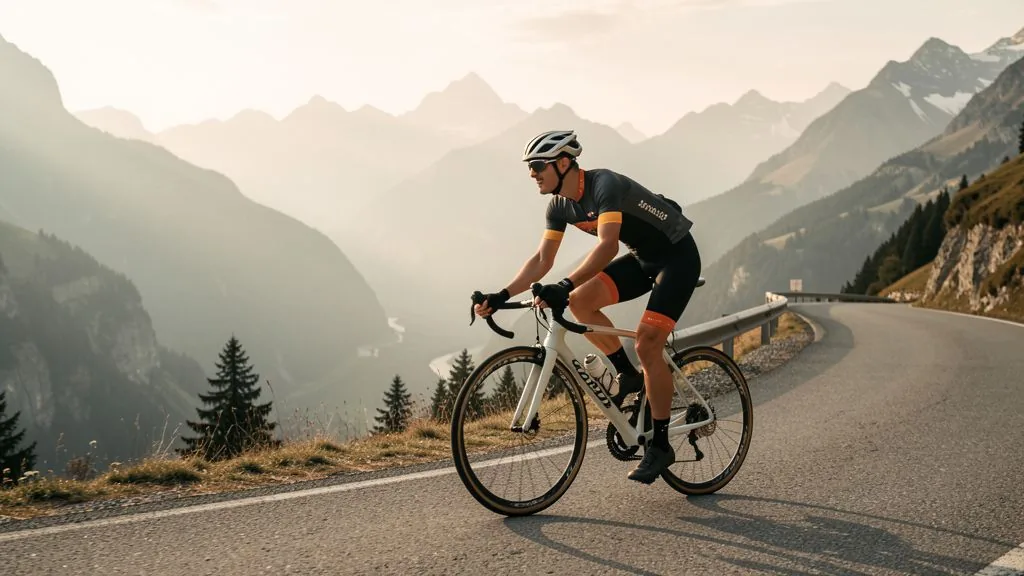
Cadence — how many times per minute you turn the cranks — partly determines how economically you ride and how fresh your legs feel at the end of a long race. Many recreational riders grind at 70 rpm, many beginners spin their legs to exhaustion at 105. The good news: your optimal cadence can be measured, understood, and trained deliberately.
What is cadence?
Cadence is the number of crank revolutions per minute, measured in rpm. Together with gearing and pedal force it determines your power: watts = torque × angular velocity. The same 200 watts can be produced at 60 rpm with high pedal force — or at 95 rpm with little force. The power is identical; the load on your body is not.
At low cadence the main load sits on the muscles: pedal force per revolution is high, type-II muscle fibres work harder, lactate and local fatigue rise. At high cadence the load shifts towards the cardiovascular system: heart rate climbs, breathing quickens, but the legs are spared. This shift is why professionals can still sprint after six hours — they have protected their muscles the entire day.
Why 85–95 rpm suits most riders
The research is clear: trained cyclists freely choose cadences around 90 rpm, and for good reason. Studies show that at this frequency, heart rate, oxygen consumption, and perceived exertion at a given power are at their lowest — metabolic economy is at its best. At 60–70 rpm, force effectiveness per pedal stroke rises slightly, but muscular fatigue over hours outweighs this advantage.
In practice that means:
- Flat and rolling terrain: 85–95 rpm as the standard range. Riding permanently below 80 rpm wears your legs out unnecessarily.
- Climbing: 70–85 rpm is normal and efficient. Below 65 rpm, economy drops noticeably — your gearing is then too hard, not your stroke too slow.
- Time trials and threshold work: Many time triallists instinctively ride 5 rpm above their comfort cadence, around 90–100 rpm. The higher heart rate is the price for maximally fresh legs.
- Triathlon: The principle applies even more strictly — ride the bike leg at 70 rpm and you will run on tired legs. 85–90 rpm protects your run reserves.
How to find your optimal cadence
Real-world numbers: professionals ride four- to five-hour stages at an average of 90–95 rpm; sprinters hold 110–120 rpm for the final 15 seconds. Untrained riders voluntarily sit at 60–75 rpm — because it initially feels "strong". The difference shows after two hours: riding permanently low costs noticeably more power over the distance than the same rider at a higher frequency.
Your personal optimum depends on fibre type, training level, and riding style. A simple self-test gives a good approximation: on flat terrain or a trainer, ride 3 × 5 minutes at constant power — once at 80, once at 90, once at 100 rpm, with 5 easy minutes between. Note heart rate and feel for each block. The cadence with the lowest heart rate and a subjectively relaxed pedal stroke is your current sweet spot. Without a power meter for structured watt-based training, use constant heart rate as the fixed variable and compare speed instead.
Important: the optimum is trainable but not rigid. After years at 75 rpm you will not become a 95-rpm rider in two weeks — but with six to eight weeks of systematic work, you very well can.
Training cadence: 4 effective drills
- High-cadence intervals: 3–5 × 5 minutes at 100–110 rpm in an easy gear, 3-minute recoveries. Goal: round, calm strokes without bouncing in the saddle. Once a week, ideally on the trainer or flat roads.
- Spin-ups: From a moderate pace, gradually raise cadence over 30 seconds up to your maximum — just before you start bouncing — then coast for 30 seconds. 6–8 repetitions. This trains neuromuscular coordination at high frequency.
- Single-leg pedalling on the trainer: 4 × 1 minute per leg at 85–90 rpm, one leg unclipped. Exposes "dead spots" in the pedal cycle and smooths the stroke — the foundation of every high cadence.
- Low-cadence strength work (sparingly): 4 × 5 minutes at 50–60 rpm in a moderate gear, seated. Builds pedal force so high frequencies later feel "light". At most every other week — knees and Achilles tendons need the recovery.
These drills complement but never replace your base training: long, steady riding at your natural cadence remains the foundation. Cadence work builds on top of it.
Gearing: the underestimated cadence problem
Many riders are not pedalling too slowly — they simply lack the right gear. With a hardest-to-easiest setup ending at 34 × 28 on a 10-percent climb, you have to grind at 55 rpm whether you want to or not. The solution is mechanical: a compact crankset (50/34) with an 11–32 or 11–34 cassette allows 70+ rpm even on steep ramps. That is not a sign of weakness — professionals ride 34-tooth cassettes on summit finishes. Saddle position matters too: a poorly set-up bike changes perceived pedalling economy significantly — a professional bike fit is worth it before you spend months adjusting cadence.
Over a five-hour gran fondo with 2,000+ metres of climbing, gearing decides whether your legs are still turning on the final climb — or locked up.
Common mistakes
- "A big gear makes you strong." Permanently grinding below 70 rpm produces muscular fatigue, not strength endurance. Targeted low-cadence work has its place — as an occasional drill, not a permanent state.
- Cadence drills without a smooth stroke. Forcing 110 rpm with a jerky stroke only trains bouncing. First single-leg work and spin-ups for technique, then raise the frequency.
- Overnight change. Your habitual cadence is deeply anchored in your movement pattern. Plan six to eight weeks, or you will fall back into old patterns under load.
- Cadence as an end in itself. 95 rpm at half power is no progress. Cadence serves the goal: more power for longer with fresher legs.
How Peakora schedules your cadence work
In Peakora plans, cadence drills appear as fixed building blocks inside technique and endurance sessions — high-cadence intervals at the end of a Zone 2 ride, or spin-ups in the warm-up of a sweet spot workout. The engine places drills so they never compromise your quality days, and adapts the frequency targets to your training level: beginners start with short 100-rpm blocks, advanced riders with longer intervals at 105+. Cadence training becomes routine instead of theory.
Frequently asked questions about cycling cadence
What is the optimal cycling cadence?
For most cyclists: 85 to 95 rpm on flat terrain. Studies show trained riders have the lowest heart rate and oxygen consumption at a given power output in this range. On climbs, a practical cadence drops to 70–85 rpm.
Is a higher cadence always better?
No. A higher cadence unloads the muscles but increases cardiovascular and respiratory demand. Above roughly 100 rpm, energy cost rises again for many riders. The optimum is individual and usually sits between 85 and 95 rpm.
How do I measure my cadence?
Most accurately with a crank-mounted cadence sensor or a cycling computer with a magnet. Most power meters and smart trainers record cadence automatically. Without sensors: count one leg's pedal revolutions for 15 seconds and multiply by four.
How can I increase my cadence?
With targeted cadence drills: several times a week, ride 3–5 intervals of 5 minutes at 100–110 rpm in an easy gear. Add 30-second spin-ups up to your maximum without bouncing. After 6–8 weeks the higher cadence feels natural.
What cadence should I use on climbs?
70 to 85 rpm is normal and efficient on climbs — gravity makes higher cadences hard to sustain. Gearing matters most: a compact crankset and large cassette let you hold 70+ rpm even on 10-percent ramps instead of grinding at 50 rpm.
Train with structure — with Peakora
Training plans with cadence drills, technique sessions and power targets — tailored to your goal race. Start free, no credit card required.
Start for free