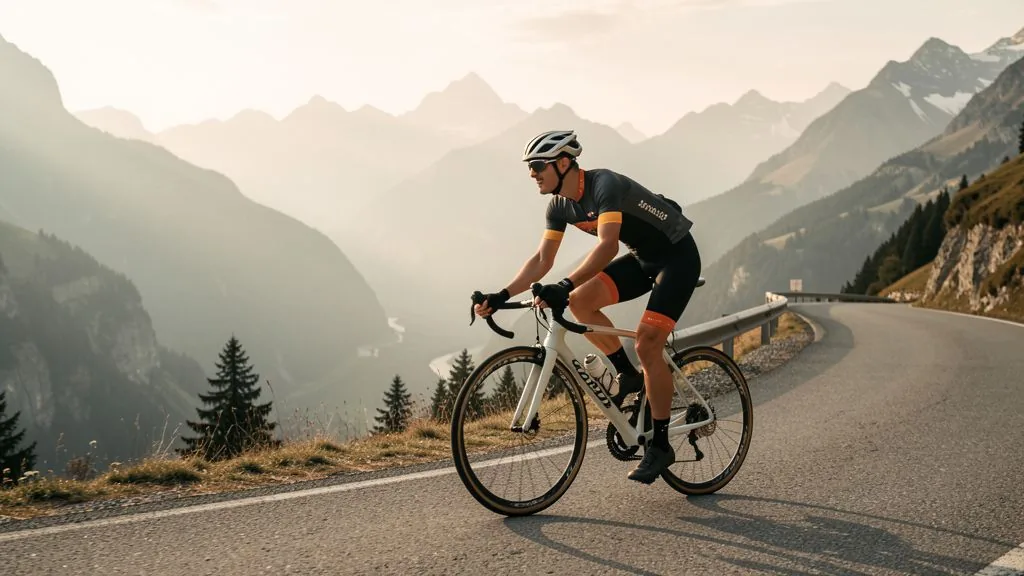
Winter is not a lost season for cyclists — it is the best opportunity for structured training. Outdoors, darkness, rain and ice dictate the daily routine; indoors you get laboratory conditions: no wind, no traffic lights, no coasting. That is exactly why trainer sessions are more effective per minute than any winter ride. Two to three structured indoor sessions per week from November to March and you enter spring with a level of fitness that riders who simply "ride through" winter only reach by May.
Why the trainer is so effective
The decisive advantage of the indoor trainer is load density. Outdoors you lose 10 to 20 minutes of every hour to descents, traffic lights, junctions and freewheeling — time in which the muscles do no work. On the trainer you pedal from the first minute to the last. One hour indoors therefore equals roughly 1.5 hours outside in terms of actual load. For working athletes, that is the difference between "training fits into the day" and "training gets postponed to the weekend".
The second advantage is precision. Outdoors, power output fluctuates with wind, terrain and traffic; indoors, 240 watts is exactly 240 watts — for 3 minutes or for 20. Interval formats that are almost impossible to ride cleanly on the road become reproducible on the trainer. That makes winter the ideal phase for targeted threshold and VO2max work, while long, easy base riding continues outdoors whenever conditions allow.
The setup: what you actually need
The equipment list is shorter than you think. A direct-drive smart trainer is the most comfortable option: it measures power, holds the prescribed wattage automatically in ERG mode and pairs with apps. A classic wheel-on trainer or free-motion rollers work just as well — you then control intensity through gearing and cadence, ideally with a power meter or at least a heart rate strap. What matters is never the device but the structure of the session.
Three things, however, are non-negotiable. First, a powerful fan: the missing headwind is the main cause of overheating — core temperature rises, heart rate drifts upward, and power drops noticeably at the same perceived effort. Second, a towel and protection for frame and handlebars: sweat is aggressive and eats bearings and cables. Third, bottles within reach — you sweat far more indoors than outside; 500 to 750 ml per hour is the norm. A front-wheel riser or a book under the front wheel levels the bike and brings the riding position closer to your road position.
Control: power, heart rate or feel?
With a power meter or smart trainer, you steer indoor sessions primarily by watts — the most objective metric, unimpressed by heat, caffeine or daily form. Heart rate stays in view as a control variable: if your pulse climbs unusually fast at constant power across an interval set, that is a fatigue signal. Without a power meter, the same workouts work via heart rate zones or the perceived exertion scale (RPE) — easy means "conversational", threshold means "short sentences only". The physiological target zones are identical; only the measuring instrument changes.
The 6 best winter workouts
- Aerobic base Z2 (60–90 minutes): Easy pedalling at 60–75% of threshold power, cadence 90–95 rpm. Boring? Yes. Effective? Absolutely — these sessions build the aerobic base on which everything else stands. Podcasts or a series marathon are allowed.
- Sweet spot (2–3 × 15–20 minutes): 88–94% of threshold power with 5-minute easy recoveries. The best compromise between stimulus and fatigue: almost threshold-level adaptation at considerably lower recovery cost. The core winter session for gran fondo riders.
- Threshold intervals (2 × 20 or 3 × 12 minutes): 95–105% of threshold, recoveries half the length of the work interval. The cycling counterpart to threshold training in running — more precisely controllable on the trainer than on any road.
- VO2max intervals (5 × 3 minutes or 30/30s): 110–120% of threshold; for 30/30s alternating with 30 seconds easy. The hardest session of the week — once a week is enough, just as with VO2max training in running.
- Over-unders: 3 × 12 minutes alternating between 2 minutes slightly above and 2 minutes slightly below threshold. They teach the body to clear lactate while still working — exactly what climbs and pace changes demand in a race.
- Cadence and sprint drills: 6 × 30 seconds of high cadence (110–120 rpm) plus 4–6 short 10-second sprints from low cadence. Neuromuscular work that barely fatigues — ideal at the end of an easy session.
Sample week: winter training on the trainer
A balanced winter week with three indoor sessions and one outdoor ride might look like this: Tuesday sweet spot (2 × 20 minutes after a 15-minute warm-up). Thursday VO2max or over-unders (5 × 3 minutes) — the hard day of the week, on fresh legs. Saturday outdoors: 2.5 to 4 hours easy, the long base ride. Sunday optionally 60 minutes of aerobic base on the trainer with cadence drills. Monday, Wednesday and Friday stay free or serve strength and mobility work. That sums up to 6 to 8 hours — the winter needs no more structure than that.
The distribution remains crucial: the 80/20 principle applies on the trainer as well — roughly 80% of the time easy, 20% intense. Winter tempts riders into "always medium-hard" riding because the sessions are short and everyone wants to earn the time invested. Exactly this permanent intensity is the most common reason riders arrive in March burned out instead of fresh.
Common mistakes on the trainer
- No fan. Overheating is performance killer number one indoors. Without airflow, heart rate drifts, perception deceives you, and the session is either ridden too hard or abandoned early.
- Every session hard. Because indoor workouts are short, they often all get ridden in "hero mode". Three hard trainer sessions a week are an overload trap — intensity is rationed, even in winter.
- Overly long sessions out of duty. Three hours on the trainer are mentally harder than four outdoors and physiologically unnecessary. Base volume belongs outside whenever the weather is decent; the trainer is the precision tool, not the replacement for everything.
- Forgetting to drink. Without headwind there is no sweat feedback — many riders dehydrate indoors without noticing. Fixed drinking intervals (every 10–15 minutes) instead of "when thirsty".
- No progression. The same sweet-spot session week after week stops working after week four. Increase interval length or repetition count gradually — never both at once.
How Peakora plans your winter training
In the Peakora engine, trainer sessions are fixed building blocks of winter periodization: your plan's bike workouts can be ridden as indoor variants, and the Training Stress Score captures the load precisely via power or heart rate — a sweet-spot block registers exactly like its outdoor counterpart. The recovery monitor (form/TSB, sleep, load breaks) shows whether your legs are ready for the next interval set — and the engine reschedules the hard session when freshness is missing. If you target a spring goal like a gran fondo, the full framework is on our gran fondo training page — the winter trainer is phase one of that plan.
Frequently asked questions about indoor trainer training
How long should an indoor trainer session be?
45 to 90 minutes is enough. On the trainer there is no coasting, no traffic lights, no descents — the load density is higher, so one indoor hour equals roughly 1.5 hours outdoors. Quality beats duration here.
Smart trainer or classic rollers — which is better?
Both work. A smart trainer holds your target power automatically (ERG mode); on a classic trainer you control intensity via gearing and cadence. What determines the training effect is the structure of the session, not the device.
How do I replace the long winter ride on the trainer?
You don't, fully: long easy rides stay outdoors whenever the weather allows. The trainer covers quality work. During stretches of bad weather, 2 × 45 minutes with a break or easy rides with sweet-spot blocks work well.
Do I really need a fan?
Yes. The missing headwind is the main cause of overheating on the trainer — power drops noticeably at the same heart rate. A strong fan, a towel and at least one bottle per hour are essentials, not luxuries.
Your winter plan with structure
Peakora schedules your indoor sessions to match your form — intervals included. Start for free, no credit card required.
Start for free