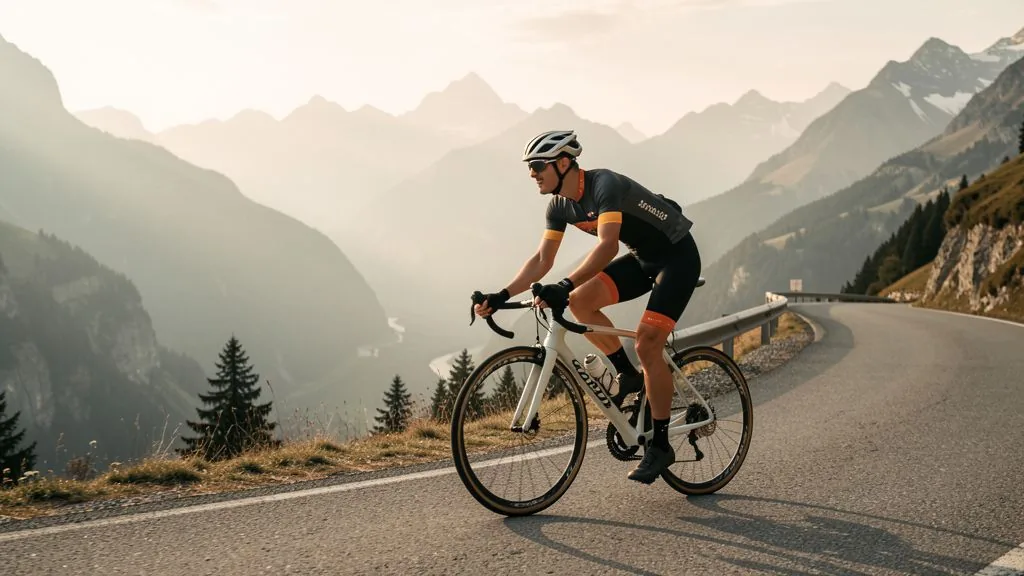
A gran fondo is not simply a longer Sunday ride. 120 to 180 kilometres, 2,000 to 4,000 metres of climbing and four to eight hours in the saddle place demands that differ fundamentally from a criterium or a sportive. The good news: with a clear weekly structure, targeted climbing workouts and a practised nutrition strategy, the first gran fondo is within reach for any healthy amateur rider.
What makes gran fondo training special
Unlike a criterium, a gran fondo is not decided by peak power but by the ability to hold a high, steady output for many hours. Three factors shape the training:
- Duration: Four to eight hours of effort means aerobic base and energy supply decide the outcome — not your maximum wattage.
- Elevation: Most gran fondos cross mountain passes. Anyone who systematically pushes too many watts on the climbs pays it back with interest in the final third. Climbing training and pacing are mandatory.
- Fatigue resistance: After five hours, threshold effort feels very different from how it feels after one hour. Long rides with tempo blocks at the end train exactly that.
The weekly structure of gran fondo training
An effective plan for your first gran fondo does not require 15 hours a week. With 6 to 9 hours, clearly distributed, you will reach the finish. Three building blocks form the backbone:
1. The long ride
Once a week, usually at the weekend. It starts at around three hours and builds to four to five hours — ideally on terrain that resembles your target race. The pace stays mostly in the endurance zone (roughly 60–75 % of FTP). Every three to four weeks, a recovery week with a much shorter ride follows.
2. Sweet-spot and tempo sessions
Once or twice a week, ride with targeted intensity. Sweet-spot intervals (88–94 % of FTP, e.g. 2 × 20 to 3 × 15 minutes) are the most efficient lever for the gran fondo: they raise your threshold without the exhaustion of maximal intervals — important, because the weekend long ride needs quality. Complementary tempo blocks (80–85 % FTP) of 30 to 60 minutes simulate hanging on in a fast group.
3. Strength training
30 to 45 minutes per week is enough: squats, lunges, core stability and lower-back work. Anyone who sits on a bike for five hours needs a stable core — most back pain on long distances is a strength problem, not a saddle problem.
Climbing training: the key to the mountains
If your gran fondo includes mountain passes, hill work belongs firmly in the plan. In concrete terms:
- Hill repeats: 3 to 5 repeats of 8–15 minutes at sweet-spot intensity, cadence 70–85. Once a week during the final eight weeks before the race.
- Standing drills: Short standing phases of 30–60 seconds relieve the seated position and distribute the load — worth their weight in gold on long climbs.
- Indoor alternative: No mountains nearby? On the trainer, climbs can be simulated convincingly via cadence (low, high resistance) and position (sitting far back).
At least as important as the climbing itself is pacing on the climbs: practise riding ascents in a controlled 80–88 % of FTP, even when more feels possible. A gran fondo is lost in the valley, not won on the climb.
Nutrition on the bike: carbohydrates per hour
Over four to eight hours of effort, fueling is not a detail — it is half the performance. The sports-science recommendation for long road races is 60 to 90 grams of carbohydrates per hour, plus 500–750 ml of fluid and 300–600 mg of sodium. On the bike this is generally easier than in running — the stomach is jostled less, and solid food (bars, bananas, rice cakes) is usually better tolerated.
The decisive factor is gut training: these high intakes only work if you practise them in every long ride starting eight weeks before the race — beginning at 40–50 g/h and building to your target. You will find the details on the 60–90 g rule, glucose-fructose mixes and a concrete hourly plan in our article Marathon Fueling: How Many Carbs You Really Need — the physiology is identical; only the execution on the bike is more forgiving.
Equipment and position
You do not need a new bike for your first gran fondo — but a properly set-up one. Three points pay directly into comfort and performance:
- Bike fitting: A professional position adjustment is the best investment before a gran fondo. After hour four, your position decides whether you stay pain-free — especially neck, hands and saddle pressure.
- Gearing: For mountainous courses, a compact crankset (50/34) with an 11–32 or 11–34 cassette pays off. Better one gear too easy than one too hard.
- Tyres: 28 mm at moderate pressure rolls faster on real roads than 23 mm at maximum and damps vibration — a noticeable freshness gain over six hours.
Everything on the bike on race day should have been tested on a long ride beforehand: jersey-pocket layout, saddle bag, nutrition, clothing.
Tapering before the gran fondo
In the final 10 to 14 days, volume is reduced by 40–60 % while short intensity touches are retained. Concretely: the last truly long ride sits two weeks before the race. Race week contains two or three short, easy sessions with a few crisp openers (e.g. 3 × 2 minutes at race pace). Anyone who wants to “test their form” in the final week gives it away at the start line.
Common mistakes in gran fondo training
- Riding every outing too hard. Without easy base miles, the aerobic foundation is missing — and the hard sessions suffer under chronic fatigue.
- Long rides that are too short. Anyone who never trains beyond three hours enters unknown territory at hour four of the race — exactly when it counts.
- Not practising fueling. The gut has to learn 80 g of carbohydrate per hour. Experimenting on race day ends in stomach cramps or a blow-up.
- Overpacing the climbs. The first ascents feel deceptively easy. The bill arrives after kilometre 100 — with interest.
- New equipment on race day. New shoes, a new saddle, untested gels: race day is not an experiment.
Frequently asked questions about gran fondo training
How long should you train for a gran fondo?
For your first gran fondo, 12 to 16 weeks of structured training is ideal. If you already ride two- to three-hour outings regularly, 10 to 12 weeks will do. Consistency matters more than total duration: three to four sessions per week across the whole block beats five sessions for three weeks followed by a break.
How many hours per week do you need for a gran fondo?
For a safe finish at your first gran fondo, 6 to 9 hours per week is enough. The backbone is the long weekend ride, which builds from 3 up to 5 hours. Add one hard sweet-spot or tempo session, one easy ride and 30 to 45 minutes of strength training.
What should you eat and drink during a gran fondo?
For efforts over four hours, the guideline is 60 to 90 grams of carbohydrates per hour, plus 500 to 750 ml of fluid and 300 to 600 mg of sodium per hour. Gels with a glucose-to-fructose ratio of 1:0.8 make these high intakes possible. The strategy must be practised in every long ride starting eight weeks before race day.
Peakora builds your gran fondo plan
Weekly structure, sweet-spot intervals, climbing workouts and tapering — Peakora creates your individual training plan for the gran fondo, adapted to your time and level. Start for free, no credit card required.
Start for free