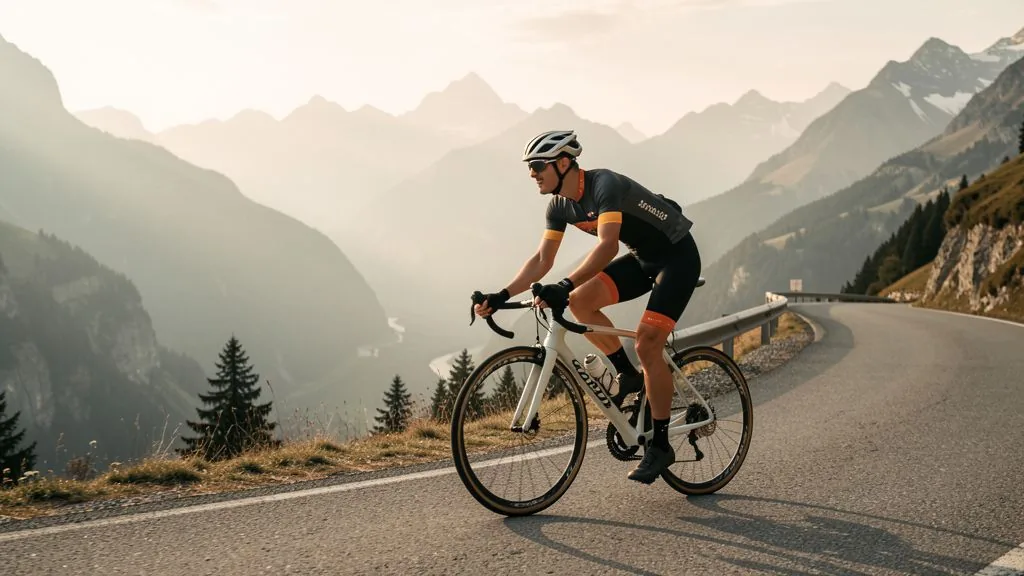
Climbs are the biggest time bank in cycling: on the flat, good and average riders are often separated by mere seconds per kilometre — on a climb it is minutes. The good news is that climbing well is not purely a matter of talent. With the right technique, a suitable cadence and disciplined pacing, you will gain more on an ascent than any aero upgrade will ever deliver.
Why a climb works differently from the flat
On flat roads, air resistance consumes around 90% of your power — it grows with the square of your speed. From roughly 6–8% gradient, the relationship flips: gravity takes over, and your power now goes mainly into gaining altitude. The consequence: absolute watts no longer decide the outcome — watts per kilogram of body weight (W/kg) do. A rider producing 300 watts at 75 kg (4.0 W/kg) climbs a 10% ascent faster than one producing 330 watts at 90 kg (3.7 W/kg) — even though the heavier rider would be clearly quicker on the flat.
Two levers follow from this: raising your threshold power and lowering the system weight (rider plus bike). Both work disproportionately well uphill — which is exactly why climbing deserves targeted training instead of being left to chance.
Seated or standing? The technique question
The ground rule is: stay seated whenever you can. Seated, you work roughly 3–5% more economically at the same power, because you do not have to support your body weight with your legs. Your upper body stays calm, your hands rest loosely on the bar tops or brake hoods, and all force flows into the pedals.
Standing, by contrast, is a tool for special moments, not a permanent state:
- Very steep ramps (above 10–12%): when your gearing reaches its limit, switching to standing lets you shift weight onto the pedals and keep the revolutions up.
- Accelerations and attacks: short standing phases mobilise more peak power — when overtaking or at the foot of a climb.
- Relief: on climbs of 30 minutes or more, a brief stint out of the saddle engages different muscle groups and eases saddle pressure. Twenty to thirty seconds is enough.
A typical beginner's mistake: grinding away standing all the time because it feels “powerful”. The price is roughly 5% higher energy cost and a faster-rising heart rate — on a 20-minute climb you pay that back twice over.
Cadence on climbs: 70–90 instead of 50
On long ascents many riders drift unnoticed into cadences of 50–60 revolutions per minute — either because their gearing is too hard or because higher revolutions feel strenuous. The problem: at low cadence the force required per pedal stroke rises sharply, and the muscles fatigue locally long before the cardiovascular system reaches its limit. The legs “switch off” while the lungs could still keep going.
For most riders, the economical range on climbs is 70–90 revolutions per minute. Lighter riders tend towards the upper end, heavier riders towards the lower. Spinning at 100+, on the other hand, drives heart rate and ventilation up unnecessarily — aerobically expensive with no speed benefit.
Train both directions deliberately: low cadence (50–60 rpm) at moderate power builds specific strength endurance, high cadence (95–105 rpm) trains coordinative efficiency. Come race day, you will have a choice depending on gradient and race situation — instead of owning only a single survival cadence.
Pacing: steady beats heroic
The most expensive mistake on a climb happens in the first three minutes: the ascent begins, the group surges, and you enter far above your threshold — only to crack badly ten minutes later. Because effort above the anaerobic threshold does not fatigue you linearly but disproportionately, you lose far more time at the end of the climb than you gained at the start.
The solution is pacing by power rather than by feel. For climbs lasting 20 to 60 minutes, a good benchmark is 90–95% of your functional threshold power (FTP) — held constant over the full length. Without a power meter, use heart rate (around 90% of maximum) or your breathing: you should still be able to speak in short sentences, but no longer hold a conversation. If you want to test your FTP and train with power, you will find a step-by-step guide there — the FTP test is the foundation of any serious climbing pace.
Distribution within the climb matters too: steep sections tempt you to push, flatter ones to recover. Keep your watts as constant as possible — on steep ramps this automatically turns into a smaller speed loss than the reverse.
Gearing and equipment: technology beats brute force
No amount of training replaces suitable gearing. If your easiest gear only allows 50 rpm on a 10% ramp, that is not a fitness question but an equipment question. The standard solution:
- Compact crankset 50/34: the amateur standard. The 34-tooth chainring is the foundation of mountain-friendly gears.
- Cassette 11–32 or 11–34: combined with the 34 ring this yields a ratio of 1:1 or easier — enough for practically every Alpine pass road.
- Tyres and wheels: light wheels matter more on climbs than on the flat, because rotating mass counts on every acceleration. Deep 60 mm aero rims are counterproductive in a hill-climb time trial.
And the most honest lever remains system weight: every kilogram saved — on the bike or on the body — is worth roughly 30–60 seconds on a 1,000-vertical-metre climb. If you plan to lose weight, do it in the build phase, not in race week.
Climbing training: the three most effective sessions
You do not become a strong climber by occasionally riding uphill — you need structured stimuli. Three session types have proven themselves:
- Threshold intervals on a climb (4 × 8 minutes): ride four blocks of eight minutes just below your FTP up an ascent, spinning easy for four minutes between them. The classic for more threshold power — and the single most important session for anyone preparing a gran fondo, where long, steady climbs decide the outcome.
- Strength endurance (3 × 10 minutes at 50–60 rpm): deliberately heavy gearing, moderate intensity (75–85% FTP), stay seated. This session builds the specific muscular force that keeps you from being forced out of the saddle on steep ramps. Once a week at most — the load on knees and tendons is high.
- Hill repeats: repeat a 5–10-minute climb three to five times, using the descent as recovery. The advantage over flat intervals: the gradient automatically enforces a high, even load without spikes.
If you live in flat country, all three sessions can be simulated on an indoor trainer — with high resistance and a fixed cadence target this works surprisingly well, as our article on indoor trainer training shows.
Common mistakes on climbs
- Starting too fast. The foot of a climb feels easy because you are fresh. Anyone above threshold here pays it back double in the second half.
- Gearing that is too heavy. Pride is not a drivetrain. A 34 chainring and a big cassette are not a disgrace — they are physics.
- Training only on hills. Climbing needs an aerobic base. Without base endurance there is no threshold worth pacing at.
- Giving it all away on the descent. What you earned going up, you surrender at the bottom with hesitant descending. That is trainable too — cornering technique and line of sight first.
How Peakora plans your climbing training
In the Peakora engine, threshold intervals and strength-endurance sessions are fixed building blocks of cycling periodisation: in the build phase before a gran fondo or an Alpine tour, the coach automatically schedules hill repeats and FTP intervals into your week — dosed according to your current form status (TSB), so that you complete the hard sessions properly recovered. If you enter a climb or a mountain race as your goal, the engine weights the specific sessions more heavily. For the bigger picture, see our gran fondo training page (German) and the training glossary, for example the entry on FTP.
Frequently asked questions about climbing
Should you climb seated or standing?
Mostly seated. Seated climbing is roughly 3–5% more economical at the same power. Standing pays off only briefly: on very steep ramps above 10%, when accelerating, or to relieve different muscle groups.
What cadence is ideal when climbing?
For most riders, 70–90 revolutions per minute. Below 60, muscular strain rises sharply; above 100, heart rate climbs unnecessarily. Train both directions deliberately to stay flexible across gradients.
How should you ride a long climb?
Steadily at about 90–95% of your functional threshold power (FTP). Start deliberately conservatively — riders who go above threshold in the opening minutes lose far more time at the top than they gained at the bottom.
Do I need different gearing for mountain races?
Usually yes. A compact crankset (50/34) with an 11–32 or 11–34 cassette allows a healthy cadence even on 10% ramps. Your easiest gear should be at least 1:1.
Plan your training with Peakora
Intervals, threshold work and periodisation for your next gran fondo — automatically matched to your form. Start for free, no credit card required.
Start for free