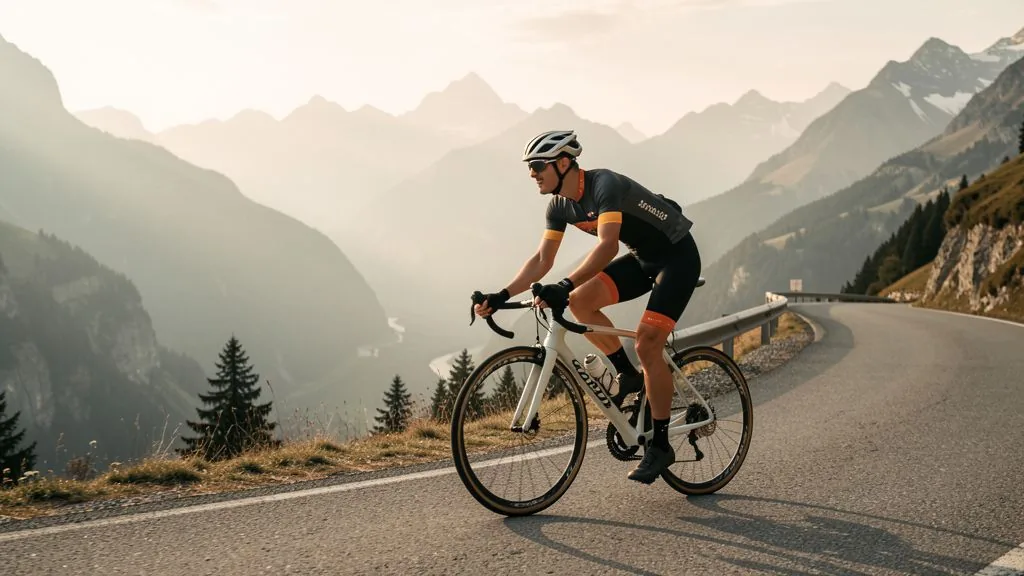
From around 25 km/h, aerodynamic drag is your biggest opponent — at 40 km/h, 80–90% of your power goes into overcoming air resistance alone. The good news: most of that drag does not come from the bike but from you. Optimise your position and a few targeted components, and you save 30–70 watts without training a single day harder. Those are the famous “free watts.”
Why aerodynamics decides almost everything
Three forces resist you on a bike: air resistance, rolling resistance and — uphill — gravity. Rolling resistance rises linearly with speed; air resistance rises with the square, and the power needed to overcome it with the cube. In concrete terms: riding 40 km/h instead of 30 does not take a third more watts but roughly double — nearly all of it against the wind.
A worked example with typical values (rider plus bike 80 kg, CdA 0.32, Crr 0.004, flat road, no wind):
- 30 km/h: about 150 watts — already around 80% of it fighting the air.
- 35 km/h: about 225 watts — air resistance share around 85%.
- 40 km/h: about 320 watts — almost 90% of your power battles the wind.
This leads to the key insight of cycling physics: on flat terrain, your FTP alone does not decide your speed — the ratio of power to drag does, watts per CdA. Two riders with identical FTP can finish several minutes apart over a 40 km time trial, simply because one of them sits more slippery.
CdA: the number behind everything
The aerodynamics of the rider-bike system is described by CdA: the drag coefficient (Cd — how slippery the shape is) multiplied by the frontal area (A — how much area you present to the wind). Typical magnitudes on a road bike:
- Upright on the hoods: CdA around 0.38–0.42 m².
- In the drops, flat back: CdA around 0.30–0.33 m².
- Optimised time-trial position (forearms horizontal): CdA around 0.26–0.29 m².
The decisive point: the rider accounts for 70–80% of total drag, the bike only 20–30%. That is why position is the biggest lever — and why an expensive aero frame under an upright rider is money wasted.
Position: the biggest lever costs nothing
The most effective aerodynamic measure is free: your riding position. Moving from an upright posture on the hoods into the drops with a flat back lowers CdA by 0.08–0.10 m² — at 40 km/h that equals 30–50 watts. For comparison: that is more than most people gain in FTP over a full year of structured training.
Three rules for a fast position you can actually hold:
- Flat back, not just low shoulders. The goal is a spine as horizontal as possible, not a cranked neck. Ducking only your head gains little and costs you visibility and control.
- Narrow front profile. Elbows and knees tucked in, shoulders narrow — every splayed limb is a small parachute. Gripping the drops almost automatically brings your arms into line.
- Realistic aggression. The fastest position is the one you can hold for 3–5 hours. An aggressive posture abandoned after 30 minutes is slower than a moderate one that lasts — more on that below.
Whether your saddle and handlebar geometry even allows a flat position is something a professional bike fitting will clarify. Stack, reach and saddle position are the boundary conditions — aerodynamics starts with geometry, not willpower.
Equipment: what saves how much?
After position comes equipment. All figures apply at around 40–45 km/h — at 30 km/h they roughly halve:
- Aero handlebar with internal cable routing: 10–15 watts. A compact bar with a flat top section is the cheapest entry point.
- Deep-section wheels (50–60 mm): 10–20 watts over standard aluminium wheels. The biggest jump happens from stock wheels to the first aero set; going from 50 mm to 80 mm rims adds less.
- Aero frame: 10–20 watts over a classic round-tube frame — real, but expensively bought.
- Skinsuit and tight jersey: 10–20 watts. A flapping jersey can eat half your wheel savings — the most commonly underestimated detail.
- Aero helmet: 5–10 watts over a standard helmet; per euro often the best investment of all.
- Shaved legs, shoe covers, bottle placement: another 5–10 watts combined. Marginal gains that add up.
The priority list is therefore clear: position first (€0), then helmet and clothing (small money), then handlebar and wheels (medium money) — the aero frame comes last, once everything else is right.
Testing aero without a wind tunnel
You do not need a wind tunnel to improve your position. Three field-practical methods:
- Chung method (“virtual elevation”): on a calm loop, ride the same short circuit several times in both directions at constant power, varying only your position. Software such as GoldenCheetah estimates your CdA from the data. The error bars are bigger than in a lab, but for comparing position A against B the method works well.
- Speed comparison at constant power: simpler but robust: same stretch of road, same power, same conditions — once upright, once in the drops. The speed difference at identical input is your aero gain. Saving 20 watts is worth roughly 1.5 km/h at 40 km/h.
- Video analysis: a side-on recording on the trainer shows back line, arm angle and head position more honestly than any feeling. Many riders believe they sit low — the video reveals an upright torso with a ducked head.
Important for all field tests: wind is the biggest confounder. Test early in the morning in calm conditions or on a sheltered loop, and repeat every configuration at least three times before drawing conclusions.
Aerodynamics versus comfort and power output
There is a point where more aero makes you slower. Three conflicts you need to know:
- Holding time: a position you can only hold for 30 minutes gains nothing over a five-hour gran fondo — on the contrary: a rider who sits up after an hour gives away more than the aggressive posture ever saved. Train the aero position like a fitness quality: start with 10-minute blocks in the drops, then extend them.
- Power output: a hip angle that is too closed (too low at the front) can cost many riders 5–10% of their power. If 10 watts of aero savings cost you 20 watts of pedalling power, the deal is bad. So always check via field test whether you can still hit your target wattage in the new position.
- Safety and handling: the drops in city traffic or on technical descents is a bad idea. Aerodynamics ends where control begins — and on climbs above roughly 8–10% gradient, weight dominates over wind anyway (more in our article on climbing technique).
Common mistakes
- Equipment before position. The classic: €3,000 wheels under an upright rider. Rider first, bike second — in that order.
- Taking wind-tunnel numbers literally. Manufacturers test at 45–50 km/h and ideal yaw angles. At your 32 km/h in gusty crosswinds, often only half of the promised gain remains.
- Flapping clothing. A loose jersey with folds across the back costs 10–20 watts — more than an aero helmet saves. Kit must fit skin-tight without wrinkles.
- Copying a position instead of adapting one. A pro's time-trial posture is the product of years of adaptation and mobility work. Copying it blindly ends in neck pain and power loss. Trunk mobility and stability are the prerequisite — mobility training helps cyclists too.
- Misjudging aero in group rides. In a draft, your drag drops by 30–40% — personal aero optimisation matters less in the bunch. It counts most when riding solo, into headwinds and when pulling at the front.
How Peakora approaches aerodynamics
Peakora manages your training through power and load — aerodynamics is the lever that turns the same power into more speed. In practice: lower your CdA and you ride faster at the same fitness, without the engine demanding more watts. And when you train for a long goal like a gran fondo, the algorithm schedules exactly the sessions where aero position and endurance come together: long rides with targeted pressure phases in which you practise holding the low posture while fatigued — because at the end of a race it is not the best position that wins, but the one you can still hold.
Frequently asked questions
What is the CdA value in cycling?
CdA is the product of drag coefficient (Cd) and frontal area (A) and describes how strongly the wind slows you down. An upright rider sits at about 0.40 m², a good drops position at 0.28–0.32 m² — at 40 km/h that difference is worth roughly 40 watts.
How much does an aerodynamic riding position really save?
More than any component: moving from an upright posture to flat forearms saves around 30–50 watts at 40 km/h — more than an aero frame and wheels combined. What matters is that you can hold the position for the entire race distance.
How many watts do aero wheels save?
Deep-section wheels with 50–60 mm rims save about 10–20 watts over standard aluminium wheels at 40 km/h. The gain depends on speed and yaw angle; on slow climbs, weight usually matters more than aerodynamics.
Is aerodynamics worth it for slower riders?
Yes — proportionally even more so. Drag rises with the square of speed, but slower riders spend more time on the course and accumulate more time savings. Tests show: at 30 km/h a good position saves more minutes over a gran fondo than at 40 km/h.
Train smarter with Peakora
Power-based cycling plans with automatic load management and a recovery monitor — so your watts turn into maximum speed. Start free, no credit card required.
Start for free