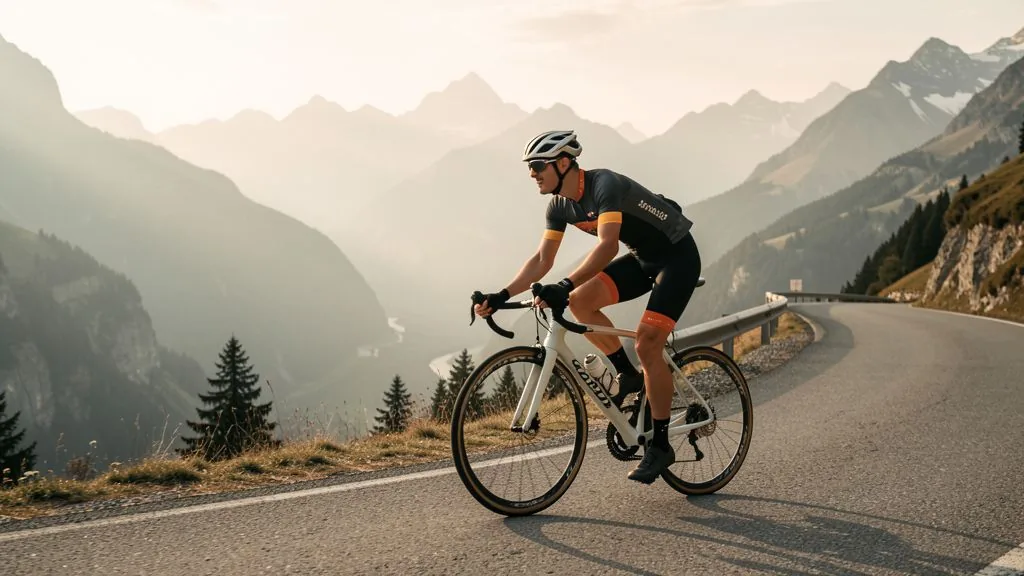
172.5 millimetres — that has been the default crank on a size 54 road bike for decades. It is not a biomechanical finding but a market convention from an era of low bottom brackets and tall pedals. Today almost every WorldTour team puts 165 mm cranks on smaller riders, and a few pros ride 160. This article covers what shorter cranks actually change, who benefits from the swap and where the limits are — with numbers rather than gut feeling.
What crank length means physically
The crank is a lever. Its length defines the circle your pedal travels — and with it three things at once: the distance your foot covers per revolution, the joint angles in hip and knee at every point of that circle, and the torque you put into the bottom bracket for a given force.
An example makes the scale clear. At 90 revolutions per minute, a pedal on a 172.5 mm crank travels 97.5 metres per minute; with 165 mm it travels 93.3 metres — roughly four per cent less distance for the same power. Pedal speed drops as well, which is why you either spin slightly faster at equal power or apply more torque per stroke.
The second effect matters more: top dead centre drops when the crank gets shorter. That is exactly where most position problems live — the hip is most flexed, the knee is most flexed, power drops off and load on the patellar tendon peaks.
The hip angle: the real lever
There is very little room between thigh and torso in the aero position. Ride 172.5 mm cranks with a flat torso at 35 to 40 degrees to horizontal and you often end up with a hip angle of only 35 to 45 degrees at top dead centre. Below roughly 45 degrees it gets tight: the thigh pushes into the stomach, breathing becomes shallow, and power falls exactly in the phase where it should be highest.
Ten millimetres less crank moves that point noticeably — a rule of thumb says one millimetre of crank length equals about one degree of knee flexion at top dead centre; in practice, going from 172.5 to 165 mm is reported as eight to twelve degrees less flexion. This is why time trialists and triathletes have ridden cranks between 155 and 167 mm for years: they gain hip opening without raising the saddle or the bars.
What the research says — and what it does not
The frequently cited work by Martin and Spirduso from 2001 tested crank lengths from 120 to 220 mm and found that maximal power stays nearly constant across a wide range, with an optimum roughly at half the leg length. Later studies with 165, 170, 172.5 and 175 mm in trained cyclists confirmed that for oxygen uptake, heart rate and lactate: no relevant differences.
Two conclusions follow. First: anyone buying a shorter crank to gain "more watts" will be disappointed. Second: because power does not suffer, crank length is a free parameter — you can choose it for comfort, position and joint tolerance instead of a performance promise. That is precisely why the trend exists.
- Power: no relevant difference between 165 and 175 mm at submaximal or maximal effort.
- Sprinting: short cranks build torque a little more slowly but spin up more easily — the net difference in a sprint is small.
- Biomechanics: clear differences in hip angle, knee flexion at top dead centre and frontal-plane knee tracking.
- Economy: practically identical at matched cadence; differences only appear when you deliberately change cadence.
Who benefits from a shorter crank
Not everyone needs the swap. There are, however, clearly defined groups where 165 or 170 mm almost always pays off:
- Small riders: Below 170 cm body height a 172.5 mm crank is biomechanically too long. It forces the thigh into a steeper angle and increases knee flexion without giving anything back.
- Time triathlon and triathlon: In the aero position the hip angle is the limiting factor. Cranks between 155 and 167 mm are standard here because they open the hip without increasing saddle-to-bar drop — see the aerodynamics article for the position side.
- Riders with front knee pain: Anyone with pain at the patella or patellar tendon under load reduces peak knee flexion with a shorter crank. That is no substitute for finding the actual cause, but it is an effective building block.
- Hip impingement or osteoarthritis: Every degree less flexion counts. Here crank length is often more effective than any saddle tweak.
- Short legs: With an inseam under 80 cm, 172.5 mm is simply oversized. Scaling from half the leg length (Martin/Spirduso) gives 165 to 167 mm.
Tall riders who spend a lot of time out of the saddle and have no symptoms can stay at 172.5 or 175 mm — climbing out of the saddle needs leverage, and long cranks provide it.
Consequences for your position
A crank swap is always a change to your position. Three settings need follow-up:
- Saddle height: Up by the difference in crank length, so two to five millimetres. Bottom dead centre rises with a shorter crank, and the leg would otherwise stay too flexed. How to set it properly is covered in saddle height setup.
- Saddle setback: Usually zero to five millimetres forward, because the effective knee angle over the bottom bracket stays the same.
- Bar height: Check first, change later. Shorter cranks open the hip angle, so you can often drop the stem and gain aerodynamics — a point that belongs in a proper bike fit.
Important: change only one variable per test ride. Adjust crank, saddle height and stem at the same time and you can no longer tell which change did what.
What you lose in gearing
With the same cassette and chainring, development drops because the crank circle gets smaller. From 172.5 to 165 mm that is about 4.3 per cent. In practice: where you used to climb in 34×28, you now feel like you need one more gear.
The fix is mundane: a chainring two teeth bigger, a larger sprocket, or — if the crank is being replaced anyway — a compact 50/34 instead of 52/36. On climbs what decides is power-to-weight, not crank length; how to improve the watt-per-kilogram ratio systematically is covered in the article on power-to-weight ratio.
Cadence: what changes in the pedal stroke
With a shorter crank, pedal speed drops at the same cadence. Many riders unconsciously respond with a higher cadence — landing at 90 to 95 instead of 80 to 85 revolutions per minute. That is not a mistake, it is the actual effect: lower peak forces per stroke, less muscular fatigue, more endurance at the same power.
Anyone who used to grind at 70 rpm should use the change to raise cadence deliberately. The mechanics behind it — force application, muscle recruitment, fatigue — are described in detail in cadence in cycling. What matters is consistency: one week at 95, the next at 75, is worth less than a stable cadence across the whole winter.
Choosing: which length for which rider
- Under 160 cm: 155 to 160 mm, especially in the aero position.
- 160 to 170 cm: 165 mm — the pragmatic standard for small to mid-size riders.
- 170 to 180 cm: 170 mm, or 167.5 with a lot of time trial riding.
- Above 180 cm: 172.5 mm, optionally 175 from 190 cm up.
That table is a starting point, not a rule. What decides are hip angle in the real riding position, knee flexion at top dead centre, and what your body reports over weeks. Anyone spending big money on a wheelset while riding a crank that is too long and dealing with front knee pain has invested in the wrong place.
Practical test: finding out whether it fits
The cleanest route is a test crank from a dealer or a club. If that is not possible, video measurement helps: phone on a tripod, side-on, 60 frames per second, then read the hip angle at top dead centre — the angle between the torso line (shoulder to hip) and the thigh. Under 45 degrees is a warning sign, under 40 degrees is almost always a problem.
To judge the change over weeks you need data, not feel. Record power at a fixed heart rate on a flat reference route, plus perceived effort and everything the knee reports. If after four weeks heart rate at the same power is two to four beats lower and the symptoms are gone, it was the right decision.
Common mistakes
- Looking only at body height. Two riders at 175 cm can have different leg lengths and hip mobility. The table is a starting point; measurement decides.
- Not adjusting the saddle. The most frequent mistake after a swap: shorter crank, same saddle height — and suddenly pain at the back of the knee because the leg stays too flexed.
- Changing too radically. Going from 175 straight to 155 mm is a shock for coordination and pedal pattern. Ten millimetres per step makes sense.
- Swapping mid race season. Four to six weeks of adaptation is not a formality. Winter is the right window — see winter training on the bike.
- Not recalibrating the power meter. The crank is part of the measuring system; anyone on a crank-based power meter must recalibrate after the swap and check that old values remain comparable.
- Ignoring chainline and front derailleur. A different crank model often changes chainline. If shifting gets worse afterwards, that is usually the reason — not crank length.
Example: a 168 cm gran fondo rider
Starting point: 172.5 mm, saddle-to-bar drop 7 cm, front knee pain from kilometre 80, average cadence 74. After switching to 165 mm and raising the saddle four millimetres:
- Hip angle at top dead centre from 42 to 50 degrees — breathing stays open in the drops.
- Cadence after six weeks at 88 on average, same power, heart rate three beats lower.
- Knee pain gone without any change in training volume.
- Development down four per cent — compensated with 50/34 instead of 52/36.
That is not magic, it is mechanics: less flexion at top dead centre, lower peak force per stroke, more even load around the whole pedal circle. That is how position work should feel — measurable, not esoteric. Anyone approaching this systematically will find the basics in bike fitting and in the gran fondo training pillar page, where position, volume and intensity distribution come together across a season.
How Peakora handles a changed position
A crank swap does not change load immediately, but indirectly: higher cadence means more cardiovascular work and less peak muscular load, which shows up in your CTL/ATL/TSB trend as slower fatigue. In Peakora you log rides as usual — the engine rates them by duration and intensity, independent of the hardware. If you deliberately ride easy for a week after the swap to adapt, your fitness curve dips; that is normal and no cause for concern.
Frequently asked questions about crank length
What crank length should I ride?
Body height is the starting point: under 170 cm use 165 mm, between 170 and 180 cm use 170 mm, above that 172.5 mm. What matters more than height is hip angle, riding position and symptoms — with front knee pain or a deep torso angle, a shorter crank is worth it regardless of height.
Do shorter cranks produce more power?
Not directly. Studies comparing 165, 170, 172.5 and 175 mm find no relevant differences in peak power, oxygen uptake or lactate in trained cyclists. Shorter cranks work through position and range of motion: more open hip angle, less knee flexion, easier pedalling in the aero position.
Do I have to adjust saddle height after changing cranks?
Usually yes, two to five millimetres up. At bottom dead centre the leg is less extended with a shorter crank, so the saddle moves with it. Re-check knee flexion at top dead centre and review the position after two or three rides once the movement pattern has settled.
Do short cranks cost me gearing on climbs?
Slightly. With the same gearing, development drops by four to five per cent because the crank circle is smaller. You can compensate with a chainring two or three teeth bigger or a larger cassette sprocket. On climbs what decides is power-to-weight anyway, not crank length.
How long does it take to adapt to a new crank length?
Expect four to six weeks before cadence and coordination feel automatic. Early rides feel higher-cadence at the same power, and climbs seem to ask for more torque. Riders who are on the bike often adapt faster, so test the change in base phase rather than three weeks before your goal race.
A training plan that matches your position
Peakora builds your cycling and triathlon plan from your actual sessions — intensity distribution, recovery control and adjustments when a week goes differently than planned. Start free, no credit card required.
Start for free