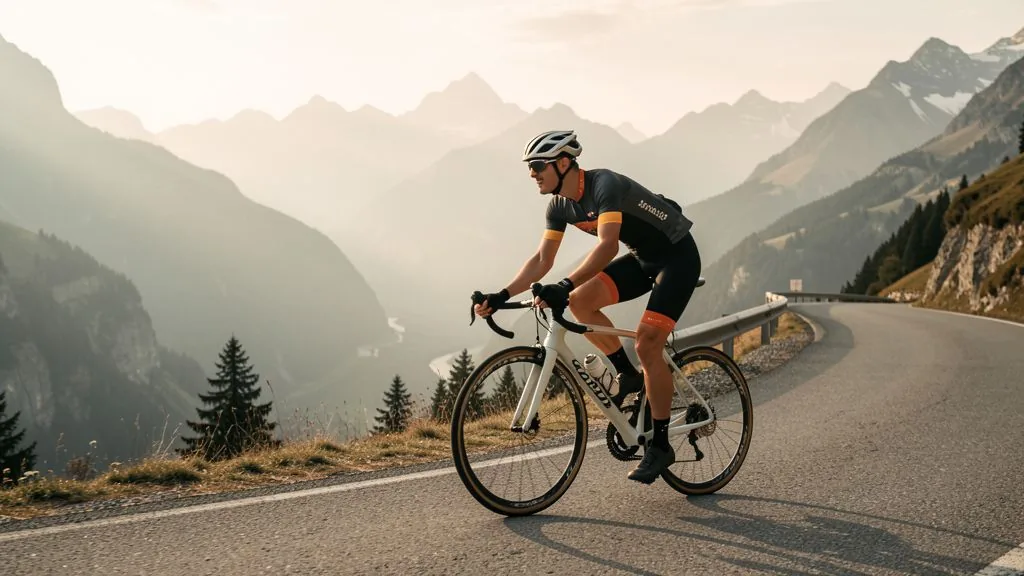
Two riders, both at 300 watts at threshold: one weighs 68 kilos, the other 84. On a climb, the first one rides away from the second by several minutes per hour — at identical power. That is the power-to-weight ratio, and it is the only metric in cycling that expresses output and body mass as a single relationship. Once you understand it, you stop working on two separate problems and start pulling the lever that actually moves your race results.
What watts per kilo actually tells you
Power-to-weight is your power in watts divided by your body weight in kilograms. The reference point is almost always functional threshold power (FTP) — the power you can hold for about an hour. How to establish it is covered in the article on the FTP test and power-based training. A rider with 280 watts FTP at 70 kilos sits at 4.0 W/kg; the same 280 watts at 85 kilos is only 3.3 W/kg.
The crucial point: this number is only one of two metrics that matter. On flat roads and in time trials, absolute power counts, because aerodynamic drag dominates there and body weight barely does. On climbs, the ratio counts. So cycling has no single "best" number — it has two targets that you weight differently depending on the race profile.
Why the ratio decides on climbs
The physics is unspectacular but relentless. Uphill, the share of your output that must be delivered against gravity rises to 80–90 percent of total power. That lifting work is directly proportional to your mass — every kilo you haul up the mountain costs power, no matter how aerodynamic you sit. On the flat it is the reverse: above roughly 30 km/h, aerodynamic drag absorbs 70–80 percent of your power, and it grows with the square of speed. Weight hardly matters there; position and wheels matter enormously.
That explains why a heavier rider with high absolute power dominates on flat roads and cracks in high mountains, while the light climber does exactly the opposite. It also explains why race organisers tune course profiles so carefully: a 40-kilometre time trial favours the engine, a 12-kilometre climb at 8 percent favours the ratio.
For training practice this means: if you have climbing goals, you develop two things in parallel — maximum power and a body weight that does not eat that power alive. If your goals are flat, you can largely ignore weight and invest your energy in position and threshold power instead. Position details are in the article on cycling aerodynamics.
Reference values: what is realistic
The ranges below refer to FTP and to middle-aged men with several years of training. Women typically reach about 10–15 percent lower values, which is physiologically grounded and not a performance deficit. Treat the numbers as orientation, not as a norm:
- 2.0–2.5 W/kg: entry level, little structured training. Here any form of consistency produces massive gains — often 15–25 percent within six months.
- 2.5–3.2 W/kg: solid recreational fitness, regular rides, occasional races. The typical range for hobby riders after two to three years.
- 3.2–4.0 W/kg: well trained, structured plan with threshold and VO2max stimuli. In this band the detail work decides: periodisation, fatigue management, nutrition.
- 4.0–4.8 W/kg: very strong, front group of amateur races and gran fondos. Reached by riders logging 8–12 hours per week over several years.
- 4.8–5.5 W/kg: top amateur, category 1. From here, genetics and a highly disciplined lifestyle are prerequisites.
- above 5.5 W/kg: professional territory. WorldTour climbers sit at 6.0–6.5 W/kg for 20–30 minutes.
An important reality check: to go from 3.2 to 4.0 W/kg you need either 25 percent more power or 20 percent less weight — or a mix. Both take months to years. The most common mistake is attacking both aggressively at once and ending up with an injury or a form hole.
The weight lever: dosing instead of dieting
Because power and weight feed into the same metric, rapid weight loss is no automatic route to a better ratio. Lose three kilos but give up 15 watts at threshold, and you have gained nothing. The rule that has proven itself in practice: a maximum of 0.5–1 percent of body weight per week, and only in the base phase — not in race preparation, not during a build block with hard sessions.
In practice, for a 75-kilo rider that means 375–750 grams per week, which corresponds to a moderate deficit of 300–500 kilocalories per day. Small enough to preserve training quality, large enough to move 4–6 kilos over three months.
Three rules prevent the typical loss of power:
- Keep protein high: 1.6–2.0 grams per kilogram of body weight daily. In a deficit this protects muscle mass and adds satiety. More on this in the article on protein for endurance athletes.
- Time your carbohydrates around hard sessions: do not cut globally, concentrate instead. Intake stays full before and during intense rides; you save on rest days and easy spins.
- Keep strength training: two sessions per week with heavy compound lifts signal to the body that muscle mass is needed. Drop strength work in a deficit and you lose exactly the tissue that produces power.
A warning sign many overlook: if you are constantly cold, sleep badly and wake with a resting heart rate 5–8 beats above your normal in a deficit, you have gone too far. That is where adaptation flips. How to monitor this systematically is covered in the article on HRV and heart rate variability.
The power lever: more watts without more mass
The second path is the underrated one. Two to four watts per kilogram of additional threshold power is realistic with consistent training over two to three years — and this route costs not a single gram of body mass. The most effective stimuli, in descending order:
- Zone 2 volume: mitochondrial density and capillarisation only grow through volume. Keep 60–80 percent of weekly hours easy, as described in the article on Zone 2 training.
- Threshold work: 2 × 20 minutes or 3 × 12 minutes at 95–105 percent of FTP. This is the most direct stimulus on the reference metric itself.
- VO2max intervals: 4–6 repetitions of 3–5 minutes at 110–120 percent of FTP. This raises the ceiling underneath which your threshold sits.
- Strength training: heavy squats and deadlifts improve motor unit recruitment and therefore economy. Four to eight reps, two sets, twice a week — details in strength training for cyclists.
- Hill work: climbs are threshold work with built-in resistance, and they train the specific climbing position at the same time. See climbing technique on the bike.
The decisive point: these stimuli need recovery to take effect. Two hard sessions per week is the ceiling at which most ambitious recreational riders still adapt. Anything beyond that produces fatigue, measurable as a falling FTP.
A worked example showing the order of magnitude
Take a rider at 80 kilos with a 280-watt FTP — 3.5 W/kg. He climbs a pass of 8 percent gradient and 8 kilometres length. Holding a steady 280 watts, he needs roughly 42 minutes depending on system weight and rolling resistance. Lose 5 kilos without losing power and the ride drops to about 39 minutes — three minutes for five kilos. Instead add 20 watts of FTP and he lands around 40 minutes. Both together: 36–37 minutes.
This shows two things. First, the weight lever on climbs is real and measurable. Second, it is limited: beyond the first 4–6 kilos it becomes physiologically expensive, and the power lever takes over. That is why the sequence is almost always: build power first, optimise weight in the base phase, then build power again. This sequence is also called seasonal weight periodisation.
What power-to-weight does not tell you
A high W/kg number does not make a good cyclist. Three things are entirely absent from the metric:
- Fatigue resistance: two riders at 4 W/kg can differ by 15 percent in power output after three hours of racing. Whoever holds the ratio after 200 kilometres wins more races than the one with the better starting value.
- Punch and acceleration: a 60-second climb sprint and a 20-minute ascent are physiologically different disciplines. FTP says almost nothing about your kick.
- Technique and tactics: cornering, drafting, positioning before a climb and fuelling often decide amateur races more than a 0.2 W/kg difference.
There is also a medical point that appears too rarely in this discussion: a permanently low energy supply combined with high training load leads into relative energy deficiency (RED-S) with consequences for hormones, bone density and immune function. Anyone optimising power-to-weight through chronic under-fuelling pays with health. More in the article on RED-S and energy availability.
How Peakora works with power-to-weight
The Peakora engine reads your power values from the power meter and relates them to your stored body weight — so after every session you see where you stand without maintaining spreadsheets yourself. The second part matters more: the system doses your load via TSS, CTL and TSB and schedules hard stimuli only when your form can carry them. That is exactly what counts during a power-to-weight campaign, because a calorie deficit measurably lowers recovery capacity.
Concretely: if your TSB drops below −20, the plan reschedules the threshold session instead of cancelling it. If your resting heart rate rises by more than five beats over two weeks, the next intensity session is converted into an easy spin. And because every session is stored with power, duration and heart rate, after eight weeks you can see in black and white whether your W/kg grew — or whether you simply got more tired. For climbing-oriented season goals, the build plans in the training hub fit alongside this.
Frequently asked questions about power-to-weight
What is a good power-to-weight ratio in cycling?
For ambitious recreational riders, 3.5 to 4.0 watts per kilogram at threshold counts as good, 4.0 to 4.5 W/kg as very strong. Above 5 W/kg you ride in the front group of amateur races; professionals sit at 6 W/kg and higher.
How fast can I lose weight without losing power?
A maximum of 0.5 to 1 percent of body weight per week, and only outside the race season. Losing faster usually drops your threshold by more than your weight — the ratio gets worse instead of better.
Does power-to-weight matter in running too?
Yes, on climbs and when accelerating. On the flat, running economy dominates instead — how much oxygen you use per kilometre. In cycling, W/kg is the dominant metric because air resistance at race speed is far smaller than in running.
Why does watts per kilo matter more uphill than on the flat?
Uphill, the share of work done against gravity rises to 80–90 percent of total output. On the flat, above roughly 30 km/h, aerodynamic drag dominates — it grows with the square of speed and barely depends on body weight.
Train by watts, not by feel
Peakora doses threshold, VO2max and base work according to your form — and shows you whether your power-to-weight is actually growing. Start for free, no credit card required.
Start for free