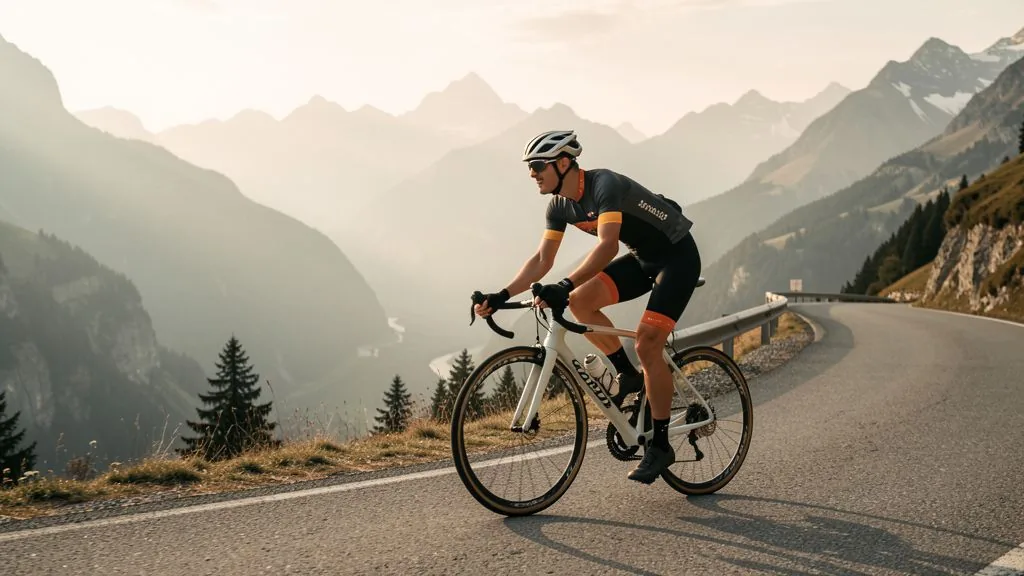
Stand up on a steep climb, slide your upper body forward and rock the bike in time with the pedals — no element of cycling looks as effortless as standing out of the saddle, and none is used so badly. Professionals sprint away on a ramp where you pace yourself into the red standing up, then settle straight back into the saddle. The difference is not power but understanding when standing pays off, how to do it cleanly and how to train it without wrecking your climbs.
Why standing up on a climb is faster at all
While seated, only your leg muscles pull and you push against your own body weight resting on the saddle. Standing up changes the mechanics completely: you no longer just push against the crank but pull with arms, back and trunk as well. The upper-body and arm musculature becomes an extra power source, and power at the pedal rises by ten to twenty percent in short surges compared with sitting.
Leverage comes on top: standing shifts your centre of mass over the bottom bracket and uses a longer crank path, which produces more torque per stroke. On a steep slope, where rolling resistance barely matters and gravity dominates everything, that extra force translates straight into forward motion. But there is a price — standing is not free of charges from physics.
When standing is faster — and when it is not
The rule of thumb sounds simple: stand briefly, stay seated when it drags on. Above roughly six to eight percent gradient, or on short steep ramps, standing is the faster route because you mobilise more power than you could — or would want to — produce seated. For steady climbs that run for kilometres, it is the expensive option instead.
The reason is oxygen demand: more working muscle mass means a higher metabolic rate. Studies show that oxygen uptake does not drop when standing at the same position but actually rises slightly, and heart rate sits two to eight beats higher than seated at the same power — at the same speed, up to ten beats. Anyone who stands for minutes on a climb pays that interest through premature fatigue. The same mechanism shows up in your heart rate zones, which seem to leap upwards the moment you stand.
The technique: five points that make the difference
Clean standing is not yanking on the bars but a steady, rhythmic dance on the pedals. Done well, it looks calm — even while the legs are working. These five points decide:
- Gear choice: Shift two to three gears harder than seated. Gears that are too easy let the crank spin, the bike becomes unstable and you lose control of the surge.
- Quiet upper body: The upper body stays largely still; the movement comes from hips and legs. Letting shoulders and head bob wastes power and looks exhausted long before you are.
- Metered hip sway: The hips sway gently left to right and the bike follows the pressure. Too much sway tips the bike from edge to edge; too little makes the motion stiff and powerless.
- Relaxed hands: The bars are for balance, not for gripping hard. White-knuckling the bars tenses shoulders and back — keep the grip loose and elbows slightly bent.
- Round pedal stroke: Accelerate the crank smoothly instead of jerking it through each half-circle. A round standing stroke holds speed steady and costs fewer matches than a jerky one.
A common beginner mistake is treating standing as a sprint: full power for ten seconds and then collapsing. The experienced rider meters it — standing when the gradient steepens or an attack comes, and sitting down once the pace is stabilised. How such a hilly ride fits into your training week with controlled load is also covered in the article on climbing technique on the road bike.
Training out-of-the-saddle climbing specifically
Standing is a trainable skill, not just a racing trick. Two to three sessions a week with short repeats are enough to improve technique and strength endurance on the climbs noticeably. Proven formats:
- Standing intervals: On a steady climb (4 to 8 percent), two 8 to 10 minute blocks with 30 seconds standing every 2 minutes — stand briefly, sit, stand again.
- Short surges: On the flat or a slight grade, 8 to 12 surges of 20 to 30 seconds in a bigger gear, with three easy minutes rolling in between. This session sharpens the kick and power at the crank.
- Steep ramp: A short, steep section (10 to 15 percent) ridden entirely out of the saddle in your biggest gear — perfect for strength endurance and technique under high resistance.
- Controlled single-leg: On the trainer, alternate single-leg standing pedalling — a very light format that improves the roundness of the stroke and your balance.
Dosing follows the same logic as in every endurance sport: the stimulus must stay technically clean. Once you are no longer pedalling smoothly out of the saddle but fighting it, the repeat is over — technique work ends where form collapses. A useful frame is training load by TSS (Training Stress Score): a hilly ride with many standing surges easily lands at 120 to 180 TSS and needs an easy day afterwards.
Using standing correctly in a race
In competition, standing is a tactical tool, not a permanent state. Three situations where it pays off:
- On the steepest ramp: Where the climb kinks and briefly goes above ten percent, stand to hold speed — not to accelerate.
- Attacking or responding: When someone attacks on a climb, standing is the fastest answer to hold the wheel. Then sit straight back down and breathe calmly.
- For relief: Riders who stay seated until the sit bones and lower back quit can use short standing phases to unload the holding musculature and change position — that extends the time before the back becomes the limiting factor.
The most important race tactic, though, is restraint: most amateurs stand far too often, far too long and far too early on a climb, burning exactly the matches they will need at the summit and on the descent. A good cue: if it feels like your heart rate "jumps", the standing surge was one notch too hard. How to control that fatigue with training tools is described in the article on CTL, ATL and TSB.
Common mistakes when standing on the pedals
- Standing too often. Riders who stand on every climb burn enormous energy across a ride. Standing is a tool for short, steep sections, not for the whole mountain.
- Gear too easy. Out of the saddle you need a harder gear than seated. Too easy lets the crank spin and you "flutter" without force instead of pushing.
- Yanking on the bars. Power comes from the legs and hips, not from pulling on the arms. Pulling tenses you up and costs you the feel for the line.
- No sense of pace. Standing is neither a rest nor an all-out sprint. It should hold speed or raise it moderately, not blow your heart rate wide open.
- Not sitting back down after the surge. Every standing phase deserves a controlled return to the saddle with calm breathing — otherwise oxygen debts stack up until you overload.
How Peakora maps the climbs in your plan
A hilly ride with many standing surges creates a load that distance or average heart rate barely expresses. The Peakora engine scores such sessions by Training Stress Score and feeds them into your form curve (CTL/ATL/TSB). That way you see in black and white that a hilly ride was not simply "a spin" but a real training stimulus — and the plan automatically schedules the right recovery for the next day before the next hard session is due. Because the engine combines power, heart rate and your subjective feel, the standing day stays dosed and the climb becomes a training tool instead of an overload trap.
Frequently asked questions about climbing out of the saddle
Is climbing out of the saddle faster uphill than sitting?
Above roughly six to eight percent gradient, standing in short, powerful surges is usually faster because you use your upper body and arms as an extra power source. On long, steady climbs, staying seated is more energy-efficient over the whole distance.
Why does heart rate rise so much when I stand up?
Because more muscle mass is working and the load lands on the same legs that are already pedalling. Heart rate sits two to eight beats higher than at the same power while seated, and up to ten beats higher at the same speed. That costs you the matches you need later on the climb.
What is the correct technique for standing on the pedals?
Shift two to three gears harder than seated, keep your upper body quiet, let the hips sway only slightly and do not yank on the bars. Accelerate the crank smoothly rather than jerking it, and keep the bike on a straight line instead of rocking side to side.
How often should I train out-of-the-saddle climbing?
Two to three times a week is enough. Short repeats of 20 to 60 seconds standing, built into a hilly ride or as hill intervals, improve technique and strength endurance. During the race phase, one maintenance stimulus a week suffices.
Train the climbs with a system
Peakora plans your hilly rides, scores the load and schedules the right recovery. Start for free, no credit card required.
Start for free