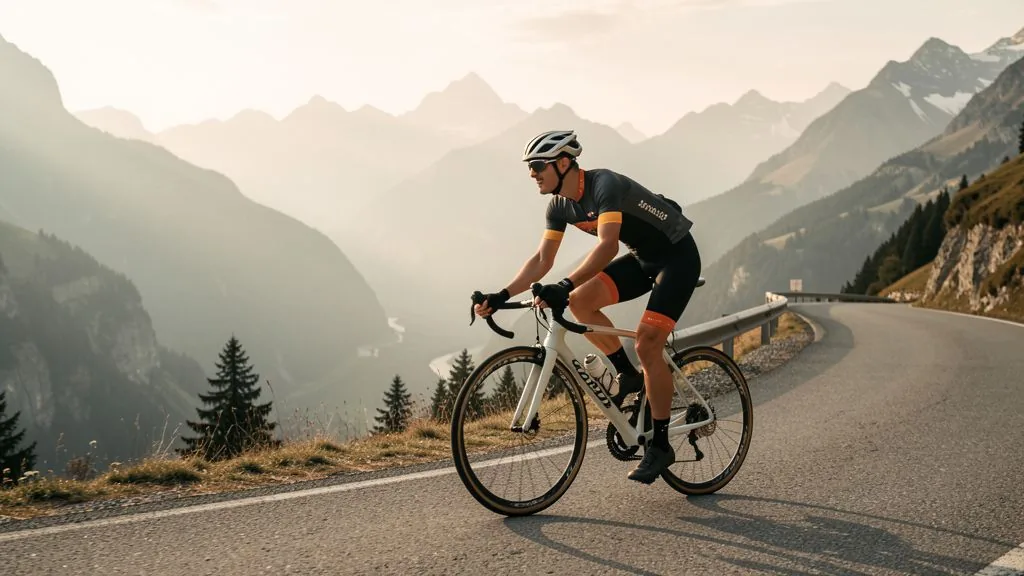
Knee pain is the second most common complaint among road cyclists — right behind neck pain, but far more stubborn. The reason lies in the movement itself: on the bike the knee bends and straightens up to 5,000 times per hour, every time under load. Any deviation from the ideal line therefore repeats thousands of times, and that is exactly what turns small position and pedalling errors into real joint problems.
Why the knee is so vulnerable in cycling
Unlike running, the knee carries no body weight on the bike. You might think that makes it insensitive — in fact the opposite is true. Because the load is not delivered in impacts but repeated very evenly and very often, the joint lacks variation. Muscles and tendons adapt to recurring patterns, but they do so exactly in the direction you load them. If the force does not travel cleanly through the kneecap, the extensor mechanism and the menisci, a harmless misalignment becomes irritation after two hours non-stop.
Then there is the chain: the knee is not an isolated joint but connects hip and foot through the whole leg chain. A tilted pelvis, a shortened hip or a wrongly set shoe all feed through the chain into the knee. That is why the cause of knee pain often does not sit in the knee itself.
The four most common causes
- Saddle too low: The classic, and the most common cause of front-of-knee pain. With the seat too low the knee is bent more at the top of the pedal stroke; the angle between thigh and lower leg becomes sharp and the pressure of the kneecap on the cartilage pad rises significantly. Rule of thumb: at the bottom of the stroke the knee stays slightly bent — not straight, not deeply flexed.
- Saddle too far forward or too far back: The horizontal position determines how far the knee travels forward over the pedal. If the saddle is too far forward, the load shifts under the kneecap (front pain). Too far back and the pull lands on the back of the joint and the hollow behind the knee.
- Too-heavy gears and low cadence: Pushing 60 revolutions per minute in a big gear produces high torque per pedal stroke. That torque loads tendon and cartilage far more than a higher cadence at the same speed.
- Foot position, shoes and cleats: Foot position reaches up into the knee: a cleat turned too far in or out forces the whole leg chain into rotation. A foot that rolls inward heavily (overpronation) or has a high arch also travels up through the axle.
Before you touch position and training, rule out medical causes. A swollen, locking or unstable knee, a clicking sound with pain, or pain that persists at rest needs medical assessment — not a repair stand.
Check your position: the three basic settings
The cheapest intervention is geometry. You do not need a professional bike fit — an Allen key set and some patience are enough. Work through it in this order and change only one variable at a time, otherwise you will never know what worked.
- Saddle height: Measure it from your inseam, not your body height. As a starting point: inseam length in centimetres times 0.885 gives the distance from the centre of the bottom bracket to the top of the saddle, measured along the seat tube. From there, fine-tune: at the bottom of the pedal stroke the knee stays about 25 to 35 degrees bent.
- Saddle position fore/aft: Sit on the bike in your normal position and let a plumb line drop from your kneecap straight down. It should roughly hit the pedal axle when the crank is horizontal (pedals level).
- Cleats and foot position: Align the cleats so the foot sits in its natural direction — not artificially straight. With the ball of the foot over the pedal axle, pressure distributes more cleanly through the foot.
Test every change over at least two rides longer than 90 minutes. Shorter rides say too little about knee problems, because these only develop with duration. Note your saddle height and position so you can always reset — and change only one variable per week. If you also struggle with hands, neck or back, the connected adjustments are in the article on bike fitting.
Cadence as protection for the knee
After position, cadence is the second most important lever. The relationship is simple: at the same speed, a heavy gear produces high torque at low frequency — and that high torque per pedal stroke is what loads tendons and cartilage. Ride the same speed at 90 revolutions instead of 60 and the same total power spreads over 50 percent more force cycles, and the peak load per stroke drops noticeably.
For most cyclists the optimal cadence on the flat sits at 85 to 95 revolutions per minute. On climbs it may drop, but should not normally stay below 70 for long — anyone who grinds the hardest gear on every climb is a candidate for front-of-knee pain. A cadence sensor or your bike computer display helps you develop a feel for the number. More on cadence training, exceptions and a self-test is in the article on cycling cadence.
Strengthen the muscles and the leg chain
If the geometry fits and symptoms remain, it almost always comes down to strength and mobility along the leg chain. Three areas decide:
- Glutes: Weak glutes let the knee collapse inward while pedalling — a classic in runners and cyclists. Hip thrusts, lunges and squats build exactly the strength that keeps the knee tracking straight.
- Hamstrings and quads in balance: Most often the front of the thigh dominates while the back is too weak. Deadlifts, Romanian deadlifts and leg curls restore a balanced ratio — and relieve the kneecap as a result.
- Hip and calf mobility: Short hip flexors and a stiff calf pull the whole chain into tension. Regular stretching of hip, calf and front of thigh brings noticeable movement over weeks.
A programme of two strength and two mobility sessions per week is enough. Strength training matters especially for cyclists, because it raises the joint's load tolerance without lowering endurance. The strength sessions for cyclists can be extended easily with targeted knee and hip work.
Manage the load instead of pushing through
The third pillar is dosage. A knee that is already irritated cannot handle long rides in a heavy gear. That is exactly where the most common mistake lies: just keep training and hope it improves on its own. Deliberate management is better.
Two things help more than any exercise. First: short, frequent sessions instead of one long ride. The training stimulus is the same, but the joint load per day is lower. Second: load in waves. Never increase volume or intensity by more than about ten percent per week, and insert a deload week when symptoms appear. Peakora accounts for ride duration in its TSS values, so you can steer long-ride dosage deliberately instead of breaking off at the same point every Saturday — form becomes traceable through Training Stress Score, CTL and TSB rather than gut feeling.
When it is no longer "just irritation"
The majority of knee pain in cycling is muscular or position-related and responds to geometry, cadence and strength within four to eight weeks. But some warning signs mean something else:
- Swelling of the joint or a knee that feels tight and hot.
- Locking or catching — the knee sticks in one position or "jumps".
- Instability — the joint feels like it gives way, for example walking downstairs.
- Pain at night and at rest that does not react to load.
- Clicking with pain or symptoms after a crash involving the knee.
In these cases: no self-treatment and no pushing through, but medical assessment with imaging where indicated.
Common mistakes with knee pain
- Only icing and taping, changing nothing: Ice and tape give short-term relief, but as long as position and cadence are off, the pain returns.
- Raising or lowering the saddle radically: Sudden changes of several centimetres create new problems at the hip or back. Always in small steps.
- Always riding harder to get "stronger": Big gears on climbs are poison for a knee with existing damage. Stabilise cadence first, then build force.
- Taking a break without finding the cause: Two weeks off calms the knee, but without a position and strength change you sit in the same faulty position afterwards.
- Never checking shoes or cleats: Foot position is constantly overlooked in knee problems, even though it works through the whole chain.
How Peakora supports your cycling training
Knee pain rarely appears in a day; it comes from the sum of many sessions. Peakora plans your bike sessions in structured zones and form, keeps stability and strength work in the plan and uses the recovery monitor to check whether the body can take the next hard session at all. The gran fondo build with its long rides and climbing blocks is clustered on the radmarathon training page. Terms like TSS, CTL and TSB are explained in the training glossary.
Frequently asked questions
Why do I get knee pain when cycling?
Because in the saddle the same movement hits the same joint with the same load thousands of times per hour. At 80 revolutions per minute that is about 4,800 loaded knee bends per hour. Small errors in saddle height, knee tracking or cadence quickly add up to irritation of the kneecap, tendon or outer ligament.
What saddle height is good for the knee?
As a starting point: set bar height so your knee stays bent about 25 to 35 degrees at the bottom of the pedal stroke — not fully straight, but not overly bent either. A saddle that is too low is the most common cause of front-of-knee pain, because it increases pressure on the kneecap.
Does a higher cadence help with knee pain?
Often yes. A higher cadence of 85 to 95 revolutions per minute lowers the torque per pedal stroke, and with it the peak load on the knee. Pushing a too-heavy gear loads tendon and cartilage considerably more.
When should I see a doctor about knee pain?
If the knee swells, locks, feels unstable or hurts at night and at rest, it needs medical assessment. The same applies to a clicking sound with pain, symptoms after a crash, or pain that has not eased after two to three weeks despite adjustments.
Plan your cycling training with Peakora
Structured sessions, form tracking and automatic adjustment — for gran fondos, triathlon and everything in between. Start free, no credit card required.
Start free