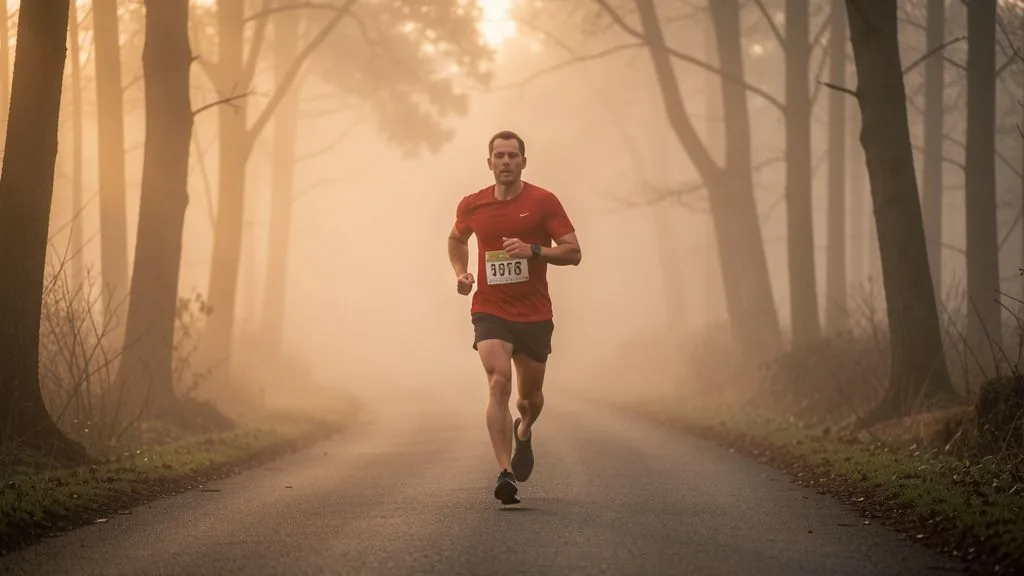
Between October and March, a large share of your runs happen in the dark — and there, equipment does not decide seconds, it decides stopping distances. Two numbers make the difference clear: a driver on dipped beam spots dark clothing at just 20 to 30 metres, but retroreflective material at up to 150 metres. At 50 km/h a car covers almost 14 metres per second, so the gap between 30 and 150 metres is the gap between a full stop and a collision. This guide explains which numbers on the packaging actually matter, where each light source belongs, and how to build a setup for under 100 euros.
Why visibility is a safety issue, not a comfort one
The arithmetic is brutally simple. A car at 50 km/h needs roughly 27 metres to stop — about 12 metres of reaction distance plus 15 metres of braking. If you are only recognised at 25 metres, there is no time left. At 100 km/h on a country road the stopping distance is 90 to 110 metres, and that is exactly where many after-work loops run on roads without a footpath. Relying on bright clothing means betting on a property that does almost nothing at night: fluorescent yellow works by reflecting ambient light, which is fine at dusk but close to useless in true darkness. At night, only two things count — material that throws light back, and light that shines itself.
There is a second factor that is often overlooked: you do not just need to be seen, you need to see. A pothole, a root, a dropped kerb — under a weak lamp you cannot judge depth, because contrast and shadow are missing. That is precisely why a sensible setup always has two halves: active light for the path and passive reflection for everyone else.
Lumens, lux and beam distance: the three numbers that count
Lumens (lm) is the total amount of light a lamp emits. Manufacturers advertise almost nothing else, because big numbers sell. Lux (lx) describes illuminance on a surface — one lumen falling on one square metre equals one lux. And that is where it gets interesting: a 400-lumen lamp focused into a narrow cone can deliver more lux at ten metres than an 800-lumen model with a wide flood. For runners, focus matters as much as raw output.
As practical orientation: 200 to 400 lumens are enough on familiar routes — roads, cycle paths and your regular loop, where you mainly need markers rather than detail. 400 to 700 lumens is the right class for unknown terrain, trails, wet conditions or snow, because uneven ground only appears as shadow at that level. Anything beyond is mountain-bike or night-orienteering territory — expensive, heavy and usually counterproductive for runners, since the turbo mode often drains the battery within 90 minutes.
The third number is beam distance (metres, measured to the ANSI/PLATO standard at the point where only 0.25 lux remains). A practical value for running is 40 to 80 metres. Anything under 30 metres is too little to react in time at 12 km/h — at that pace you cover 3.3 metres per second, and an obstacle 20 metres away is reached in six seconds.
Headlamp, chest lamp, handheld: where the light belongs
The headlamp is the default because it lights wherever you look. On rolling ground and steep climbs that is a real advantage: raise your gaze and the beam follows. The downside is the shallow angle — light sits almost at eye level, casts few shadows and makes undulations look flat and low-contrast. This is where the chest lamp scores: it sits steadier (no head bob with every stride), casts longer shadows thanks to the lower angle, and makes roots and holes far easier to read. Anyone running trails regularly is best served by the combination of head and chest lamp — two sources from different angles create the depth perception a single emitter cannot provide.
The handheld light is the underrated third option. It is cheap, flexible and can be dipped instantly when oncoming traffic appears — exactly the situation where a 600-lumen headlamp dazzles others and becomes a safety risk itself. For commuters on mixed paths, a small handheld on the waist or in hand is often the most pragmatic solution.
Reflection beats neon: what retroreflective material delivers
Retroreflection is a physical trick: glass microbeads or prisms inside the material send incoming light straight back to its source. A headlight pointing at you sees its own light returned — which is why reflectors glow so brightly in the dark despite having no power source. The relevant standard is EN ISO 20471 (formerly EN 471), with three classes: class 1 for low risk, class 2 for most road works, class 3 for motorways and high-speed night work. For runners, class 2 is the sensible benchmark — vests and straps in this class carry at least 0.50 m² of reflective material combined with fluorescent background fabric.
The distinction between fluorescence and retroreflection matters: fluorescent dyes convert UV light into visible light and are strong at dusk and in rain, but worthless in complete darkness. Retroreflection only works when light hits it — but then it works out to 150 metres. Which means: neon without reflective strips is a fashion statement, not safety equipment. Check at the point of sale whether the material is described as retroreflective or carries a reflection class; coloured fabric alone is not enough.
The most effective placement follows movement: feet and ankles, because they move and the human eye detects motion instantly; hands, because they swing as you run; torso as the large surface. Ankle bands cost under ten euros and deliver more visibility per euro than any other item — provided you are not running exclusively on unlit paths where nobody points a headlight at you.
The three-tier setup: 40, 80 and 150 euros
You do not need professional gear, but you do need an order of priority. On a tight budget, invest in passive visibility first — it costs little and counters the most common hazard, traffic approaching from behind.
- Tier 1, around 40 euros: reflectors and vest. A high-vis vest or reflective strap to EN ISO 20471 class 2, plus ankle or wrist bands. That makes you detectable at 100 to 150 metres as a vehicle approaches — no battery, no charge state, no failure mode.
- Tier 2, around 80 euros: add a lamp. A headlamp with 300 to 400 lumens, 40 metres of beam distance and USB-C charging. Look for a red rear light on the back of the head or the vest — the blind spot from behind is the most dangerous one, and steady red plus a flash mode is picked up at greater distance than white light.
- Tier 3, around 150 euros: the trail system. A 500 to 600 lumen headlamp plus a chest or waist lamp, two batteries or a power bank, and a vest with reflective strips. This is the kit for runs of an hour or more on unlit paths and anything heading towards winter trail or night ultra.
One point no datasheet mentions: flashing beats steady light on the road, but not in fog or rain, where it degrades contour recognition. And a red rear light belongs at the back, not the front — sounds trivial, yet it is the most common mounting mistake.
Batteries, cold and the 20 percent rule
Lithium-ion cells lose noticeable capacity at low temperatures — typically 20 to 30 percent at zero degrees, considerably more at minus ten. A lamp that runs four hours in medium mode in summer often manages only two and a half in January. So: charge after every session, not when the beam starts to dim, and carry the lamp under your jacket or in an inside pocket at the start so the battery begins warm. A spare cell costs 15 to 25 euros and is the cheapest insurance against an unlit walk home.
On charging: USB-C at 10 watts or more cuts charge time significantly; older micro-USB models need two to three hours longer for the same cell. And check water resistance to IPX4 — splash protection handles rain from above, while IPX6 or IPX7 is the more robust choice in heavy rain and slush.
Visibility in traffic: the rules that actually protect you
Equipment is half the job; behaviour is the other half. The most important rule concerns which side of the road you use: run facing oncoming traffic, so you can see approaching vehicles, step aside and make eye contact. On cycle paths and in blind bends where that is impossible, run on the right, move onto the footpath before corners and wait briefly at obscured spots. At junctions and driveways, never assume you have been seen: seek eye contact with the driver before crossing.
Music and headphones are the second issue. One earbud is permitted in Austria and Germany, both are not — and in the dark, hearing accounts for half your situational awareness. If you will not run without music, use transparency mode or only one bud on the inside of the curve. Also underestimated: dark stretches between two streetlights. That is exactly where things get dicey, because the driver comes out of a bright area and their eyes have not yet adapted.
Five mistakes that cost money and safety
- Relying on neon alone. Fluorescent yellow without reflective strips is good at dusk and nearly invisible in true darkness. Without retroreflective material, the part that matters is missing.
- Confusing lumens with visibility. An 800-lumen lamp does not make you more visible to a driver approaching from behind — it only dazzles them. Active light for the path, reflection for the others.
- Forgetting the rear light. Most runners think of the headlamp and nothing else. Seen from behind, you are then a dark silhouette with a bright dot in the distance.
- Ignoring the battery. Cold costs 20 to 30 percent of capacity, and few lamps report charge level precisely. A spare cell or a small second lamp is cheaper than an unlit way home.
- Checking gear only in autumn. Anyone discovering in October that the vest is torn and the lamp dead runs the first dark week unprotected. Check both on the first dusk run in September.
Lighting and training: what the dark season does to your plan
Visibility is one side — the other is that the dark season structurally changes your training. Shorter days, slippery paths and lower temperatures push some sessions indoors or onto the treadmill, and that is exactly where the typical mistakes arise: too many hard sessions in a short window, because the easy long runs fall away. Anyone neglecting base work in November pays for it in spring.
A fixed weekly structure with two dark and two light sessions has proven itself in practice: quality work at the weekend or at lunchtime, easy runs on the dark evenings — with vest, lamp and a familiar loop. For pacing in the dark, heart rate is often more reliable than feel, because without a clear view of the path you instinctively slow down. How to set the zones correctly is covered in the article on heart rate zones; anyone steering intensity by sensation instead will find the scale in RPE training.
One last planning point: recovery after a night run is often worse, because core temperature drops later and sleep ends up shorter. If you regularly run at 8 pm, schedule hard sessions earlier where possible and keep the easy evening runs short. More on that in sleep and endurance performance.
How Peakora plans your training through the dark season
Peakora knows your available hours and arranges sessions so that quality and daylight line up: hard stimuli when you can run in the light, easy kilometres in the dark hours. The plan also accounts for the fact that winter volume often falls short of what was intended, distributing load through TSS, CTL and ATL instead of pressuring you over missed sessions. For anything building towards a race in winter, the 16-week marathon plan provides the structural framework.
Frequently asked questions about running lights and visibility
How many lumens do I need for running in the dark?
For familiar roads and paths, 200 to 400 lumens are enough. On unknown trail terrain, in wet conditions or snow, 400 to 600 lumens make sense because uneven ground only becomes visible as shadows at that output. More lumens cost battery life and weight.
Do reflectors let me see without my own light?
No — reflectors make you visible, not seeing. They bounce headlight beams back and are detectable up to about 150 metres, while dark clothing only shows up at 20 to 30 metres. They do not light the path ahead; that requires active light.
Headlamp or chest lamp — which is better?
A headlamp points wherever you look and wins on steep sections. A chest lamp sits steadier, throws long shadows and reveals uneven ground better because the light source is near eye level. On the road a headlamp is enough; on trails the combination is ideal.
Is a high-visibility vest mandatory when running?
Austria and Germany impose no vest or helmet requirement on runners. Visibility is only prescribed where road traffic law demands it for vehicles. Even so, a vest certified to EN ISO 20471 is the single most effective measure you can take.
How often should I charge the lamp battery?
Charge after every session in the highest mode, because lithium-ion cells lose 20 to 30 percent of capacity in the cold. A second, light battery or a small backup lamp costs little and prevents you from standing in the dark without light.
Run visible — and train properly
Peakora builds your training plan for marathon, triathlon or gran fondo, adapts it to your form every week and places hard sessions where you have daylight. Start for free, no credit card required.
Start for free