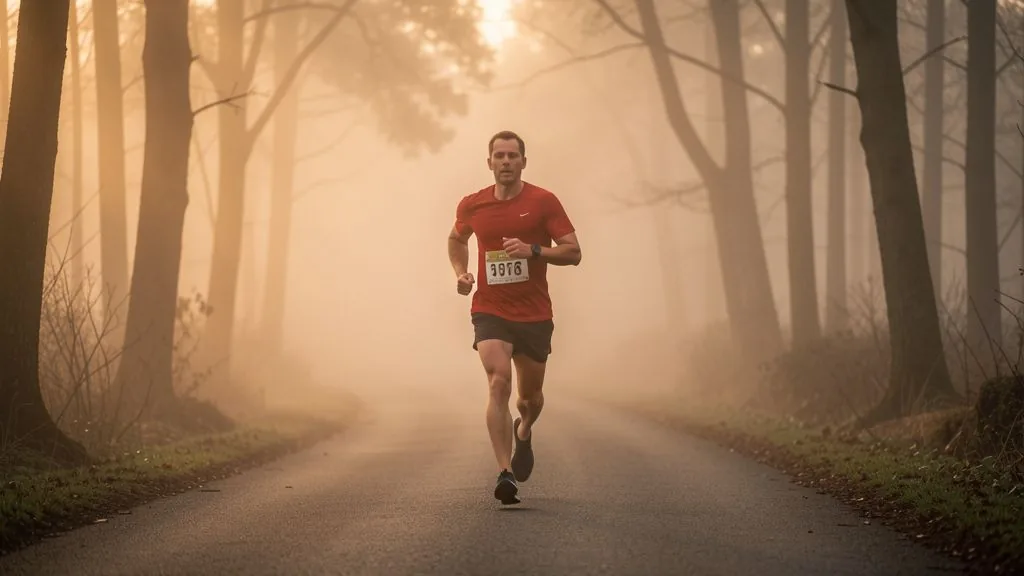
Few topics divide the running world as reliably as whether the treadmill "counts". Some see it as a stopgap for bad weather, others run their intervals indoors all winter. Both camps are right — and both miss the same point: the treadmill and the outdoors are not competitors but tools with different strengths. Knowing where each one wins keeps your training plan stable all year round.
Why the treadmill feels easier
The difference starts with physics. Outdoors you also have to overcome air resistance, and it grows with the square of your speed. At an easy training pace of 10 km/h the effect is barely measurable, but at 14 to 16 km/h it already accounts for roughly 2 to 4 percent of your power output. On the belt the air stands still, that resistance disappears — and the same displayed pace feels noticeably easier.
Then there is the surface. A treadmill is even, almost perfectly cushioned and gives back identically in every stride phase. Outdoors, asphalt, gravel, forest floor and kerbs change constantly, the terrain tilts up and down, and your foot has to find new stability with every step. That costs energy — and makes endurance sport exactly what it is.
The one percent incline rule
From this missing air resistance comes the best-known rule of indoor running: set the belt to at least a one percent incline to mimic outdoor conditions. For the 10 to 14 km/h range that is a solid approximation. At higher speeds air resistance rises disproportionately, where 1.5 to 2 percent is more realistic. If you are only jogging slowly, you can skip the incline — the effect is practically zero.
More important than the exact percentage is another point: the incline on the belt changes not only the resistance but also the muscle work. One percent is enough to challenge the calves and Achilles tendon again — precisely the structures that are underworked on flat treadmill running.
What the outdoors does better
Outdoor runs train things no treadmill simulates. That includes running economy and technique on varied surfaces, downhill running with its eccentric loading (the muscles brake instead of accelerating), stair and hill training, and heat adaptation when you run at 25 degrees in summer. Mental toughness also develops outdoors: wind, rain, climbs and tired legs in the closing kilometres cannot be compared to an even belt mat.
For sessions that shape the specific race form of your legs, the long run outdoors therefore remains the gold standard. Long run training demands time on your feet under realistic conditions — exactly where you train what decides the final ten kilometres on race day.
What the treadmill does better
- Weather independence: In black ice, darkness, heavy rain or a heatwave the belt reliably delivers the planned session. No lost training stimulus, no rescheduling.
- Precise control: Pace, incline and recoveries are set to the second. For interval work that is a real advantage, because you do not have to judge by feel — the belt sets the pace.
- Gentle on the body: The even cushioning reduces impact load on knees, hips and Achilles tendon. That makes it a good entry point when returning from injury — as covered in injury prevention.
- Safe environment: No traffic, no uneven ground, no roots. For tempo runs in the dark or in poor visibility, the belt is often the more sensible choice.
- Controlled intensity: Especially on hard sessions, the fixed setting helps you resist the urge to run "by feel" even faster — a proven route to overload.
The most common treadmill mistakes
- Too fast, too flat. Without incline and with no air resistance you are effectively training slightly easier than planned — the stimulus is smaller than the display suggests. A one percent incline fixes it.
- Holding on to the handles. Anyone leaning on the handrail carries less body weight in their legs and runs a different movement than outdoors. Run without support, even if it is harder.
- Short steps for the whole session. On the belt many runners automatically shorten their stride. Consciously aim for a full push-off and a round motion.
- Indoor only. Those who spend winter exclusively on the belt often return in spring with technique, downhill and surface deficits. One or two outdoor runs a week, weather permitting, prevents this.
How to translate treadmill pace to outdoor pace
A common trap runners fall into: transferring belt pace one-to-one to the road. Because air resistance and uneven ground are added outdoors, the same speed feels noticeably harder outside. A practical rule of thumb: with a one percent incline, outdoor pace is roughly equal; running flat, the same display equals about 10 to 15 seconds per kilometre of "free" pace compared to the road. Even more robust than any conversion, though, is steering by heart rate: it is the objective anchor as described in heart rate zones — it tells you whether a session was really as easy or hard as planned, regardless of surface.
Why it is not either-or
The most productive answer to "treadmill or outdoors?" is: both, with a clear division of tasks. Threshold and VO2max intervals with exact pace, recovery sessions in bad weather and runs in the dark are handled reliably and predictably by the belt. Base runs, the long run, uphill and downhill training, technique work and heat adaptation belong outside. This keeps your training plan stable all year — without weather-related gaps and without one-sided loading.
A sample week with belt and road
What the division of tasks looks like in practice is shown by a typical build week in winter. The two quality sessions — say 5 × 1,000 metres at race pace and a 20-minute threshold run — happen on the belt at a one percent incline, because pace there is exactly prescribed. The long run at the weekend takes place outside, in any weather, so your legs stay used to the surface and the duration. One or two easy base runs follow how you feel: on the belt in rain or darkness, otherwise outside. A short uphill block with hills or stairs rounds off the week and delivers the stimulus a flat belt cannot. No session is dropped, yet the specific outdoor load is never lost.
How Peakora handles indoor and outdoor sessions
In the Peakora engine, the surface is secondary: every session is scored by duration and intensity via the Training Stress Score (TSS), which feeds fitness (CTL), fatigue (ATL) and form (TSB). Whether you run your intervals on the belt, the track or in the forest — the plan responds to the actual stimulus, not the location. For marathon preparation with the 16-week marathon training plan that means you can bridge bad weather with belt sessions without breaking the periodization. Because the engine tracks load over weeks, it automatically ensures the specific outdoor stimuli — long runs, downhill runs, race pace — are not pushed out by too many indoor sessions.
Frequently asked questions
Is running on a treadmill easier than running outdoors?
Yes, slightly. Outdoors you also overcome air resistance, which is absent on the belt. At 12 to 14 km/h that equals roughly 2 to 4 percent of your power output. A one percent incline cancels out this difference.
Is a one percent incline enough to compensate?
For most runners at 10 to 14 km/h, yes. At higher speeds air resistance rises disproportionately, so 1.5 to 2 percent is more realistic. When jogging slowly the effect is practically zero.
Does a treadmill session count as much as an outdoor run?
For training load, yes — duration and intensity matter, not the surface. Load depends on pace, heart rate and time. Outdoor runs add technique and downhill stimuli that the belt cannot replace.
Can I prepare for a marathon on the treadmill?
Yes, but not exclusively. Base and interval work functions fully indoors. For running economy, downhill training, heat adaptation and mental race toughness you need regular outdoor runs.
Why does my pace feel faster on a treadmill?
Because the belt assists the leg movement and air resistance is missing. The same pace therefore feels easier indoors than outdoors. Train by heart rate or effort rather than by the belt display.
Train predictably all year round
Peakora scores indoor and outdoor sessions equally and keeps your periodization stable — whether you take to the belt in the rain or head outside in the sun. Start free, no credit card required.
Start free