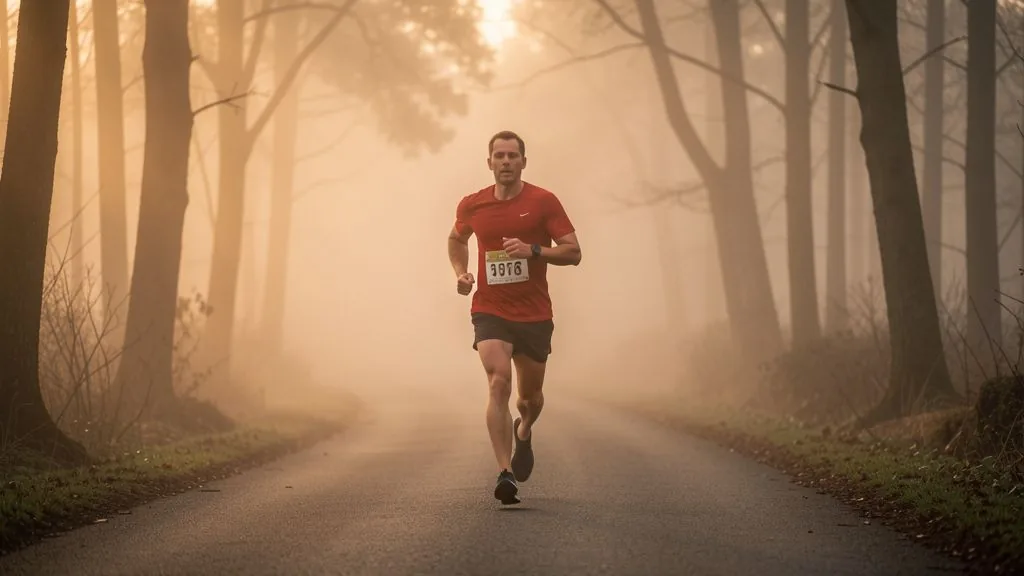
From mid-September we lose around 20 minutes of daylight per week — for anyone with a job, that means a large share of the training week happens in the dark from October to March. That is no reason to flee to the treadmill or write off the season. With the right gear, a smart route choice and a few behavioural rules, running in the dark is just as safe as running by day — and it often has qualities of its own: empty paths, calm air, clear thoughts.
Why darkness really increases the risk
Accident statistics are unambiguous: pedestrians and runners are involved in a disproportionate number of collisions at dusk and at night. The reason is simple physics and perception psychology. A driver using low beams spots a dark-clothed pedestrian at only about 25–30 metres — at 50 km/h that leaves under two seconds of reaction time. Bright clothing improves this to around 60 metres, reflectors to 130–150 metres. That is the difference between an emergency stop and an unremarkable pass.
The second factor concerns you: in the dark you lose the visual frame of reference for pace, footing becomes less secure on uneven ground, and your peripheral perception narrows. You react later to roots, kerbs and potholes — especially in autumn, when wet leaves camouflage uneven surfaces.
Visibility: the 360-degree rule
The single most effective measure costs less than 20 euros: reflectors all around your body. Three principles make the difference:
- All around, not just the front: A reflective stripe on your chest only helps oncoming traffic. Overtaking cars see you from behind, cross traffic from the side — so wear reflectors on all four sides.
- Motion beats area: Reflectors on joints (ankles, wrists, elbows) create a motion pattern that the human eye instantly classifies as a person — so-called biological motion. Studies show that reflectors on moving body parts are recognised significantly earlier than the same area on the torso.
- Neon works by day, reflection works by night: High-vis yellow and neon orange perform superbly at dusk but lose almost all their effect in headlight beams. For full darkness, retroreflection and active light are what count.
A proven combination in practice: a reflective vest or running jacket with 360-degree reflectors, reflective bands on the ankles, and a small red blinking light on your back. Many modern running shoes and jackets come with reflectors built in — check for them specifically when buying.
The headlamp: seeing and being seen
A headlamp serves two purposes when running: it lights your way — and it makes you unmissable to others. Clear guidelines apply when choosing one:
- Brightness: On lit streets, 100–200 lumens is sufficient — there it mainly serves your visibility. On unlit country and forest paths you need 300–400 lumens to spot bumps and obstacles in time. More than 500 lumens rarely makes sense for runners and only costs weight and battery life.
- Weight and fit: Under 100 grams total, otherwise the lamp bounces with your stride. An adjustable elastic strap and a slightly downward-tilted beam (no blinding of oncoming traffic) are essential.
- Battery life: Plan for your longest session plus 50 % reserve. Cold drains battery performance noticeably — in winter the reserve is no luxury.
- Extra rear light: A small red blinking light on the back of the strap or on your vest closes the gap behind you that the headlamp cannot cover.
A practical tip: run the first few minutes deliberately slower until your eyes adapt to the darkness. After about 10–15 minutes you perceive far more contrast — your pace regulates itself almost automatically from there.
Route choice: lit, familiar, populated
In the dark, different criteria apply than by day. The adventurous forest loop with narrow singletracks is the wrong place for experiments from November on. Better options:
- Lit paths first: Streets with streetlights, lit parks and riverside promenades are the first choice. You see the ground, others see you.
- Familiar routes: Run routes you know in daylight — you know where the roots, kerbs and narrow spots are. Explore new routes on the weekend in the light.
- Run against traffic: Where there is no pavement, run on the left side of the road, facing traffic. You see approaching cars and can dodge if needed — instead of relying on the attention of the driver behind you.
- Busy rather than lonely paths: Especially in the evening hours, well-frequented routes are safer — in traffic as well as in the interpersonal sense. Our article on running route planning shows how to plan and store such loops systematically.
- Factor in the weather: Fog and rain worsen visibility further and make road surfaces slippery. On such evenings the lit city loop beats the country lane — or the interval session moves to the treadmill.
Seven behavioural rules for the dark season
- 1. Headphones off or at a minimum. Your hearing is your early-warning system: you hear cars, cyclists and e-scooters long before you see them. If you want music, use bone-conduction headphones or a single earbud at low volume.
- 2. Never surprise anyone. At crossings, driveways and zebra crossings: seek eye contact or stop. Knowing the right-of-way rule does not help you if the driver simply did not see you.
- 3. Adapt pace to the ground. On unlit paths, run deliberately 10–20 seconds per kilometre slower. The dark autumn and winter months are base-training time anyway — hard tempo runs belong on a lit track or in daylight.
- 4. Let someone know where you are. A quick message to your partner or flatmate with your route and expected duration — or live tracking via your sports watch. Modern GPS running watches offer emergency features with fall detection.
- 5. Take your phone and keys. The phone is a torch, a telephone and a navigation device in one. Carry it close to your body in the cold so the battery does not collapse.
- 6. Expect others who cannot see you. Cyclists without lights, dogs on retractable leads, pedestrians in black — in the dark you are not the only one who is hard to see. Raise your own attention instead of relying on your visibility.
- 7. Do not dodge in panic. If an oncoming car dazzles you: ease off, look at the right edge of the path, stop if necessary. Never jump sideways spontaneously — the edge is exactly the area you cannot survey.
Morning or evening runs — which is safer?
Both slots have their own profile in the dark season. In the early morning, traffic is thinner, the air calmer, and you have the session done before the day interferes. On the other hand, autumn mornings more often mean wet or frosty ground, and your body needs a longer warm-up. In the evening you are physically more alert and pavements are often cleared of leaves — but there is rush-hour traffic, and the day's fatigue lowers your attention. Our comparison of morning vs. evening training covers the physiological differences in detail. In terms of safety: the best slot is the one you stick to reliably — consistency beats optimisation.
Common mistakes
- Dark functional clothing without reflectors. The black running jacket looks classy in the shop and makes you practically invisible at night. Buy functional clothing for the dark season specifically with reflective panels.
- Lighting only to the front. Headlamp yes, but nothing to the rear — for overtaking cars you are invisible. Add a red blinking light on your back.
- Testing a new trail route in the dark. Unknown terrain plus poor visibility is the classic fall combination. New paths belong in daylight.
- Keeping your summer pace. If you still run your August pace on dark, slippery paths in October, you risk falls and strains. Adapting pace to visibility and ground is not weakness but training intelligence.
- Trusting the battery. Check headlamp and phone before every evening session — an empty lamp five kilometres from home is more than an annoyance.
How Peakora plans your training in the dark season
The dark months are not swept under the carpet at Peakora: the engine structures the autumn and winter weeks as base training — easy Zone 2 sessions that pair perfectly with the slower pace on dark paths. When you plan your sessions in the app, you see your weekly structure at a glance and can deliberately move hard quality sessions to daylight hours on the weekend while the easy runs stay on weekdays. And because the recovery monitor tracks sleep and load, you notice early when the low-light season is wearing on your recovery — terms like Zone 2 or supercompensation are explained in the training glossary (German).
Frequently asked questions about running in the dark
Is running in the dark dangerous?
Not inherently — but the risk rises measurably because pedestrians and runners are seen much later in the dark. With reflective clothing all around, a headlamp and a lit or low-traffic route, the accident risk drops close to daytime levels.
Which headlamp do I need for running?
For lit streets, 100–200 lumens is enough; on unlit paths and trails you want 300–400 lumens. More important than maximum lumens are low weight (under 100 g), a stable fit without bouncing, and battery life that covers your longest session with 50 % reserve.
Can I run with headphones in the dark?
Better not. At night, your hearing replaces a large part of the missing vision — you hear cars, cyclists and other people before you see them. If you need music, use bone-conduction headphones or a single earbud at low volume.
What should I wear for running in the dark?
Bright, neon clothing plus reflectors on all sides — moving reflectors on arms and legs work best because drivers recognise motion as a human. A vest with 360-degree reflectors is the single most effective measure; plain dark sports clothing makes you nearly invisible.
Plan your winter training with Peakora
Base training that fits your season — with adaptive planning and a recovery monitor. Start free, no credit card required.
Start for free