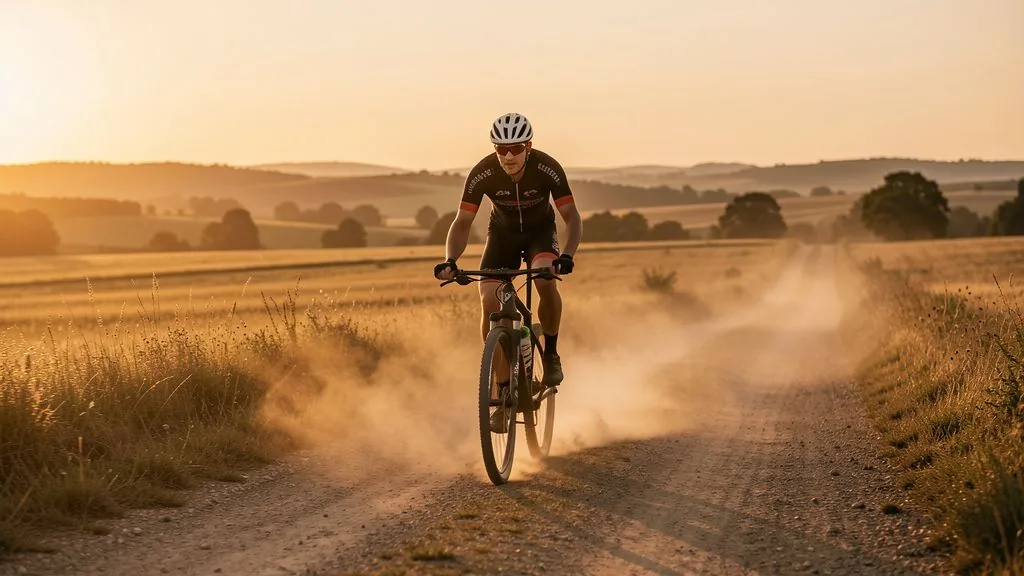
You optimize your training plan, your nutrition and your gear — but the most powerful adaptation happens while you do nothing at all: during sleep. No workout in the world makes you faster if the body never processes the stimulus, and that processing happens at night. Studies show measurable performance gains from more sleep alone — without a single additional kilometre. Yet chronic sleep restriction is the norm among ambitious athletes, not the exception.
What happens in your body at night
Sleep is not switching off — it is peak activity in the repair shop. During deep sleep, which concentrates in the first half of the night, the body releases the bulk of its daily growth hormone. Growth hormone drives the repair of training-stressed muscle, bone remodelling and the synthesis of new proteins. In short: the adaptation you train for happens here — not out on the road.
The REM phases in the second half of the night do a different job: they process motor learning and stabilize coordination. Technical work in particular — a more economical running style, a more efficient cadence, swim technique — is consolidated during REM sleep. If you systematically sleep too short, you sacrifice the late sleep cycles first — and with them exactly these phases.
Two more night shifts matter: glycogen stores are replenished, and the immune system steps up its defence work. Chronically short sleep lowers immunoglobulin levels and increases susceptibility to upper respiratory infections — in studies, athletes sleeping under 7 hours caught colds considerably more often than those sleeping 8 hours or more. Every infection costs training weeks that no plan, however clever, can win back.
What the research shows
The best-known study comes from Cheri Mah and her team at Stanford University: basketball players extended their sleep to around 10 hours per night over several weeks — and significantly improved sprint times, shooting accuracy and reaction time. Comparable results exist for swimmers and tennis players. The message is unambiguous: more sleep is not just recovery, it is a performance lever with a measurable effect.
The opposite direction is just as reproducible: restricting sleep to 4–6 hours degrades endurance performance, perceived exertion and cognitive decision-making. One detail is especially relevant for athletes: perceived exertion (RPE) rises more under sleep deprivation than objective performance falls — training feels harder than it is, and that undermines session quality and motivation over weeks.
The distinction that matters: a single bad night is almost meaningless. Chronic sleep restriction over weeks is not. It elevates stress hormones like cortisol, disrupts blood sugar metabolism and dilutes every training adaptation — the body effectively trains on half its recovery capacity.
How much sleep do endurance athletes need?
The general recommendation of 7 hours applies to healthy adults without a training load. For endurance athletes training 5–10 hours per week, sports science points to 8–10 hours. During hard build blocks or training camps, more is appropriate — elite athletes regularly sleep over 9 hours there, plus a midday rest.
Practically speaking: what counts is not theoretical time in bed but actual sleep duration. Going to bed at 11 pm but falling asleep at 11:40 and rising at 6 am yields barely 6 hours — a structural deficit. Realistically, 8 hours of sleep require roughly 8.5–9 hours in bed. And a 20–30 minute power nap in the early afternoon is a legitimate tool, especially on double-session days.
7 tips for better sleep
- Fixed times, even on weekends. Your circadian rhythm loves consistency. Alternating between 6 am on weekdays and 9 am on weekends is a mini jet lag that ruins Monday and Tuesday.
- Caffeine cutoff at 2 pm. Caffeine has a half-life of 5–6 hours. The espresso at 4 pm is still a quarter active at 10 pm — enough to cost you deep sleep without you noticing.
- No alcohol as a "sleep aid". Alcohol shortens sleep onset but wrecks sleep architecture: less REM, more awakenings, worse heart rate variability. After a single glass of wine, recovery is measurably poorer.
- Hard training at least 3 hours before bed. Intense sessions push core temperature and sympathetic activation — both enemies of falling asleep. Keep evening sessions easy or move them earlier.
- Cool, dark, quiet. 16–19 °C room temperature is ideal; core temperature must drop to fall asleep. Blackout curtains and, if needed, earplugs beat any sleep app.
- Wind down the screens. Not primarily because of blue light, but because of mental activation: emails, results lists and training data at 10 pm keep the brain awake. The last half hour belongs to a boring ritual.
- Daylight in the morning. 10–15 minutes of daylight right after waking sets your internal clock — the most important anchor for a stable sleep rhythm, and free of charge.
Sleep around race day
Nervousness, an early alarm, an unfamiliar hotel bed: the night before the race is rarely perfect — and that is fine. Research clearly shows that a single short night barely impairs endurance performance. What matters is race week as a whole: sleep a consistent 8 hours or more ("sleep banking"), and the body will easily forgive the restless final night. That is why in tapering sleep is scheduled just as deliberately as the volume reduction.
For races with travel across time zones: plan roughly one day of adjustment per time zone, seek morning light and gradually shift bedtime towards the destination time zone.
Common mistakes
- Treating sleep as negotiable. "Up an hour earlier for the session" sounds disciplined but is often counterproductive: you trade recovery for a half-hearted workout. When choosing between a 5:30 alarm and one more hour of sleep in a tired phase, sleep almost always wins.
- Training hard after bad nights. After a night under 5–6 hours, coordination, load tolerance and immune defence are all impaired — shift the interval session or convert it to an easy one. Exactly this logic is described in the article on recovery in endurance sports.
- "Catching up" only on weekends. Sleeping in smooths fatigue short-term but repairs neither the week's lost adaptation processes nor the disturbed rhythm. Consistency beats rescue operations.
- Blindly trusting the sleep tracker. Wearables measure sleep duration reasonably well, sleep stages only roughly. There is now a term for people who sleep badly because of bad tracker scores: orthosomnia. Your subjective feeling in the morning is the more reliable metric.
- The caffeine loop. Tired → coffee → worse sleep → more tired. The 2 pm cutoff is the only exit from this spiral.
Reading your sleep: resting HR and HRV as an early warning system
You don't have to guess whether sleep is working — your body delivers the data every morning. A resting heart rate sitting 5–10 beats above your normal value for no obvious reason, or a markedly reduced heart rate variability (HRV), are the classic markers of incomplete recovery. Measure your resting pulse in the morning, lying down, before getting up — the same value that sharpens your heart rate zones. If the deviation persists for several days, the signal is clear: volume down, sleep up.
How Peakora integrates sleep into load management
Peakora's recovery monitor treats sleep not as a lifestyle note but as a measured variable in the model: your form score is composed of roughly 65% training load (TSB, based on the Training Stress Score) and roughly 35% of a sleep factor — plus a bonus for genuine recovery breaks. A short night after a hard session therefore pushes the score down visibly more than the session alone would.
The practical consequence: instead of stubbornly executing the plan, you see every morning whether your body can absorb the scheduled session — and the engine re-doses when sleep doesn't cooperate. In this model, training and recovery are not opposites but two halves of the same equation.
Frequently asked questions about sleep and performance
How many hours of sleep do endurance athletes really need?
8 to 10 hours per night — well above the 7 hours generally recommended for adults. The reasons are the elevated recovery demands of training and studies showing measurable performance gains from extending sleep to 9–10 hours.
Does a midday nap help recovery?
Yes. A 20–30 minute power nap in the early afternoon improves alertness, mood and reaction time without disturbing night sleep. During hard training blocks, longer naps of up to 90 minutes — one full sleep cycle including deep sleep — provide additional recovery.
Is a bad night before the race a problem?
No — a single short night barely reduces endurance performance, because race-day arousal and adrenaline compensate. What matters are the nights before: sleep a consistent 8 hours or more during race week. The second-to-last night counts more than the last one.
Can I offset sleep deprivation with caffeine?
Only superficially. Caffeine masks fatigue and improves attention and performance short-term, but it cannot replace sleep processes like growth hormone release or glycogen synthesis. Caffeine after 2 pm also degrades the following night — the deficit grows.
Measure recovery instead of guessing
Peakora's monitor combines training load and sleep into one honest form score — so every session lands at the right time. Start free, no credit card required.
Start for free