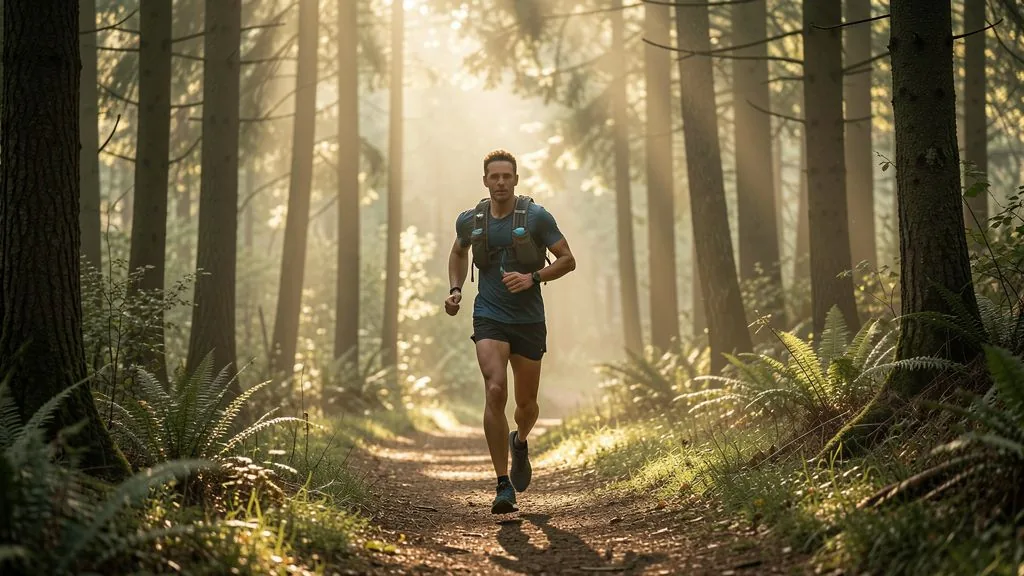
Nobody loses as much time in a trail race as the athlete who insists on running a steep climb. Stride length shrinks to fifty centimetres, cadence climbs, the torso tips forward — and you reach the top with a heart rate of 180 and heavy legs. Power hiking is the alternative: structured, forceful walking with arms, hips and long steps that is faster and far more economical than running beyond a certain gradient. This article shows where the crossover sits, what the technique looks like and how to train both systematically.
Why walking is faster on a steep climb
The energy cost of running rises disproportionately with gradient. On flat ground a kilometre costs about 1.0 kilocalories per kilogram of body weight; at 10 per cent gradient it is already three to four times that, and by roughly 20 per cent the efficiency of running approaches that of walking — with one crucial difference: walking removes the pendulum component of the movement. You no longer lift your centre of mass against gravity, you push it from one leg onto the other.
The metric that matters is oxygen cost per vertical metre. Studies on trained mountain runners show that beyond about 15 to 22 per cent gradient, a brisk walking passage at the same vertical speed consumes less oxygen than a running stride. Anyone who keeps running in that range pays for the same elevation with a 10 to 20 per cent higher metabolic load. On a climb of 800 vertical metres that adds up to several minutes — and to a glycogen cost you will miss later in the race.
The second effect is muscular. Steep running means extreme forefoot loading, heavy calf work and a short, compressed stride pattern. After 30 minutes on a climb that becomes a local fatigue problem in the calf, not a cardiovascular one. Power hiking distributes the work across glutes, hamstrings and trunk, shifting load onto larger, more fatigue-resistant muscle groups. Athletes who walk the climbs arrive at the top with fresh calves — and that is exactly where the next section begins.
The crossover point: when to switch from running to walking
The 15 to 22 per cent range is a guide, not a rule. Your individual crossover depends on strength, climb length, surface and remaining distance. There are three practical criteria that let you find it without a lab test.
- Gradient in per cent: run below 10 per cent, run or walk between 10 and 15 per cent depending on the day, walk above 18 per cent. On technical ground — roots, scree, steps — the point comes earlier.
- Heart rate: if you sit more than 15 beats above your aerobic threshold on a climb and it does not come down within 60 seconds, walk. In a race lasting four hours you cannot afford to run the climbs in the red zone.
- Stride length: the most honest indicator. When your steps get shorter than about two foot lengths and you are tripping along on the forefoot, running costs more than it delivers.
- Remaining distance: early in a race it pays to run longer because the legs are fresh. In the second half, or with more than 600 vertical metres left in the final third, the crossover point moves down.
The decisive rule is a different one: the switch has to be a decision, not a creeping compromise. A forceful, long walking step with active arms is efficient. Half-hearted trotting at a cadence of 190 is the worst of both worlds — more energy than walking, less speed than running. How gradient translates into training control in the first place is covered in our article on hill training for runners.
The technique in five points
Power hiking is not a stroll. It is a discipline with its own technique, and it differs from normal hiking in five respects.
- Upright torso, hips forward: the most common mistake is leaning forward. Tipping the torso forward shifts work onto the lower back and blocks hip extension. Keep the hips under the torso and let your gaze sit 10 to 15 metres ahead.
- Long steps, active push-off: on a steep climb you lengthen the stride until it feels comfortable and drive off the whole foot — not just the toes. Aim for a cadence of 100 to 120 steps per minute, well below your running cadence.
- Active arms: one arm should always be forward. In walking the arm swing replaces the missing leg acceleration: elbows bent, hand at hip height, arms diagonal to the legs. Carrying your hands on your hips or hanging off the poles wastes 5 to 10 per cent of propulsion.
- Roll through the whole foot: on steep steps a shorter, springier step over the ball of the foot makes sense — on a consistent gradient, roll across the entire foot surface. That clearly reduces calf load.
- Rhythmic breathing: two steps in, two steps out; three to two on steep sections. A fixed breathing rhythm stabilises cadence and prevents the typical gasping at the top of a climb.
One detail that is often overlooked: the transitions. When you reach the ridge, do not start running immediately. Stay walking for 20 to 30 seconds, take two deep breaths and then deliberately ease into the first 200 metres. The body needs that short moment to move from walking to running rhythm without dropping into an oxygen debt.
How to train power hiking
The ability to walk steep ground fast is trainable like any other endurance quality — it just needs a specific stimulus. Three building blocks cover it.
First: vertical volume. Anyone who spends 60 to 90 minutes in hilly terrain once a week, consistently walking every climb, develops the technique almost by itself. What matters is that you actually apply pressure while walking: the target is a pace at which you could talk, but no longer in full sentences.
Second: strength endurance for the hips. The limiting factor on a climb is rarely aerobic capacity but the strength endurance of glutes and hamstrings. Lunges, step-ups onto a 40-centimetre box and single-leg deadlifts for 8 to 12 repetitions build exactly what you need while walking. Details on exercise selection are in our article on strength training for runners.
Third: the treadmill as a substitute. Without mountains within reach it also works indoors: 12 to 15 per cent incline at 6 to 7 km/h in sets of 4 to 6 minutes with 90 seconds recovery. That is the most specific session you can replicate on a treadmill — with the side effect that it demands considerably more from the calves than flat running.
For ultramarathons and mountain marathons, the share of walking in training should match the share in your target race. Anyone planning a 50-kilometre trail with 2,500 vertical metres will spend roughly 30 to 40 per cent of race time walking. If you have never trained that, you pay for it in the second half. How such blocks fit into a larger build is described in our article on mountain marathon preparation.
Trekking poles: when they help and when they don't
Poles are a tool in trail racing, not a matter of belief. The benefit is measurable: walking with poles reduces muscular load on the legs by roughly 10 to 15 per cent because part of the propulsion work comes through shoulder and trunk. At the same time heart rate rises by three to five beats at the same pace, because the upper body does more work. On long climbs of more than 500 vertical metres, or in the final third of an ultramarathon, that is a good trade.
Poles make less sense in technical passages where you need your hands for support or balance — steep descents with scree or roots, rock slabs and scrambling sections. On flat running they cost more than they give, because you have to carry them. Anyone regularly out with poles will find the equipment details in our article on trail running gear and the handling in running poles for trail running.
Fuelling and pacing on the climb
Power hiking is the moment in a race when you can eat and drink. While running uphill, gastric emptying is suppressed; while walking it normalises within two to three minutes. Athletes who use the climbs as fuelling windows come through long races with a far better energy balance: one gel or half a bar per 20 to 30 minutes of walking, plus 150 to 250 millilitres of fluid.
For pacing, one simple rule applies: do not go above aerobic threshold on a climb. The most common racing mistake in trail running is a first climb that is too fast — the legs feel fresh, the gradient is short, and at the top you carry a heart rate that takes 20 minutes to bring down. Anyone who starts the first third 10 to 15 seconds per kilometre slower than planned usually finishes considerably faster. The system behind this is in our article on marathon pacing strategy — on a climb it works in vertical metres per hour rather than minutes per kilometre.
Concretely: convert your target time into vertical speed. A good trail runner climbs at 600 to 900 vertical metres per hour in a race, and 400 to 600 on steep ground. If you need more than 1.5 hours for a 1,200-metre climb, you either started too hard or your walking technique is not yet developed.
The five most common mistakes
- Switching too late. Anyone who only starts walking when the legs burn has already run the climb too hard. The switch belongs at the start of the steep section.
- Half measures. Tripping along with short steps is less efficient than either option. Either run with normal technique or walk with pressure.
- No arm swing. The most frequent technical error. Without arms the impulse is missing, cadence drops and steps get short.
- Not training the walk. Anyone who runs every climb in training and walks in the race has never practised the movement. Strength endurance and technique need repetitions.
- Full gas right after the climb. The transition back to running takes 20 to 30 seconds. Explode at the top and you pay for it over the next two kilometres.
How Peakora accounts for climbs in your plan
A trail plan that only counts kilometres plans past the target: 15 kilometres with 800 vertical metres is a completely different session from 15 flat kilometres. Peakora converts elevation through Grade Adjusted Pace into an equivalent flat pace and weights steep climbs more heavily than gentle rollers — so hill runs land in the load model (TSS, CTL, TSB) where they belong, rather than being logged as an easy aerobic run. The same logic drives where walking passages appear in the plan: in the base phase as a technique block, in the specific phase as part of the long runs.
Anyone wanting to go deeper will find the system in our marathon training guide and the definitions in the Peakora glossary.
Frequently asked questions about power hiking
At what gradient is walking faster than running?
For most trail runners the crossover sits between 15 and 22 per cent gradient. Beyond that point, running costs so much energy per vertical metre that power hiking at the same or higher speed uses less oxygen.
Is power hiking allowed in a race?
Yes. Trail and ultramarathon rules do not forbid walking as long as you cover the course on foot. In skyrunning and mountain marathons even the winners walk the steep sections. Only technical assistance such as cable cars or vehicles is prohibited.
Do I need trekking poles for power hiking?
Not strictly, but they help on long climbs of more than 500 vertical metres. Poles take about 10 to 15 per cent of the propulsion work off the legs and lower heart rate by three to five beats at the same pace.
How do I train power hiking without mountains?
With stair running, treadmill climbs at 12 to 15 per cent incline and single-leg strength work. What matters is the specific stimulus: long sets at walking pace on a steep gradient, not sprints.
Why am I slower than others when walking uphill?
Usually it is a lack of strength in glutes and calves, or inefficient technique: steps too short, no arm drive, torso too upright. Controlling step length through cadence and using the arms actively gains two to four minutes per climb.
A trail plan built on vertical metres, not just kilometres
Peakora folds climbs into training load via Grade Adjusted Pace and shows you where walking passages belong in your plan. Start free, no credit card required.
Start free