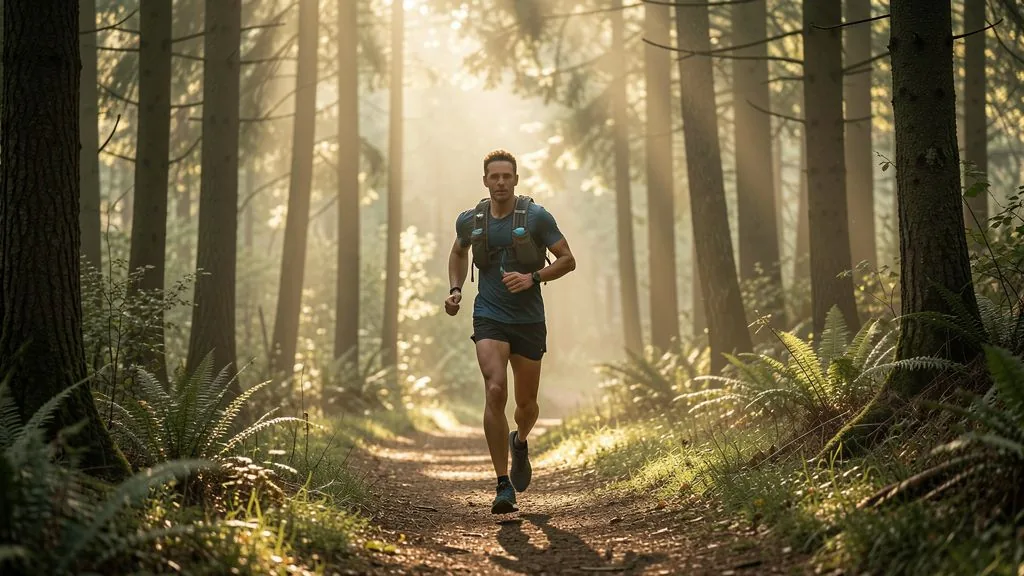
Trail running is the sport with the biggest gear temptation. Search for it once and you will find vests for 180 euros, poles for 200, shoes for 220 and clothing you will probably never need. The truth: for 90 percent of all trails you need a fraction of that. This article separates what actually makes you capable, safe and faster from what simply costs money.
Shoes: the one piece of gear that truly matters
If you make only one investment, make it here. A trail shoe differs from a road shoe in three ways: outsole, sole and protection. The deep lug pattern (usually 4 to 6 millimetres) grips on soft ground, mud and gravel. The sole is stiffer so sharp stones do not push through the foot. And a rock plate protects toes and forefoot from impacts.
- Lug depth: 4–5 mm is a good all-rounder for forest paths, grass and moderate gravel. 6 mm and more only pays off on permanently soft or muddy ground — on asphalt and hard rock those lugs actually slide.
- Heel cup and protection: A firm heel cup stabilises on uneven ground, a toe cap prevents black toenails from root contact.
- Fit: Half a size bigger than your road shoe, because the foot slides forward on descents. Otherwise your toes jam into the cap.
The important distinction: pure trail shoes are slow and wear out fast on long asphalt stretches. If 80 percent of your running is on forest roads and field paths, you are often better off with a light, sturdy road shoe. For the general buying criteria, see Buying running shoes: 8 criteria.
Hydration vest: a must beyond 90 minutes, optional below
A vest is not a status symbol but logistics. On long trails water points are rare, and unlike on the road you cannot pop into a shop after half an hour. The vest distributes weight across chest and shoulders, sits close to the body and does not bounce — unlike a backpack, which chafes and upsets your balance.
- Capacity: 5 to 8 litres of volume is enough for day trips. You only need more for multi-day tours.
- Bladder or soft flasks: Soft flasks in the front pockets are practical because you can refill them on the move and see the level. A bladder is more comfortable on long, steady routes.
- Water needs: Expect 400 to 600 millilitres per hour at moderate effort, considerably more in the heat. On long trails without water, plan on replacing around 500 millilitres per hour.
For short trails under 90 minutes a handheld bottle or belt is enough. If you are unsure whether you need electrolytes, see Electrolytes for running.
Clothing: layers instead of single wonder fabrics
On the trail the temperature swings more than on the road: climbs heat you up, descents and summits cool you down, and a weather change in the forest can arrive within minutes. The principle is therefore layering — several thin layers instead of one thick one.
- Base layer: Close-fitting technical fabric that moves sweat outward. Cotton is out — it traps moisture and chills you.
- Mid layer: A thin long-sleeve or a light vest for cool sections.
- Rain jacket: Mandatory at most trail races. The criterion is not just waterproofing but breathability — a jacket you sweat in is useless.
- Accessories: Hat or buff, thin gloves and a small emergency kit (foil blanket, first-aid kit) weigh almost nothing and save you in a worst case.
A reliable rule of thumb: dress for ten degrees warmer than it is when you start. After five minutes of running you are warm — and the excess clothing you are then wearing becomes wet and cold.
Poles: useful uphill, dead weight on the flat
Trekking poles in trail running are controversial, but the evidence is clear: on steep, long climbs and long mountain runs they measurably unload the quads and knees and can save real energy by the end of a mountain marathon. On short, flat trails they only cost time and weight, because you have to swing them with every step.
- Worthwhile: mountain runs with over 2,000 metres of climbing, long trail ultras, steep technical ascents.
- Not worthwhile: flat forest paths, short runs, technical trails with rock and scree where you need your hands free.
- Important: Practise using the poles in training. A badly planted pole disrupts your rhythm and costs more than it gives.
Ultralight vest, gels, glasses: what else matters
- Cap or trail hat: Protects from the sun and keeps sweat out of your eyes. Less important under trees, essential at altitude.
- Sunglasses: Not just comfort — on glaciers and at altitude they protect the eye from UV radiation.
- Energy: For runs over two hours, bring gels or bars. Whatever you use on the trail you have tested in training — never try something new on race day. Details in Energy gels for running.
- Trail compression calves: On technical trails these can support the calf and cushion stone impacts — a nice-to-have, not a must.
Uphill, downhill: gear and technique belong together
Even the best gear does not compensate for technique. Uphill there is no pushing — you walk or run with a small step, keep your torso upright and use your arms. Downhill, a shorter, quicker step with active braking from the legs is more economical than long, braking landings on a straight leg, which loads the knees.
A frequently underestimated point: gear you are not used to is a risk in a race. A new shoe, an unfamiliar vest or poles used for the first time can make the difference between safe and injured in split-second decisions. A test run before the race is therefore a basic rule. For how to build hills systematically into your training, see Hill training for runners.
Mandatory race gear: the rules are binding
In a trail race there are lists that do not care about your personal opinion. Most races require mandatory gear — it differs significantly depending on length and elevation profile. Typical items are:
- Rain jacket with hood (often with waterproofing and breathability ratings in mm/g, e.g. 10,000 mm)
- Drinking vessels and a minimum amount of water (often 0.5 to 1 litre)
- First-aid kit, foil blanket, whistle
- Emergency phone number and sometimes a mobile phone or GPS tracker
- Cup for water points, because disposable cups are banned
Check the rules before you enter, not the night before. Train at least once with exactly that gear so you know how it fits and how much it weighs. What depends on the race is set by the organiser; for general race-day gear, see Race-day gear for running.
Common mistakes when buying trail gear
- Buying too much too soon: You do not need a full setup for your first trail. Start with good shoes and a handheld bottle, then expand as needed.
- Saving in the wrong place: Saving on the shoe while overspending on accessories is the classic mistake. The shoe decides injury risk and performance; the accessories do not.
- Buying the vest too big: An oversized vest bounces, chafes and shifts weight. Trying it on with filled flasks is a must.
- Ignoring technique: Poles, descents and gear have to be seen together — train them in combination, not separately.
How Peakora accounts for trail gear in training
Peakora does not plan trail sessions as a "road run on different ground". Elevation, technical surface and the extra weight of gear all feed into the load calculation — a trail with 800 metres of climbing is not the same as ten flat kilometres. Because the engine computes training stress (TSS) from volume, intensity and climbing, you can see how much a mountain run taxes your form, and recovery planning adapts automatically. Terms like TSS, CTL and TSB are explained in the training glossary.
Frequently asked questions about trail running gear
Do I need different shoes for trail running than for the road?
Yes. Trail shoes have a deep lug profile for grip on soft ground, a firmer sole and often a rock plate. Road shoes slip on roots and gravel and the foot rolls more easily. On easy forest roads a sturdy road shoe is often enough.
How much water should I carry on a trail?
A rule of thumb is 400 to 600 millilitres per hour at moderate effort, more in the heat. On long trails without water points, expect to replace around 500 millilitres per hour. Vests holding 1 to 2 litres make sense for runs over 90 minutes.
Are trekking poles worth it for trail running?
Yes, for steep long climbs and long mountain runs. Poles measurably unload legs and knees and can save real energy uphill. On short, flat trails they just cost time and weight. Practise using them in training first.
What is mandatory gear at a trail race?
Usually a rain jacket, drinking vessels, a minimum amount of water, an emergency phone number, a first-aid kit, a foil blanket and often a whistle. Every race sets its own list in the rules. Check it before you enter and train with exactly that gear beforehand.
Train for trails, not for the road
Peakora factors elevation, surface and load into your plan and steers recovery accordingly. Start free, no credit card required.
Start free