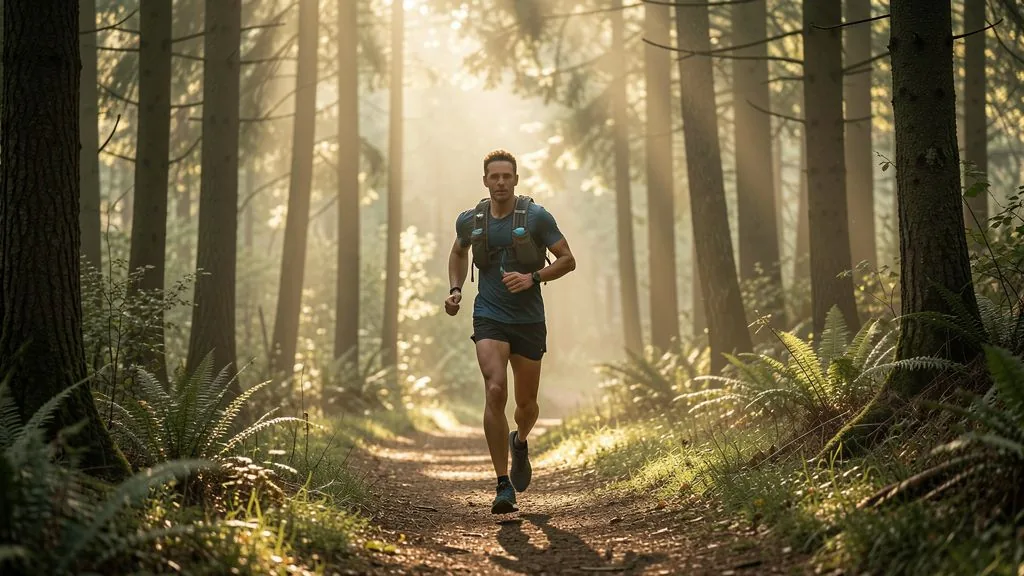
Trail running is the fastest way to escape the asphalt routine: softer ground, vertical metres instead of traffic lights, nature instead of noise. And it makes you a better runner — the changing surface trains stabilisers and coordination that road running leaves untouched. This guide shows you how to start safely as a beginner: from gear and technique to training structure with concrete numbers.
Why trail running improves your running fitness
Three effects make trails a training booster. First: the soft, uneven ground forces foot, ankle and hip stabilisers into constant micro-corrections — strength and coordination work that happens as a by-product. Second: elevation is intensity without speed pressure. Climbing in heart rate zone 2 (running or hiking) builds aerobic capacity without pounding your legs on asphalt. Third: the slower kilometre times take the ego out of the equation — on trails, effort counts, not pace. Exactly the mindset that makes the difference in base training too.
Then there is the head: research on “green exercise” shows that training in natural environments lowers perceived stress more than the same workload in urban settings. Recovery, in other words, starts during the session.
Gear: what you actually need (and what you don't)
- Shoes: For starting out on forest roads and wide hiking paths, your regular running shoes are enough. Only when it gets rooty, muddy or rocky do trail shoes pay off: 3–5 mm lugs, reinforced upper, toe protection. The fit rules from our guide to buying running shoes apply here too — a thumb's width in front of the toes, because feet lengthen on descents.
- Hydration: From 60 minutes of trail time, carry a bladder or soft flasks (0.5–1 l). Water sources in the backcountry are not a planning basis.
- Safety: A phone with a charged offline map, plus a light windbreaker — in the backcountry you may be 30 minutes from the nearest road.
- Skip for now: Poles, gaiters, a GPS watch with elevation profiles, specialist clothing. All useful, none of it necessary for your first ten trails.
Technique off-road: four adjustments
Trail running is running with different technique — the good news: four changes are enough to get started.
- Shorter strides, higher cadence: Long strides on uneven ground are an invitation to fall. Shorten your stride by about 10 % and raise your step rate towards 170–180 per minute. You land under your centre of mass more often instead of in front of it — buying reaction time over roots and rocks. More background in our article on running cadence.
- Gaze: Don't stare at your feet — look 3–5 metres ahead. Your brain processes the terrain as it approaches better than you think; runners who stare downwards lose both line and flow.
- Uphill: walking is not a failure: Above roughly 15–20 % gradient, brisk hiking (power hiking) is more efficient than running for most people — same speed at a markedly lower heart rate. Hands on thighs, torso slightly forward. Even the pros hike steep sections.
- Downhill: arms out, let go: Lean slightly forward (don't brake by leaning back), arms slightly spread as balance poles, short quick steps. The braking forces downhill are the real soreness risk — keep descents short at first.
Training structure: the first 6 weeks
The most common beginner mistake is copying road mileage onto the trail one to one. Terrain costs more load per kilometre — the steering variable is time, not distance. Plan 10–20 % longer session durations for the same strain.
- Weeks 1–2: One trail session per week, 45–60 min, forest roads and wide paths. Heart rate in zones 1–2. The rest of your training stays as usual.
- Weeks 3–4: Two trail sessions, one of them with elevation (200–400 m). Hike the steep uphill sections. Add a short technique drill: 5 × 30 seconds of quick short steps on flat trail.
- Weeks 5–6: A long trail run of 75–90 min with 300–500 m of climbing, plus a shorter session on more demanding ground. By now you will feel the difference in stability — and back on the road, in your running technique too.
Trails complement structured training rather than replacing it: long, easy trail runs are perfect aerobic sessions, and hill repeats replace classic hill training beautifully. Tempo runs and intervals still belong on flat, measurable courses.
Pace by heart rate, not by splits
On trails, pace is worthless as a control variable: the same kilometre split can mean easy or overloaded depending on surface and gradient. Steer consistently by heart rate or RPE (a 1–10 effort scale). If you train by pulse, find the right zones in our article on heart rate zones. Rule of thumb: hold zone 2–3 uphill no matter how slow it looks; on technical descents, safety before speed — heart rate rises there anyway from the eccentric work.
Safety and navigation
- Know your route: Plan your first trails on marked hiking paths or familiar forest roads. Download the offline map (Komoot, Outdooractive, OSM-based) before you leave — signal dead zones are standard in the backcountry.
- Plan a time buffer: 10 km of trail is not 10 km of road. Estimate roughly 1.5× your road time, more with serious climbing. Tell someone where you are going.
- Take weather seriously: After rain, roots and rocks turn into slides; fog in hill country can destroy orientation within minutes. When in doubt, choose the shorter, known loop.
- Fluids and electrolytes: Especially on long, hilly trails you sweat more than you notice. Beyond 90 minutes, sodium and carbohydrates belong in the plan — details in our article on electrolytes for runners.
Common beginner mistakes
- Descending too fast. The eccentric load of downhill running is the number-one soreness producer — and, overdone, a risk for patellar tendon and quad complaints. Build descents over weeks, not in one heroic Sunday.
- Training by kilometres instead of time. “Only 3 km to go” can mean 40 minutes on a steep trail. Plan sessions in minutes and vertical metres.
- Technical terrain too early. Rocky singletrack on a steep hillside is week-ten material, not week-one. Forest road → wide hiking path → narrow trail: progress in that order.
- Expecting road pace. Projecting your road target times onto trails means training too hard all the time. Switching to heart-rate control is the key mental step.
- Debuting new gear on a long run. New trail shoes, a new pack, a new bladder — test everything in short sessions first. A blister 15 km from home is a real problem in the backcountry.
How Peakora supports your trail training
Peakora steers your training by load rather than distance anyway — the Training Stress Score (TSS) scores every session by duration and intensity. That is exactly the right currency off-road: a hilly 90-minute trail run lands in the system correctly as a hard load, even if the pace looks “slow”. The recovery monitor shows how your form (TSB) responds to the new stimulus — especially valuable in the first trail weeks, when unfamiliar eccentric forces make soreness easy to underestimate. And the route suggestions in the app give you loops near you, including an estimate of how long you will be out — ideal for exploring new trails safely.
Frequently asked questions about starting trail running
Do I need special shoes for trail running?
No — for starting out on forest roads and wide hiking paths, your regular running shoes are perfectly fine. Only on technical terrain, mud or wet roots do trail running shoes with a 3–5 mm lug profile and a more stable upper become worthwhile.
How much slower am I on trails compared to the road?
Expect to be 10 to 20 % slower at the same effort, depending on elevation gain and surface. With 500 metres of climbing per 10 km, even 30 % slower is normal. That is why you should pace trail sessions by heart rate or feel, never by kilometre splits.
Is trail running more dangerous than road running?
The risk of falling is higher, but injuries are usually milder (scrapes instead of overuse damage). Because the changing surface trains joints and stabilising muscles, the long-term risk of classic runner complaints like shin splints actually decreases.
How do I train for elevation if I live in flat country?
Use stair repeats, bridge loops or a treadmill set to 10–15 % incline. Just 2 × 10 minutes of hill intervals per week measurably improve uphill running economy. Targeted strength work for thighs and glutes adds the foundation.
Train with a plan — on road and trail
Peakora scores every session by true load and adapts your plan to your recovery. Start free, no credit card required.
Start for free