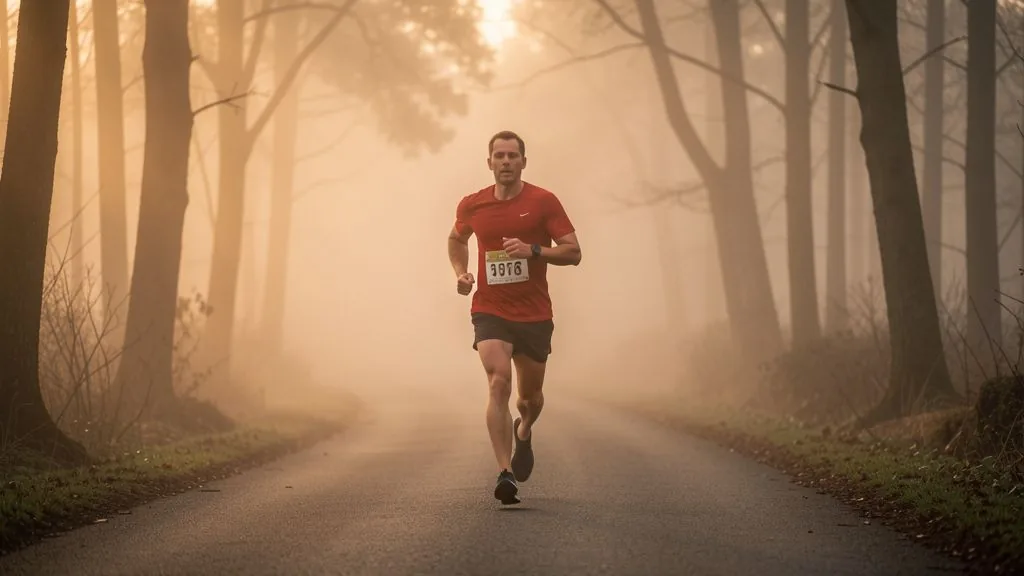
Whether you train at 6 a.m. or 6 p.m. is not just a lifestyle question. Core body temperature, hormone levels and lung function follow a daily rhythm — and that rhythm measurably affects how well a session goes. The good news: there is no universally best time to train, but there is a smarter time for every goal. This article shows what research knows about time of day and how to use it for running, cycling and triathlon.
What the body clock controls
Almost every body function follows a circadian rhythm of roughly 24 hours. Three variables matter most for endurance athletes:
- Core body temperature: It bottoms out around 5 a.m. and rises by up to one degree Celsius by late afternoon. Higher temperature means better enzyme activity in the muscles, more elastic tendons and faster nerve conduction — in the evening, the body is simply pre-warmed.
- Lung function: Maximum breathing capacity in the afternoon is up to five percent above the morning value. For intense sessions, that is a real difference.
- Perceived exertion: The same pace feels easier in the evening than in the morning — RPE tends to be lower at identical workloads. More on this in the article on training by feel (RPE).
There is a second key mechanism: the body clock is trainable. If you train at the same time for weeks, your daily performance curve shifts toward that time. For habitual morning trainers, the evening advantage shrinks to a fraction.
Evening training: the performance advantage
The evidence is clear: sprint performance, jump power and maximum muscle strength peak in the late afternoon and early evening — depending on the measure, three to eight percent above morning values. Cycling time trials and shorter running tests also typically come out one to three percent faster in that window. That sounds small, but over a marathon it quickly adds up to two to four minutes.
Practically, this means hard quality sessions — intervals, threshold runs, sweet-spot blocks — can be done in the evening with slightly less resistance from your own body. Muscles are warmer, joints more mobile, and injury risk at fast paces tends to be lower than in the cold early hour. If you do intervals at 6 a.m., you need a substantially longer warm-up to reach the same state — see the article on the running warm-up.
Morning training: the underestimated advantages
The biggest advantage of the morning has nothing to do with physiology and everything to do with consistency: if you train before work, the session can no longer be displaced by meetings, overtime or evening fatigue. In practice, consistency over months is by far the strongest performance factor — a morning run that actually happens beats a theoretically optimal evening session that gets cancelled three times a week.
Physiologically, three points add to that:
- Fat metabolism stimulus: Easy sessions before breakfast train fat burning more strongly at low glycogen levels. Dose it carefully — details in the article on fasted running.
- Cooler temperatures in summer: In hot weather, the early morning is the safest and most pleasant training time. If you deliberately want heat adaptation, you train at the warm time of day instead — see heat training.
- Daily structure: Morning training builds sleep pressure earlier in the evening and helps many people fall asleep earlier and more regularly.
Aligning with your race start time
The single most important point for competitors: most marathons and triathlons start between 7 and 10 a.m. If you train only after work for months and then have to run 42 kilometres at 8:30 a.m., you are fighting your own body clock on top of the distance.
The adjustment takes three to four weeks: in the final training block, move your key sessions — especially the long run and race-pace segments — to the planned start time. That includes your eating routine: if you want to race at 9 a.m., you need to have tested a 6 a.m. breakfast several times in training. What to eat and when is covered in the article on the carb-loading protocol.
Evening training and sleep
The warning that evening exercise ruins sleep is exaggerated but not invented. Meta-analyses show: moderate training that ends at least 90 minutes before bedtime does not impair sleep quality for most people — many actually sleep better afterwards. The problematic case is very intense sessions (intervals, race simulations) in the last hour before bed: they can delay sleep onset and elevate overnight heart rate. The simple rule: finish hard efforts at least two to three hours before sleep; easy spins or relaxed runs are fine even later. Why sleep is the most important recovery lever anyway is explained in the article on sleep and endurance performance.
Chronotype: why blanket rules do not fit everyone
Not every body clock ticks the same: early-bird types reach their performance peak one to two hours earlier than pronounced evening types. These differences are genetically shaped and can only be shifted to a limited degree. The practical test: for two weeks, note how equivalent sessions (e.g. 30 minutes at threshold) feel in the morning versus the evening and which heart rate comes with them. If your evening numbers are consistently lower but mornings are the only time you have, that is not a problem — adaptation largely closes the gap if you stay consistent. The decisive criterion remains the time you can actually keep for years.
Practical recommendations by sport
- Running: Intervals and threshold runs ideally in the late afternoon or early evening, when performance is highest. Easy endurance runs work at any time; in summer prefer mornings for the temperatures. In the final four weeks before a race, move the long run to the start time.
- Cycling: Structured indoor sessions after work are effective as long as they end two to three hours before sleep. Long base rides on weekend mornings simulate race conditions and leave enough recovery time.
- Triathlon: Swimming before work, cycling and running in the evening is a proven model for working athletes. Do brick sessions and long combinations at the weekend at the planned race time.
- Strength training: Maximum strength is highest in the afternoon and evening. If you lift in the morning, you need a longer warm-up and should not schedule maximum-strength blocks at the earliest hour.
How Peakora accounts for time of day
The Peakora engine plans sessions per day, not per clock time — but two mechanisms make the timing work for you: the recovery monitor evaluates sleep and heart-rate variability and moves hard sessions when the night after a late workout was too short. And in the final weeks before your A-race, the long run is scheduled on the day you can do it at race time — breakfast test run included. How this periodisation works as a whole is explained on the Peakora homepage.
Frequently asked questions about training time
Is it better to train in the morning or in the evening?
Both have advantages: in the late afternoon and early evening, body temperature, muscle performance and lung function peak — ideal for hard tempo sessions. Morning training scores with better consistency and matches the start time of most races. What matters is that the chosen time fits your goal and your daily routine.
When is physical performance at its highest?
Between roughly 4 and 7 p.m.: core body temperature, muscle strength, reaction time and lung function reach their daily maximum. Time-trial and sprint performances are typically one to three percent better in this window than in the early morning.
Does evening training harm sleep?
Not in principle: moderate sessions that end at least 90 minutes before bedtime do not disturb sleep for most people. Very intense intervals less than an hour before bed, however, can delay sleep onset and elevate overnight heart rate.
Is training on an empty stomach in the morning a good idea?
For easy base sessions up to about 60 minutes, yes — low glycogen stimulates fat metabolism more strongly. Hard tempo or interval sessions should never be done fasted, because quality suffers and injury risk increases.
Should I train at my race's start time?
Yes. The body clock adapts to a fixed training time within three to four weeks. Before an early-morning race, doing your key sessions and long runs at race time — including the breakfast routine — noticeably reduces perceived effort on race day.
Plan your training with Peakora
Adaptive planning that accounts for sleep, load and your race calendar — so every session sits in the plan at the right time. Start for free, no credit card required.
Start for free