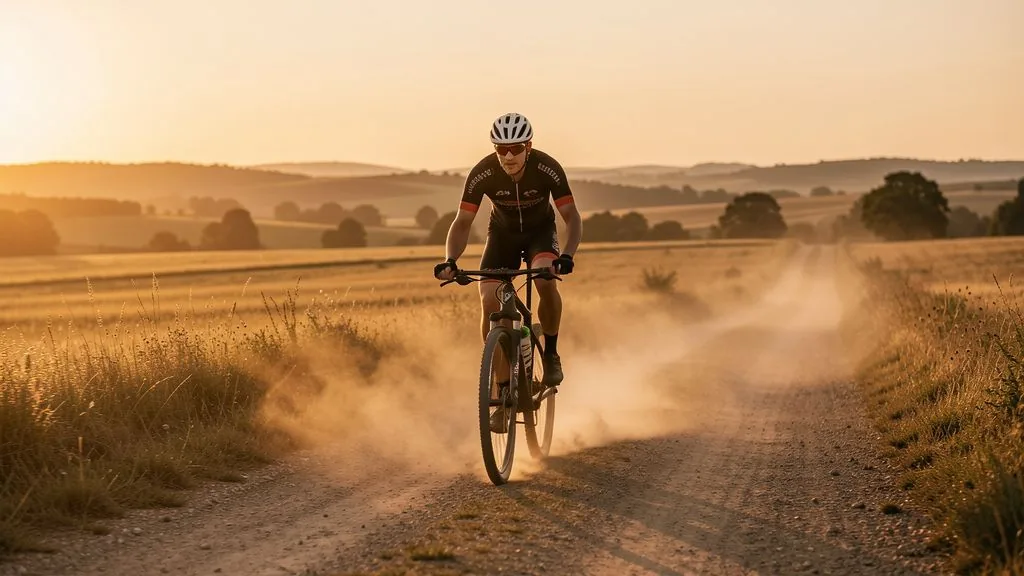
The "gravel or road bike" question is usually answered emotionally, yet it is a calculation. On smooth tarmac a typical gravel bike loses about 2 to 3 km/h against a road bike at the same power. On gravel, forest tracks and rough side roads it wins those 2 to 3 km/h back — and often more. What matters is not which bike is "better", but which surface you actually ride on.
The short answer
- Mostly tarmac, racing, time trials, group rides above 35 km/h: road bike. The difference is small, but it is measurable and, over time, demoralising.
- Mostly side roads, bike paths, gravel, forest tracks, bikepacking: gravel bike. On these surfaces it is not only faster but safer and far more comfortable.
- One bike for everything: a gravel bike with two wheelsets. With a second set and 28 mm tyres you reach about 95 percent of road bike speed on tarmac.
If you train around a city with potholed side roads, bike paths and field tracks, a pure road bike costs you more time each month in detours and compromises than the 2 km/h tarmac penalty ever will. If you live somewhere with good tarmac and target a gran fondo, the road bike remains the faster choice.
Where the speed difference comes from
At 30 km/h on flat, smooth road, a road bike on 25 mm tyres needs about 200 watts. A gravel bike with 42 mm knobbly tyres and a more upright position needs 225 to 235 watts for the same speed. Three factors cause those 20 to 30 watts, and their magnitude is well established:
- Rolling resistance: at 30 km/h, 35 to 45 percent of total resistance comes from the tyres. A good 25 mm road tyre sits around 10 watts per tyre; a 42 mm gravel tyre with tread at 18 to 25 watts. That alone is a 15 to 30 watt difference.
- Air resistance: the more upright position and wider bar increase frontal area. At 30 km/h that costs 10 to 20 watts depending on posture — more than most riders expect.
- Weight: a gravel bike typically weighs 1 to 2 kg more. On the flat this is almost irrelevant; uphill it counts.
The tyre is the biggest single factor — not the frame. That is why tyre choice is the most effective lever if you want to make a gravel bike faster.
Tyre width: the actual decision
Tyre width is not a matter of faith but of trade-offs. The rolling resistance curve is flatter than most people think: on rough tarmac, 32 mm at the right pressure is actually faster than 25 mm, because the wider tyre transmits less vertical vibration into the system and the rider "suspends" less. Depending on the surface, the crossover point sits between 30 and 35 mm.
- 25–28 mm: Smooth tarmac, racing, time trials. Minimum rolling resistance, maximum speed — but every gravel section becomes an obstacle.
- 32–35 mm: The underrated all-rounder. Only a few watts slower than 28 mm on tarmac, clearly ahead on gravel and rough roads. The most sensible choice for gran fondos and long rides on mixed roads.
- 38–42 mm: Classic gravel width. Tubeless at 2.0 to 2.5 bar: comfortable, good grip on forest tracks, 15 to 25 watts more expensive on tarmac.
- 45–50 mm: Coarse gravel, trails, bikepacking. Sluggish on tarmac, but nothing is off-limits.
Pressure matters: 42 mm tubeless belongs at 2.0 to 2.5 bar, not 4 bar. Too much pressure removes the comfort advantage and actually increases rolling resistance on rough surfaces. A tyre pressure calculator — or simply "as soft as possible without pinch flats" — delivers more than any frame debate.
Geometry: why position matters more than frame material
A gravel bike is longer, taller and more stable: longer wheelbase, more trail, lower bottom bracket. That costs agility in tight corners and makes the bike less nervous on fast descents — an advantage for long days in the saddle, a disadvantage in a criterium. The bar is wider (420 to 460 mm instead of 380 to 400 mm), which gives control on gravel but increases frontal area.
The real speed killer, though, is rarely the frame — it is position. If you ride a gravel bike with the same torso angle as on a road bike (lower stem, narrower bar, long arms), you win back a large part of the aerodynamic penalty. That is the cheapest tuning measure of all: a stem 20 to 30 mm lower and a bar 20 mm narrower often deliver more than a more expensive wheelset. How to set position and gearing properly is covered in the article on saddle height.
Uphill: what the extra weight really costs
Uphill, power-to-weight is what counts. At 1.5 kg extra weight and 250 watts of output, a 78 kg system (rider plus bike) loses roughly 0.3 to 0.6 km/h per percent of gradient. On a 5 percent climb that is about 30 to 45 seconds per kilometre — on a 10 km pass road, 5 to 7 minutes.
That sounds like a lot, but two points put it in perspective. First: most amateur riders lose more on a pass by starting too fast than through bike weight. Second: with gravel gearing (typically 40/42 up front, 10–50 at the back) you get up steep ramps with 34 teeth more easily than with a compact road crank and a 30 tooth cassette — and stay aerobic instead of blowing up. For mountain marathons and pass-road races, the road bike remains clearly ahead. Suitable sessions are in the hill training guide and in the gran fondo training section.
Everyday riding, commuting and bikepacking
Here the gravel bike wins clearly, for practical reasons: mounts for mudguards and racks, tyre clearance for mud, more robust wheels, often a 1× drivetrain with less vulnerable shifting logic. As a commuter with mudguards and 40 mm tyres it beats the road bike in almost every situation — except on a perfectly paved home loop.
For bikepacking the maths is unambiguous: a road bike on 28 mm with luggage is not a bicycle on gravel, it is a risk. If you regularly ride multi-day trips with a tent, take the buying criteria in the bikepacking beginner's guide seriously.
The cost side: two wheelsets instead of two bikes
A second wheelset costs 400 to 900 euros and turns one gravel bike into two: one set with 40 mm knobbly tyres for gravel and forest, one with 28 mm road tyres for tarmac and group rides. Swapping takes three minutes, provided cassette and brake discs match — when buying, make sure both sets use the same axle standard (12×100 / 12×142) and the same disc rotor diameter.
The compromise remains geometry: even on road tyres, a gravel bike will never feel as sharp as a road bike. For 95 percent of all training rides that is irrelevant; for criteriums and tight descents it is not. If you have the space and budget, two bikes make you happiest — if you need one that does everything, a gravel bike plus a second wheelset.
What this means for your training
Bike type changes more than your speed — it changes how you control training load. On a gravel bike, 28 km/h on gravel is a different stimulus than 28 km/h on tarmac: higher rolling resistance, more muscular work for stability, more watts for the same speed. If you train by speed, you will overload quickly on gravel.
So control gravel sessions by power or heart rate, not by the speedometer. A three-hour gravel ride at 200 watts is significantly harder than three hours on tarmac at 200 watts — the gap is 30 to 60 watts of extra output for the same speed. This is exactly where FTP-based control helps: it makes surfaces comparable, because watts stay physical while km/h do not.
Common mistakes when deciding
- Buying on looks. A gravel bike that never sees gravel is a heavy road bike with poor aerodynamics. Conversely, a road bike ridden on field tracks every weekend is a tyre killer.
- Choosing tyre width by trend. 50 mm on a tarmac commute wastes 30 watts. Conversely, 32 mm on coarse gravel is a compromise nobody enjoys.
- Overrating weight. A 1.5 kg difference costs a few minutes uphill but never costs you a ride. Position and tyres deliver more.
- Buying two bikes before the first season. Most riders only know after 2,000 km where they actually ride — before that, a gravel bike with a second wheelset is the more flexible investment.
- Buying the second wheelset without checking. Different axle standards or rotor sizes make quick swaps impossible — then each setup needs its own adjustment.
How Peakora plans for both bike types
For training planning, bike type is not a special case: Peakora calculates sessions in power, heart rate and duration, not average speed. A three-hour base ride remains a three-hour base ride — whether on 42 mm gravel or 28 mm tarmac. The difference lands in intensity classification: the plan recognises higher wattage for the same duration and rates the session as harder, instead of steering you into a false TSB. If you switch between bikes, the TSS calculation stays consistent — and you get an honest answer on whether your gravel weekend was really easy. Suitable structures for the cold season are in the guide to winter cycling training.
Frequently asked questions about gravel and road bikes
Is a gravel bike slower than a road bike?
Yes on tarmac — by 2 to 3 km/h at the same power. At 30 km/h the wider tyres and more upright position cost around 20 to 30 watts. On gravel, forest tracks and rough roads the picture reverses: there the gravel bike is clearly faster.
Can I ride a gravel bike on the road?
Yes. With a second wheelset and 28 mm tyres at about 6 bar, a gravel bike reaches roughly 95 percent of road bike speed on tarmac. Frame geometry and position remain slightly more upright and comfortable.
Which tyre width is the best compromise?
For mixed terrain, 40 to 45 mm tubeless at 2.0 to 2.5 bar. For mostly tarmac with occasional gravel sections, 35 to 38 mm is the better compromise — measurably faster and still comfortable.
How much slower is a gravel bike uphill?
At 1.5 kg extra weight, roughly 0.3 to 0.6 km/h per percent of gradient. On a 5 percent climb at 250 watts that is about 30 to 45 seconds per kilometre — noticeable, but rarely race-deciding.
Is a gravel bike worth it as your only bike?
Yes, if you mostly ride away from race courses. It covers commuting, gravel, forest tracks and group rides. If you race or time trial, you lose 2 to 3 km/h on tarmac.
Plan your cycling training with Peakora
Power-based training control for road and gravel bikes, periodised around your target race. Start free, no credit card required.
Start for free