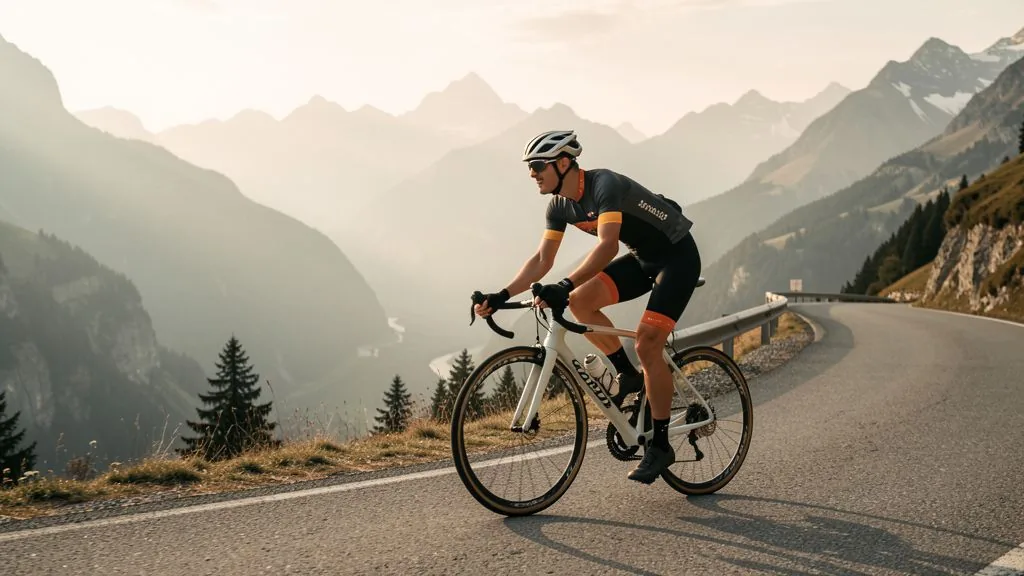
Few components on a bike are set as badly as tire pressure. Anyone who squeezes the tyre by hand and declares it "hard enough" is almost always running several tenths of a bar too high — and losing speed exactly where they are trying to find it. The reason is physical: on rough asphalt, rolling resistance is not created by the tyre itself but by the vertical movement of the rider-plus-bike system. An over-inflated tyre bounces over every imperfection instead of rolling across it. This guide explains how to calculate pressure from system weight, tyre width and surface instead of following a rule from the 1990s.
Why 8 bar is slower than 6 bar
Measurements on real road surfaces have returned the same result since the 2010s: on a test drum a hard tyre rolls better, on the road a softer one does. The drum is smooth and turns every bit of deformation energy directly into loss. Real roads are rough, and there something else decides the outcome: vertical loss from bouncing.
A tyre with too much pressure can no longer absorb imperfections. The wheel lifts slightly, slows for an instant and drops back down. Those micro impacts cost more energy than the extra deformation of a softer tyre. The heavier the rider and the rougher the surface, the bigger the effect. A 90 kilogram rider on a poor country lane loses far more time at 8 bar than a 60 kilogram rider on fresh asphalt.
Comfort follows the same logic: at lower pressure, wrists, shoulders and saddle contact fatigue more slowly. Over rides longer than two hours that is not a secondary point but a performance factor. A rider who stays comfortable holds their position longer and has more left for the final climbs.
Pressure by system weight, not by rule of thumb
The meaningful quantity is system weight: body weight plus bike plus kit, bottles and tools. A 75 kilogram rider on an 8 kilogram bike with two full bottles is therefore at roughly 85 kilograms. From that, these are sensible starting values for 28 millimetre tyres:
- 60 kg system weight: 4.2 bar front, 4.6 bar rear.
- 75 kg system weight: 4.8 bar front, 5.2 bar rear.
- 90 kg system weight: 5.4 bar front, 5.8 bar rear.
- 105 kg system weight: 6.0 bar front, 6.4 bar rear.
The 0.3 to 0.5 bar split between front and rear is deliberate: seated, roughly 55 percent of the weight is on the rear wheel, and out of the saddle the load shifts further forward. Anyone running the same pressure front and rear has either too much at the front or too little at the back — and both cost time.
Tyre width: why 28 and 30 mm now win
The second lever is width. The old logic of "narrow equals fast" comes from an era when tyres were tested on smooth tracks and with inner tubes. On real roads the picture flips. A 28 millimetre tyre at the same pressure has a flatter deformation and spreads the contact patch over a greater length. Vertical loss per imperfection drops, and rolling resistance falls with it — even though the tyre is wider.
The numbers behind it: compared with 23 millimetres, a good 28 millimetre tyre saves roughly 2 to 4 watts at 30 km/h depending on surface. Against 25 millimetres it is about 1 to 2 watts, with noticeably better comfort. A 30 millimetre tyre adds a further 0.5 to 1 watt on rough country tarmac, while the aerodynamic penalty at these widths is around 1 watt — the balance stays positive.
Only from about 35 millimetres does the ratio turn negative on smooth roads, because frontal area and tyre shape become aerodynamically unfavourable. On gravel, poor asphalt and long rides, the advantage of wider tyres remains. The takeaway: 28 millimetres is the standard today, 30 to 32 millimetres the better compromise for everything except pure time trials and hill climbs on perfect surfaces.
The 15 percent rule for any surface
Once the base pressure is set, the rest is a simple shift — put plainly: the contact patch should not change by more than about 15 percent when the surface changes. In practice that means:
- Smooth, fresh asphalt: run the base pressure from the table.
- Rough country tarmac: roughly 0.3 to 0.5 bar below the table value.
- Gravel and off-road: 0.8 to 1.2 bar less, and correspondingly more on 40 millimetre gravel tyres.
- Wet conditions: 0.3 to 0.5 bar less, because the larger contact patch delivers more grip.
- Extra weight from luggage: about 0.15 bar more per 5 kilograms, split across both wheels.
These adjustments are deliberately conservative. The difference between 5.0 and 5.3 bar is small for speed but clear for confidence and grip. If you are unsure, choose the lower value inside the recommended range — pinch flats on normal road tyres only become a risk at very low pressure.
Butyl, latex or tubeless
The system you run shifts the sensible pressure window. Butyl tubes are the standard: robust, cheap, easy to patch and barely lose air. Latex tubes deform more easily and cut rolling resistance by roughly 1 to 2 watts at the same pressure — but lose about 0.5 to 1 bar per day and must be checked before every ride. Tubeless drops the inner tube entirely, letting tyre and rim work as one; 0.3 to 0.5 bar less than butyl is typical, with better protection against small punctures.
Tubeless riders should check pressure weekly, since tubeless systems also lose air gradually. Latex riders check before every ride. Butyl riders get away with one check per week. A decent gauge pump with a manometer costs 15 to 30 euros and is the most effective accessory purchase in cycling, because it eliminates the estimating errors that the thumb method produces systematically.
The practical test: find your number in three rides
Theory only helps up to the first ride. The reliable path is a simple test across three identical routes:
- Ride 1: run the table value minus 0.5 bar. Note average speed on a fixed segment and how it felt.
- Ride 2: run the table value. Same segment, same conditions, same clothing.
- Ride 3: run the table value plus 0.5 bar. Record the same numbers again.
The fastest average wins. Ride the three sessions in similar conditions, because wind and temperature have larger effects than 0.5 bar. On a 30 second segment the difference is rarely measurable — use a segment of at least five minutes or the whole loop.
Common tire pressure mistakes
- Pumping by feel. Harder feels faster but is not. Without a gauge, deviations of 1 bar are normal.
- Running the same front and rear. Around 55 percent of the weight sits at the back — that is where the extra pressure belongs.
- Setting pressure a day early. Butyl loses about 0.1 to 0.2 bar per week, latex far more. Check before every ride, not last time.
- Measuring cold, riding hot. Friction inside the tyre raises pressure by a few tenths on a long ride — a starting point at the lower end is better than the upper.
- Ignoring a tyre change. Going from 25 to 28 millimetres and keeping the same pressure means riding clearly too hard.
- Running tubeless at high pressure. That gives away the very advantage of the system: being able to run less pressure.
Tire pressure and training control
Correct pressure is the cheapest speed available — but it does not replace training. Anyone who gains two to four watts from the right pressure loses ten times that through a plan without structure. Managing load properly is the job of training control: Peakora reads power and heart rate files and derives load, form and recovery weeks from them. How the reference values are established is explained in the article on FTP testing and power training, and how climbs work as a training stimulus in the piece on hill training for cyclists. For gran fondo preparation, the cluster cycling training and gran fondo gathers every building block, and terms such as FTP, sweet spot and critical power are covered in the Peakora training lexicon.
Frequently asked questions about tire pressure
How much pressure does a road bike tire need?
Pressure depends on system weight — rider plus bike plus kit — not on a fixed number. A 75 kilogram rider on 28 millimetre tyres runs roughly 4.8 bar front and 5.2 bar rear, about 0.5 bar more on 25 millimetres and about 0.7 bar less on 32 millimetres. The old 8 bar rule is outdated and measurably costs speed.
Is 8 bar still a sensible road bike pressure?
No. On real road asphalt a 25 millimetre tyre run at 8 bar is slower than the same tyre at 5.5 to 6 bar, because the wheel bounces over every imperfection instead of rolling across it. The higher pressure only feels harder, and therefore faster, without actually being faster.
What tire pressure for which rider weight?
On 25 millimetres the rough guide is 60 kilograms around 5.5 bar, 75 kilograms 6.0 bar, 90 kilograms 6.5 bar. Subtract roughly 1.5 bar for 28 millimetres, 2 bar for 30 millimetres and 2.5 bar for 32 millimetres. Run 0.3 to 0.5 bar more at the rear than the front, because roughly 55 percent of the weight sits there.
Can I run lower pressure with tubeless?
Yes. Tubeless allows 0.3 to 0.5 bar less pressure with no greater risk of pinch flats, simply because there is no inner tube to be trapped between tyre and rim. Latex tubes also allow slightly lower pressure than butyl, but lose air much faster.
Why are wider road bike tires recommended?
A wider tyre at the same pressure deforms into a flatter contact patch and therefore rolls over rough asphalt with less vertical loss. In measurements on real surfaces 28 to 30 millimetres are faster than 23 or 25 millimetres, with better comfort and grip. Narrow tyres only win on very smooth tarmac.
Train properly on the right setup
Peakora reads power and heart rate data, calculates load and form, and plans recovery weeks, intervals and tapering. Start free, no credit card required.
Start free