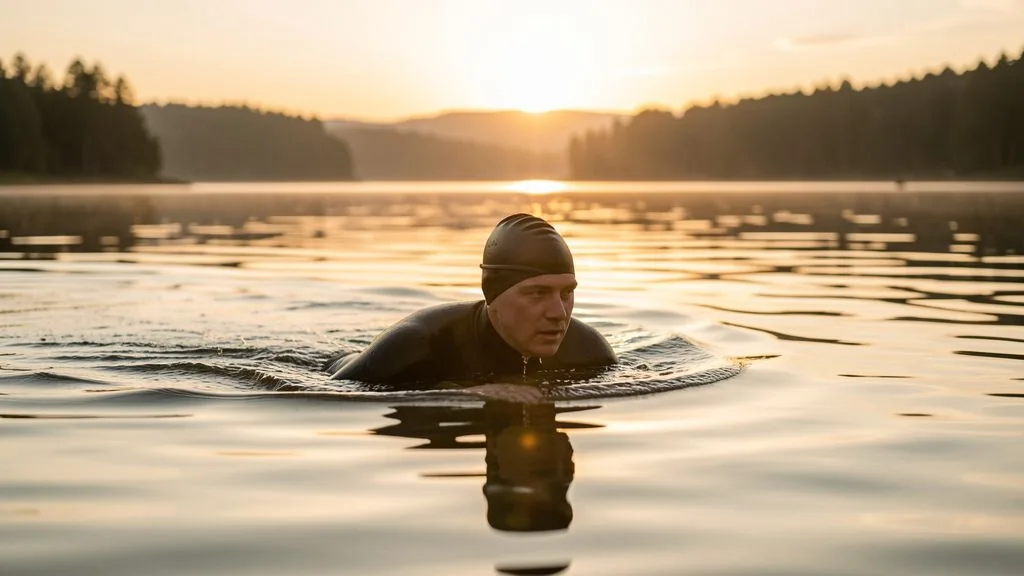
Few elements of front crawl are trained as much and understood as poorly as the flutter kick. It delivers only around 10 to 15 percent of your propulsion but consumes a large share of your oxygen — and it decides whether your legs stay at the surface or trail behind you as a brake. Understanding the kick makes you not just faster, but above all more economical.
Why the kick is overrated
The quadriceps are the largest muscle group in the body, so driving them continuously costs a corresponding amount of oxygen. Studies of oxygen consumption in the water show that kicking alone with a board costs significantly more energy than swimming with the arms only at the same speed.
The central rule for training follows from this: the kick is first and foremost a support function, not a propulsion function. Its job is to keep the legs level with the body axis — that is, to secure the horizontal position that creates the least drag. If your legs sink, your frontal area grows and you drag your own body through the water like an anchor.
That is exactly why an economical, quiet kick is the right choice over long open-water distances, while a strong 6-beat kick is the tool for short, fast sections. For technique work on the arm stroke and body position, see Improve your freestyle technique.
The technique: from the hip, not the knee
The flutter kick has little to do with pedalling a bicycle. It is a loose, whipping motion that originates at the hip and only ends at the foot.
- Start at the hip: The motion is initiated at the hip joint, not the knee. Bending the knees and “pedalling” creates braking drag instead of propulsion. The knee may be slightly bent on the upkick — on the downkick it is almost straight.
- Relaxed ankle: The ankle is the real pivot point. The foot points backwards in a stretched position on the downkick and relaxed on the upkick. A stiff foot acts like an oversized propeller blade and pushes water downwards instead of backwards.
- Small amplitude: The feet travel about 30 to 40 centimetres up and down — a range just above the width of your leg. Large kicks break the body position and waste energy.
- Legs close together: The legs run close together, almost touching. Legs splayed outwards increase the drag surface.
- Under the body axis: The kick happens under the body, not beside it. A leg pushing deep underneath you is almost always a sign that your hips are too low.
2-beat, 4-beat and 6-beat kick: which one when
The number describes how many kicks fall into one complete arm cycle — that is, two arm strokes. It is not a matter of style but of speed, distance and energy budget.
- 6-beat kick (standard): Six kicks per arm cycle, roughly 90 to 110 per minute. It produces the most stable body position and the highest leg turnover, making it the right choice for sprints, short race distances, technique work and any swimmer whose legs tend to sink. The price: the highest oxygen cost.
- 4-beat kick: Four kicks per arm cycle in a slightly offset rhythm, often swum as a crossover kick. A compromise for middle distances, when the 6-beat kick costs too much energy but the 2-beat kick no longer holds the body position.
- 2-beat kick: Two kicks per arm cycle, usually one matching the arm stroke on the same side. It is the most economical option and the default choice of long-distance swimmers and triathletes in a wetsuit — there, buoyancy keeps the legs high and the kick becomes almost redundant.
The choice therefore depends on context: a 1,500-metre pool swimmer benefits from the 6-beat kick, while the same athlete over 3.8 kilometres in open water with a wetsuit swims far more economically with the 2-beat kick. To learn the switch, train both patterns deliberately — first the rhythm in isolation, then combined with the breathing, as described in freestyle breathing technique.
Why your legs sink — and what actually helps
The most common problem in the pool is not a lack of leg strength but an ankle that cannot point the toes backwards. Plantar flexion determines how well the foot can push water backwards. A stiff ankle reduces the effective blade angle and turns the foot into a brake instead of a propeller.
The second most common cause sits further up: a head carried too high lifts the upper body and pushes the hips down — the legs inevitably follow. No amount of kicking helps here; only correcting the head position to the waterline does.
The third cause is an unsteady body axis: swimmers who roll heavily while breathing lose the line and the legs start to swing. For open water, see open-water swimming tips.
Mobility before strength: training the ankle
Before thinking about strength, mobility belongs in the programme. Plantar flexion improves with simple drills, and the effects show up in the water faster than any strength gain.
- Kneeling foot sit: Sit on your heels with the tops of your feet flat on the floor. Two to three sets of 30 to 60 seconds, several times a week; if that is impossible, start with a towel under the instep.
- Toe pull with hand assistance: Seated, gently stretch the toe backwards with your hand and hold for 20 to 30 seconds. Stretching may pull, it should not hurt.
- Toe stand at the wall: Combines mobility with calf strength and transfers directly to the catch in the water.
- Fins as a training aid: Short fins lengthen the lever and make the motion noticeable, teaching the foot the stretched position — but only in short sets, otherwise the foot position reverts to habit.
Ankle stability and calf strength on land are a useful complement — the drills in the foot strength for runners article follow the same mechanism.
Concrete kick sets at the pool
Kick training works differently from arm-stroke training: it has nothing to do with endurance and everything to do with technique and rhythm. So the rule is short distances, many repetitions, full rest. Anyone grinding out 400 metres of continuous kicking is training fatigue rather than the kick — and technique collapses in the second half.
- Warm-up (every session): 4 × 25 m kick with a board, full rest at the wall. Focus on a stretched foot and hip drive, not on speed.
- Streamline kick: 4 × 25 m without a board, arms extended overhead, face in the water. Without a board the legs sink immediately if your body position is off — the feedback is instant and honest.
- Side kick (sideswim): 4 × 25 m lying on your side, one arm extended forward, head on the lower arm. Trains axis stability and exposes any sideways splaying of the legs immediately.
- Frequency change: 4 × 25 m with 12.5 m slow at small amplitude and 12.5 m fast at higher frequency. Teaches the difference between relaxed and active.
- To finish: 6 × 25 m kick with fins, then 100 m front crawl without aids to transfer the pattern into the whole stroke.
That adds up to about 500 metres of kicking per technique session — with two sessions a week, a clearly visible improvement in body position after three to six weeks. For overall swim training volume, see swim training sets.
Common kick training mistakes
- Too much kicking in one stretch. Long sets without rest almost inevitably lead to pedalling, bent knees and loose feet. The stimulus you want evaporates in the second half.
- Mistaking the kick for endurance training. The kick trains technique and rhythm. Endurance comes from continuous swimming, not from 400 metres with a board.
- Working with fins too late. Fins are not a beginner's aid but a technique tool: they make the ankle more flexible and the motion more obvious.
- Kicking from the calf. Driving from the knee creates more drag than propulsion. Anyone initiating the upkick from the knee loses water on every stroke.
- Ignoring the head. A head carried too high pushes the hips down. The kick can look perfect and still not work if the axis is wrong.
Frequently asked questions about the flutter kick
How many kicks per minute should I swim?
For most swimmers the 6-beat kick with six kicks per arm cycle is the standard, which works out to roughly 90 to 110 kicks per minute. In a wetsuit and over long open-water distances the 2-beat kick is often enough, because the added buoyancy keeps your legs higher.
Should I drive my legs actively in front crawl?
No. Around 85 to 90 percent of propulsion comes from your arms; the kick contributes only about 10 to 15 percent while costing a lot of oxygen. Its main job is body position — it keeps your legs from sinking and creating drag behind you.
Why do my legs sink when I swim front crawl?
It is usually the ankle rather than strength: a stiff ankle cannot point the toes backwards, which creates drag at the foot. The second most common cause is a head carried too high, which pushes the hips down and the legs follow.
Does a pull buoy help with kick training?
No — a pull buoy deliberately switches the kick off so you can work on the arm stroke and body position. Train the kick with a kickboard, streamline position and fins: short sets of 25 to 50 metres, often and with full rest.
Plan your swim training with Peakora
Peakora schedules swim, bike and run sessions on one shared load curve — with technique blocks, periodisation and control via TSS, fitness and form. Start for free, no credit card required.
Start for free