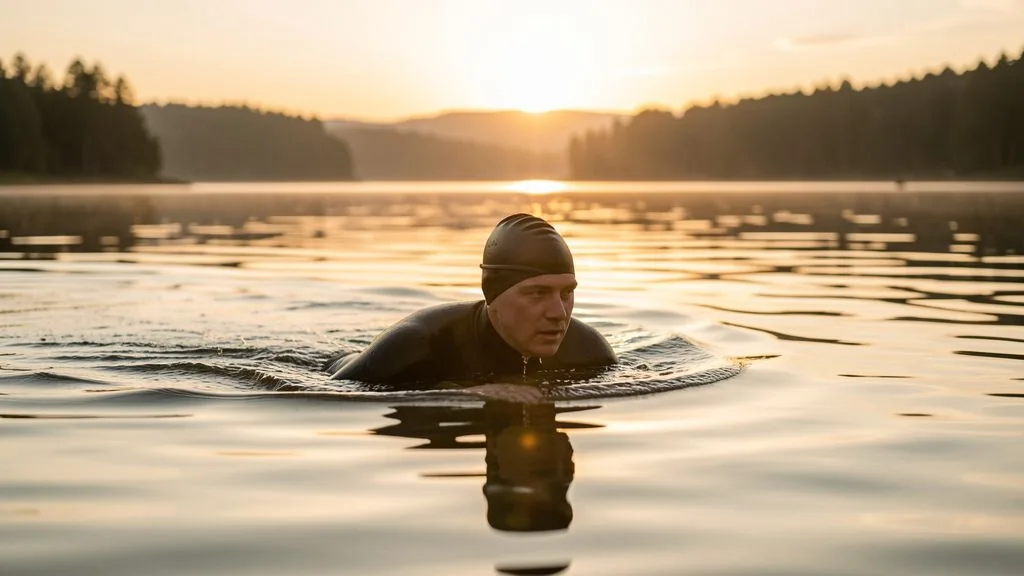
The swim rarely wins a triathlon — but it very often loses one. Step out of the water after 1,500 metres with a 90-second deficit and an empty upper body and you will struggle to make that up on the bike. The reason is almost never a lack of fitness but a lack of structure: most triathletes swim lengths instead of swimming sessions. Three clear session types solve exactly that.
Why the swim produces such a big deficit
In running and cycling, technique is self-correcting: the body finds a reasonably efficient movement on its own, because gravity and resistance give immediate feedback. In the water that feedback is missing. You do not notice that your legs are sinking or that your arm is pulling past your body — you only notice that you are getting tired. That is why swimming follows a different order from the land disciplines: technique before volume, volume before intensity. An athlete with a clean body position and moderate training will almost always beat the stronger athlete who is fighting the water.
In practice that means: of the time lost in the water, roughly two thirds can be traced to form and body position and only one third to fitness. That is where the leverage sits, and that is why swim sessions for triathletes are technique sessions with a fitness component — not the other way round.
The three levers of swim technique
- Body position: the head decides it. Lift your head to breathe instead of rolling and your hips drop, creating a brake block. Rule of thumb: one eye stays under water, the gaze goes sideways, not forward to the pool wall. A good body position often saves 5 to 10 seconds per 100 metres without any fitness gain.
- Catch and pull: propulsion comes from a long, extended pull phase — catch first, then hold the elbow high, then pull through to the thigh. Do not rip hard at the start: force in the first third of the pull is wasted, because the lever is poor.
- Rhythm: continuous propulsion instead of stop-and-go. Once the hand enters, the next stroke of the other side begins immediately. Anyone who briefly "glides" at the end of each stroke loses speed that has to be rebuilt expensively with the next burst of force.
One detail that pays off in practice: exhale completely under water. Anyone who lifts the head to exhale and inhale extends every cycle by roughly a second — over 1,500 metres that adds up to two minutes. A detailed look at the stroke is in the article Swimming in triathlon: technique tips.
CSS: your pace reference in the water
Without a pace reference, every interval session is guesswork. The most common one is Critical Swim Speed (CSS) — roughly the pace you could hold for an hour. You determine it with two simple tests:
- Test 1: 400 metres all out, note the time. Take 5 to 8 minutes easy in between.
- Test 2: 200 metres all out, note the time.
- Formula: CSS (m/s) = (400 − 200) ÷ (time in seconds for 400 m − time in seconds for 200 m). That gives you your pace per 100 metres — usually about 4 to 8 seconds slower per 100 m than the 400-metre test.
Example: 400 m in 7:20 (440 s), 200 m in 3:25 (205 s). That gives 200 ÷ 235 = 0.851 m/s, so around 1:58 per 100 metres. That figure is your target for the threshold set — not faster. Anyone swimming the threshold set at 1:45 is not swimming at CSS but sprinting, and the benefit flips into the opposite.
The test belongs on the plan every six to eight weeks. A gain of 4 to 6 seconds per 100 metres over a winter is a realistic and already clearly noticeable result for most triathletes — over Olympic distance that is 60 to 90 seconds.
Three session types — and what each one does
If you swim three times a week, fill them with three different types. If you only manage two, drop the volume session, never the technique.
Type 1: technique session (short, precise, frequent)
45 minutes, high technique content, low intensity. The goal is body position and movement pattern, not speed. Every set is swum deliberately, if in doubt with counting or breathing rules so concentration does not slip.
- Warm-up: 300 m easy, including 100 m legs only with a pull buoy.
- Technique block: 6 × 50 m with pull buoy; 6 × 50 m with closed fists (feel for the water); 6 × 50 m with a raised head-contact drill and calm breathing rhythm. 15 seconds rest between each.
- Position set: 8 × 50 m focused on "one eye stays down" — 15 seconds rest, pace deliberately easy.
- Cool-down: 200 m easy, including 100 m legs only. Total 2,000 m.
Type 2: threshold session (holding CSS, controlled)
This is the most important session for fitness, and it always follows your CSS. The stimulus sits at 20 to 30 minutes of total threshold work in the water — the same logic as a threshold run.
- Warm-up: 400 m easy, 4 × 50 m build (each one faster, never all out).
- Main set: 3 × 300 m at CSS, 30 seconds rest — that is 900 m of threshold work.
- Second set: 6 × 100 m at CSS, 20 seconds rest.
- Cool-down: 200 m easy. Total 2,800 m.
Typical mistake: cutting the rest short because you feel good, then the third repeat collapses. The prescribed rest is part of the stimulus — short rest is not a bonus, it shifts the session towards anaerobic.
Type 3: volume or race session (long sets, rhythm)
Once a week, or every other week, a longer, steady or race-specific set. This is not about pace but about holding technique and rhythm over 30, 45 or, for middle and long distance, up to 60 minutes continuously.
- Race session example: 1,000 m continuous at endurance pace, 3 minutes rest, 1,000 m continuous at race pace, 3 minutes rest, 400 m with a focus on swimming cap pace. Total 3,500 m.
- Volume session example: 5 × 400 m at a calm, even pace with 30 seconds rest — ideal for learning to pace over long distances.
- Winter example: 5 × 400 m and 5 × 200 m with 25 seconds rest each, all easy — the classic for the base phase.
Two example weeks: two vs. three sessions
If you get in the water twice a week, spread technique and threshold work over two slots and cover the volume through cycling and running. If you swim three times, attach the race session midweek or at the weekend.
- Tuesday: technique session, 2,000 m, 45 minutes — body position and rhythm.
- Thursday: threshold session at CSS, 2,800 m, 55 minutes.
- Saturday/Sunday: race session with long sets, 3,000 to 3,500 m, 60 to 75 minutes.
Important for the calendar: swim sessions sit badly with hard land days on the same day. Anyone who hangs a hard interval run onto 3,000 metres loses quality in both disciplines. The threshold session in the first half of the day and an easy run later works well instead.
The most common mistakes in swim training
- Just swimming up and down. 2,000 metres continuous without structure achieves almost nothing — technique degrades with every minute of fatigue, and the intensity is too low for any real stimulus.
- Training without a pace reference. Without a CSS figure every set is guesswork. Four seconds per 100 metres off target means over a minute of difference by the end of an Olympic distance race.
- Technique only at the start. Once fatigue sets in, body position is the first thing to break. That is why technique refreshers belong in the second half of long sessions too.
- Ignoring the legs. Leg sets look boring but stabilise body position and stop the hips from sinking. At least 10 percent of weekly metres should be legs.
- Pool only. Before every open-water race you need two or three sessions in open water — sighting, chop and getting used to the wetsuit cannot be simulated in a pool. More on that in Open water swimming tips.
How Peakora schedules swim sessions
In the Peakora engine, swim sessions are not stored as "swimming, 2,000 m" but as real workouts with warm-up, main set and cool-down — aligned to your season plan and the distance of your A race. The swim volume scales with the target distance: for sprint and Olympic distance the swim load stays constant at two to three sessions, for middle and long distance it rises to three or four by the build phase. Because the engine adds up training stress across all three disciplines, it also sees when swimming, cycling and running block each other, and shifts the sessions instead of stacking them.
Frequently asked questions
How many swim sessions per week does a triathlete need?
Two sessions per week is the minimum to hold your swimming level and improve slowly. For Olympic distance two to three sessions are enough, and for middle and long distance three to four make sense, one of them a long session.
What is CSS and how do I test it?
CSS stands for Critical Swim Speed, the pace you could roughly hold for an hour. You find it with two tests: 400 m and 200 m all out. CSS = (400 - 200) divided by the time difference in seconds. It is your target for interval pace, not for sprint or technique sets.
Should I swim more technique or more volume in winter?
More technique in winter. With no races on the calendar, a block of short repeats and video or coach feedback pays off. Volume comes in the build phase once the stroke holds — otherwise you cement errors with every lap.
How long should a swim session be?
45 to 75 minutes in the pool is the normal range, which equals 1,500 to 3,000 metres. Anything beyond 90 minutes rarely helps in triathlon, because the swim leg is under two hours at almost every distance. Quality of the repeats beats raw metres.
Plan your triathlon training with Peakora
Swim, bike and run sessions from one engine, automatically aligned to your A race. Start for free, no credit card required.
Start for free