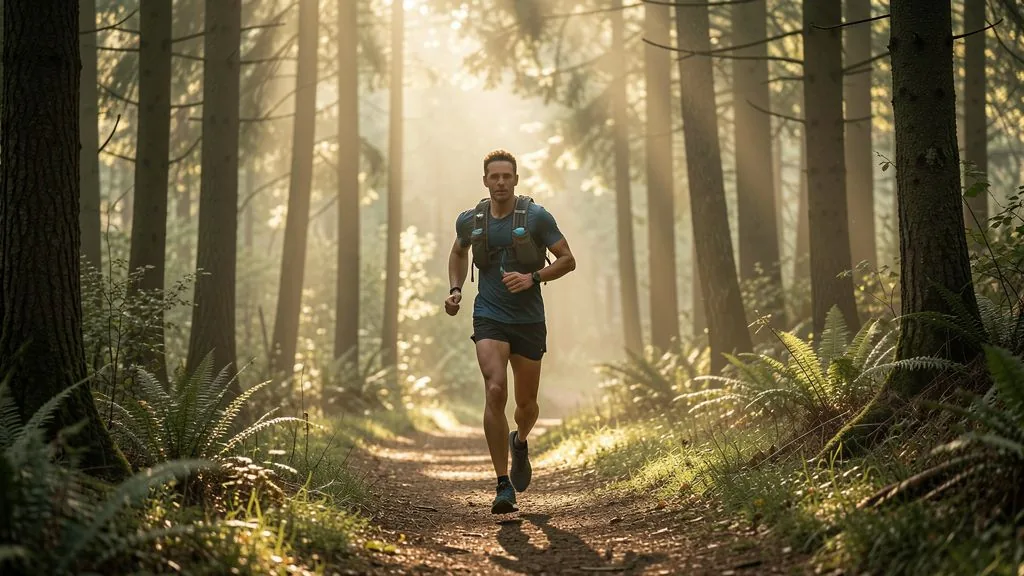
In endurance sport, cold is usually the problem rather than the tool: stiff muscles, frozen hands, a feeling that makes the first kilometre twice as long as it should be. At the same time a counter-image has emerged over the past few years — people running in a T-shirt in winter, cold-showering every morning, claiming that cold can be trained like an interval session. Both views are partly right. This article covers what cold acclimatisation actually changes physiologically, where its benefit realistically lies, and where the show begins.
What cold triggers in the body
As soon as skin temperature drops, the body responds in a fixed sequence. First, blood vessels in the skin and extremities constrict — vasoconstriction. Blood is shifted inward to the core to preserve it. Heat loss falls, blood pressure rises slightly, and the kidneys produce more urine (cold diuresis) — an underestimated fluid loss on longer sessions in the cold.
If that is not enough, shivering begins: involuntary muscle contractions that produce heat but consume exactly the energy you actually need for forward propulsion. In the cold, this thermoregulatory share can amount to several percent of total output. That is why the same wattage feels harder on a cold April day than in July.
The third mechanism is the most interesting one: below the shivering threshold, the body can generate heat via brown adipose tissue — non-shivering thermogenesis. Brown fat burns fatty acids primarily for heat production. With regular cold stimuli, this tissue can become functionally more active, and the shivering threshold shifts downwards. That is precisely the core of what "cold training" actually means.
What cold acclimatisation measurably changes
Research on repeated cold exposure is remarkably consistent in what it shows — and in what it does not show. After two to four weeks with several cold sessions per week, these adaptations typically appear:
- Less shivering at the same cold. This is the most robust finding of all. The shivering threshold drops, and when shivering starts it is weaker. In practice: cold costs you less energy because you have less to fight against.
- Higher skin temperature in hands and feet. Peripheral vasoconstriction is dosed more efficiently and partly less pronounced. Translated: warmer fingers, fewer aching toes.
- Altered cold perception. The same temperature feels less unpleasant. That is largely habituation — but habituation is the factor that decides in a race whether you focus on your pace or on your discomfort.
- No performance gain. And here it gets sobering: for endurance performance in normal conditions — moderate temperatures — the evidence shows no advantage. Cold acclimatisation makes you cold-proof, not faster.
The last point matters because it corrects expectations. Unlike heat training, which genuinely improves performance in the heat through plasma volume expansion and heat shock proteins, cold adaptation is mainly a comfort and efficiency story. It improves your ability to deliver your performance in cold conditions — not your maximum capacity itself.
Why this still matters for endurance athletes
Anyone planning a season in central Europe knows the problem: the first spring marathon happens at 6 °C, the autumn gran fondo at 9 °C in rain, and the long winter sessions sit between 0 and 5 °C anyway. A relevant share of your races therefore takes place in conditions where thermoregulation is a genuine performance factor.
Concretely, cold tolerance pays off in three situations:
- Long sessions and races in the cold. If you start freezing an hour earlier, you lose focus, your shoulders tighten and your technique deteriorates. Cold tolerance is a technique factor here, not a comfort factor.
- Long descents and waiting periods in cycling. At gran fondos and in triathlon the cold stress is often greatest not during the effort but on windy descents or after the swim. If you do not cool down there, you enter the next climb with empty legs. For handling the swim exit see T1 and T2 in triathlon.
- Cold starts in the morning. Early sessions at low temperatures: if you find a rhythm after 10 minutes instead of 25, you collect many better kilometres over a season.
How to dose cold exposure training
The most common mistake is the belief that cold training has to be hard. Adaptation does not come from the maximum but from repeating a moderate stimulus — exactly as in training build-up, where increasing volume does not work through one monster session per month either.
A proven basic pattern for beginners:
- Frequency: two to three cold stimuli per week. That is the dose at which most studies demonstrate adaptations — more does not scale linearly.
- Duration: 10 to 20 minutes of moderate cold is sufficient. What matters is staying below the shivering threshold: shivering is a sign the stimulus is too strong, not too weak.
- Temperature: 10 to 15 °C water temperature or a cool room at 12 to 16 °C. Ice water is not necessary for adaptation.
- Timeframe: four to six weeks for a first measurable adaptation. Afterwards a maintenance dose of one to two sessions per week is enough.
- Everyday integration: turning the shower cold for the last minute is the most pragmatic version — 30 to 90 seconds, daily, no logistics. Entirely sufficient to start with.
Important is the difference between a cold stimulus and cold exposure during sport. A long winter session at 2 °C is not acclimatisation but a load you have to manage: it costs energy, it raises injury risk with cold, stiff muscles, and it gets you nowhere if you cannot sustain it. That is why every winter session includes the equipment question — details in winter running shoes and on clothing in running clothing.
The right formats for everyday life
Not everyone has a lake on the doorstep, and not everyone wants to sit in a stream in winter. The formats differ in intensity and effort, not in their fundamental effect:
- Cold shower: 30 to 90 seconds at the end of a normal shower, turning the water colder gradually. The lowest-threshold entry point, doable daily, good circulatory effect. Sufficient for acclimatisation if you stay consistent.
- Cold bath in tub or lake: 5 to 15 minutes at 10 to 15 °C. The strongest stimulus with the best research backing — and the most effort. Worth doing once or twice a week in the winter months.
- Short runs in light clothing: the last 10 minutes of an easy session without a jacket, if it is not below 5 °C. Relatively low risk because the muscular work itself produces heat — but only at easy pace. In hard sessions, cooling down is a performance killer.
- Cold water after swimming: a natural cold stimulus for triathletes in winter training. Caution with circulatory problems, and never alone in open water — for the risks see hypothermia in endurance sport.
Where cold exposure training does not help
The honest counter-list belongs to this topic, because the cold marketing machine now promises almost everything. What cold does not deliver:
- Boosting fat burning. Brown fat does burn calories for heat production, but the amounts are so small they are irrelevant for weight regulation — realistically in the range of a few dozen calories per cold session.
- Substantially strengthening the immune system. There are hints of altered immune markers, but no robust evidence of fewer infections. If you really want to do something for your immune system, the effective levers are in the immune system in endurance training — sleep, energy availability, training dosing.
- Accelerating recovery. That is the job of ice baths and cryotherapy, and even there the effect is mainly subjective. Cold acclimatisation is a separate stimulus with its own adaptation — it does not replace a recovery strategy. Details in ice bath after training.
- Wishing inflammation away or treating depression. Cold exposure has mood effects via noradrenergic activation, and they feel real. As a therapy substitute it is not suitable.
The frequently cited link between cold and testosterone is thin as well: individual studies show short-term increases after cold exposure, but robust long-term effects on hormone status are missing. For training decisions that is not an argument.
Risks and stop criteria
Cold is a physiological stressor, and as with any stressor there are people for whom it is unsuitable. Before any regular cold exposure: with heart disease, arrhythmias, untreated high blood pressure, Raynaud's syndrome, cold urticaria or open wounds the topic needs medical clearance. The cold shock response — the reflexive, uncontrollable gasp when entering cold water — measurably stresses the circulation and is the moment when most incidents happen.
Practical rules that keep the risk small: never enter cold open water alone, always enter slowly instead of jumping, keep breathing calmly instead of holding your breath, and warm up gradually afterwards rather than taking a hot shower immediately. With chills, confusion, numbness in the fingers or slurred speech, stop at once and warm up — those are signs of incipient hypothermia, not signs of toughness. Anyone who has done a pre-race health check knows their limits better anyway.
Cold exposure and training control
The decisive question for endurance athletes is when cold makes sense and when it blunts adaptation. Cold exposure immediately after a hard session is recovery and dampens the training stimulus — that is well documented for ice baths and the reason supercompensation needs time and inflammatory signals. Cold exposure at a separate time, with distance from the session, is a stimulus of its own without that drawback.
The rule of thumb: cold stimulus yes, but at least four to six hours away from the hard session — or on a rest day. In a build week with high load, cold training is an additional stressor that counts toward total load; in a deload week or in the base phase it fits without issue.
How Peakora frames it
Whether an extra cold stimulus makes sense right now is a question of your current load — not of your motivation. Peakora continuously calculates CTL, ATL and TSB from your sessions, and with them your form score. If TSB is deeply negative, the engine shows you that recovery now takes priority over additional stressors; in quiet phases there is room for cold exposure. Practically relevant: cold sessions in winter change your thermoregulation, but the engine only assesses training load — which is why cold baths should not be logged as sessions, and short cold showers certainly not. That keeps the form score meaningful, and cold training stays what it is: a tool for comfort and cold tolerance, not a training substitute.
Frequently asked questions about cold exposure
Does cold exposure training make you faster?
No, not directly. Cold acclimatisation improves cold tolerance, not endurance performance. Studies show no performance gain in warm conditions after repeated cold exposure — if you want to get faster, you need training stimuli, not cold.
How often should you do cold exposure training?
Two to three sessions per week for four to six weeks are enough for a measurable adaptation. Consistency matters more than intensity: moderate cold for 10 to 20 minutes without shivering does more than one maximal cold shock every two weeks.
Is a cold shower already cold exposure training?
Yes, if it is regular and lasts at least 30 to 90 seconds. Adaptation comes from the repeated noradrenaline release and habituation to the cold stimulus, not from the water temperature alone. Ice baths are not required for this.
Does cold exposure training prevent colds?
The evidence is weak. There are hints of altered immune markers, but solid proof of fewer infections is missing. If you want to support your immune system, sleep, sufficient energy intake and well-dosed training are far more effective.
When is cold exposure training dangerous?
With heart disease, arrhythmias, untreated high blood pressure, Raynaud's syndrome or cold urticaria. Cold exposure alone in open water is also risky. When in doubt, get medical clearance and never plunge straight into the cold shock response.
Measure training load instead of guessing — with Peakora
CTL, ATL and TSB in view, planned deload weeks and a coach that recognises when an extra stimulus is too much. Start free, no credit card required.
Start free