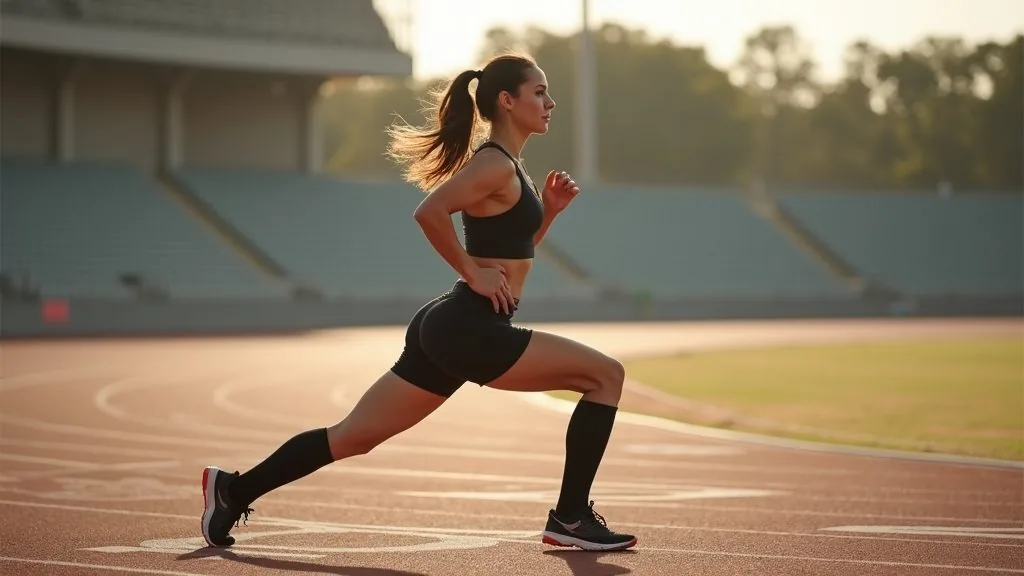
Running is a one-dimensional movement loop: tens of thousands of identical steps load the same structures — hip flexors, calves, foot arch — and leave their counterparts undertrained. Yoga targets exactly the areas running makes tight and narrow: hips, hamstrings, ankles and single-leg stability. This article covers which poses are actually relevant for runners, what a 15-minute routine looks like, and when yoga helps your training plan — and when it gets in the way of a hard session.
Why runners in particular benefit from yoga
The running stride uses only a narrow slice of the available hip range: flexion forward, extension behind, barely any lateral or rotational movement. Run 40 to 80 kilometres a week inside those narrow rails and your body adapts to them — the hip flexor shortens because it is rarely stretched beyond neutral; the gluteal muscles lose activation because they share the extension work with the large back extensor; the arch musculature dulls because shoes take over the fine work. The result is not acute pain but a creeping loss of mobility that eventually shows up in your running form: shorter back-side swing, sinking hips, an unstable landing moment.
Yoga is, at its core, systematic counter-training: every pose moves a joint into a range the running cycle never reaches. For runners that makes it not wellness but a tool against the structural tightness a running-only practice produces — the same logic behind dedicated mobility training for runners, just delivered as ready-made shapes you perform instead of having to construct.
The 6 most effective yoga poses for runners
Not every yoga class serves a runner. Complicated balance sequences or extreme backbends deliver little. What matters are the poses that address the structures running loads and shortens:
- Low lunge / Anjaneyasana (hip flexors): From a lunge, lower the back knee, brace the core, and slide the hips forward until you feel a stretch along the front of the rear hip. This is the most effective position against the shortened hip flexor — cause number one of a sinking pelvis while running. Hold 60 to 90 seconds per side.
- Pigeon pose / Eka Pada Rajakapotasana (glutes): Bring the front leg forward and inward, extend the rear leg back, and fold long over the front leg. It stretches the gluteus maximus and the deep hip rotators — often tight in runners and a frequent contributor to runner's knee and ITBS. If the pose feels too intense, start with the lying version (figure-four stretch).
- Downward dog (hamstrings & calves): From all fours, press the hips up, keep the knees slightly bent, then draw one heel at a time toward the floor. It lengthens hamstrings and calves together — the two muscle groups most overloaded by downhill running and most often implicated in shin splints.
- Warrior III (single-leg stability): From a lunge, lift the rear leg until torso and extended leg form one line, arms forward. It demands foot arch, hip stability and trunk control at once — precisely the chain that has to work at the landing moment of every stride. 30 seconds per side, next to a wall if needed.
- Low lunge rotation (thoracic mobility): From a lunge, bring the opposite elbow toward the front knee and rotate upward. The trunk rotates against the pelvis on every stride — when that rotation is missing, the pelvis compensates with side-to-side sway.
- Seated forward fold with bent knees (hamstring-friendly): Sit tall, hinge forward from the hips rather than a rounded back, knees slightly bent. The gentler variant for runners whose hamstrings are already tight; the focus stays on long, calm exhales instead of forcing depth.
Five of these six poses are enough for a complete routine — pick them by your personal weak point: tight hips → lunge and pigeon; tight calves or hamstrings → downward dog and forward fold; unstable landing → Warrior III first.
The 15-minute routine for rest days
The routine runs without a warm-up, directly after an easy run or on a free day. The order is deliberate: big muscle groups first.
- Minutes 0–2: Settle on all fours, calm belly breathing, cat-cow to mobilise the spine.
- Minutes 2–5: Low lunge, left then right, 90 seconds each. Briefly pass through downward dog between sides.
- Minutes 5–8: Downward dog with alternating heel drops, then move into pigeon pose, 90 seconds per side.
- Minutes 8–11: Warrior III, 30 seconds per side, then low lunge rotation, 30 seconds per side.
- Minutes 11–13: Seated forward fold with bent knees, 90 seconds, keeping the breath calm.
- Minutes 13–15: On your back, knees bent, let them slowly drop to the right and then the left (trunk rotation to finish), then rest briefly.
Two to three rounds of this routine per week are enough. Consistency is what matters: once a week does little; done regularly over four to six weeks, the mobility gains become noticeable — in daily life first, later in how running feels.
When yoga belongs in the training plan — and when it does not
Timing decides whether yoga helps or hurts. Static hold positions beyond 60 seconds measurably reduce maximum strength and jumping power for a short window afterwards — irrelevant on a quiet rest day, counterproductive before an interval session. The rules:
- Good timing: Rest days, the evening after an easy run, or as a standalone session on a lightly loaded day. After hard sessions yoga also works, provided the holds stay calm and no aggressive stretching lands on already damaged muscle tissue.
- Bad timing: Directly before tempo, interval or long-run sessions. Instead of long static holds, this is where a dynamic warm-up belongs — movement instead of held positions.
- In the competition phase: Keep the routine, but dose it. In the final ten days before an A-race — i.e. during the taper — prefer shorter, gentler sessions: they give rest days structure without adding fatigue or strain risk.
One practical note: yoga does not replace strength training. If you shake during lunges or Warrior III, you have found a weak point — but a targeted strength plan for runners fixes it better than more stretching. The two complement each other: strength builds load tolerance, yoga supplies the mobility that keeps strength from being restricted.
Common runner mistakes in yoga
- Forcing the stretch. Yoga poses are not a competition against your own flexibility. A stretch that causes pain triggers protective tension — the opposite of the intended effect. Dose the intensity so a clear but calm stretch remains.
- Hold times too short. Five seconds per position is gymnastics, not stretching. Structural effects on muscle and fascia need 60 to 90 seconds — that is what separates a fleeting feeling from an actual mobility gain.
- Neglecting the breath. Held breath raises muscle tone. The exhale is the moment a pose opens deeper — three to four conscious breaths per hold are standard, not esoteric.
- Treating yoga as recovery when it is a workout. An intense power-vinyasa class is training load, not rest. On a rest day it turns recovery into a second session. For recovery purposes, the calm variant is what counts.
How Peakora builds yoga into your plan
In the Peakora engine, supplementary sessions such as yoga, core work and mobility are part of the weekly structure: the coach schedules them on recovery-oriented days and counts them in the load calculation instead of ignoring them as neutral sessions. When a hard week leaves your hips feeling tight, the routine appears in your plan instead of another easy run — and on the weekly view the recovery monitor shows how form and freshness develop alongside the supplementary sessions.
Frequently asked questions about yoga for runners
Is yoga good for runners?
Yes — as a supplement, not a replacement. Yoga improves hip and ankle mobility, trains single-leg stability and supports recovery. Runners benefit most from the poses that open exactly the structures running shortens.
When should a runner do yoga?
Best on recovery days or after a run — never directly before a hard session. Long static holds before fast running can temporarily reduce strength and power, so yoga belongs on rest days or easy afternoons.
Which yoga poses are best for runners?
The most effective poses target classic runner weaknesses: lunge variations for the hip flexors, pigeon pose for the glutes, downward dog for the hamstrings and Warrior III for single-leg stability. Five poses are enough for an effective routine.
How often per week should runners do yoga?
Two to three 15- to 20-minute sessions per week are enough for measurable effects on mobility and recovery. Consistency over several weeks matters more than frequency — an occasional class delivers less than a short routine done regularly.
A plan with supplementary sessions built in
Peakora schedules yoga, strength and recovery directly into your week — matched to your running sessions. Start for free, no credit card required.
Start for free