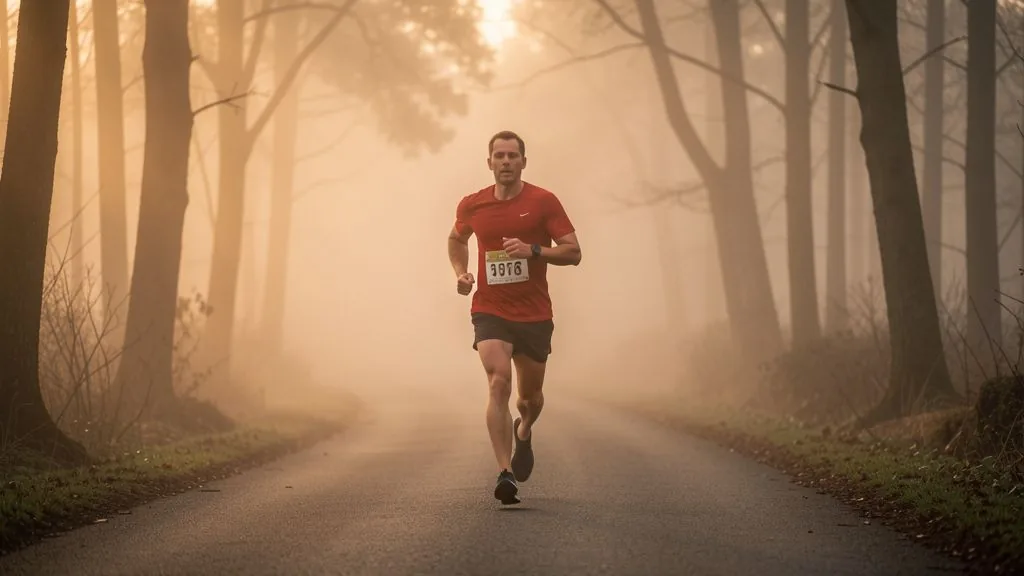
A pulling, stabbing pain on the outside of the knee that arrives after a few kilometres and becomes unbearable on downhills — that is the classic picture of runner's knee. Iliotibial band syndrome (ITBS) ranks alongside shin splints among the most common overuse injuries in running: studies attribute 5 to 14 percent of all running injuries to it. The good news: it is highly treatable — if you address the actual cause. And that almost never lies in the knee itself, but in the hip.
What is runner's knee (ITBS)?
The iliotibial band is a strong fascial sheet running from the pelvic crest along the outside of the thigh to the outer edge of the top of the shin. For a long time, runner's knee was considered a "friction syndrome": the band snaps over the outer thigh bone (the lateral epicondyle) with every flexion and extension of the knee and irritates itself in the process. Newer research describes a compression syndrome instead — at roughly 30 degrees of knee flexion, exactly the angle at foot strike during running, the richly perfused tissue beneath the band is pressed against the bone. Both lead to the same result: a painful irritation on the outside of the knee that increases under running load.
Importantly, the band itself is rarely the structural problem — it is nearly inextensible and extremely resilient. The irritation arises from how load reaches the knee. And that is controlled to a large extent by the hip musculature.
Symptoms: how to recognize runner's knee
- Pain on the outside of the knee. Precisely localizable at the outer thigh bone, about two to three centimetres above the joint line. Not a diffuse knee pain — a clear point.
- Typical onset pattern. The pain does not start immediately but after a strikingly consistent distance — often between kilometres 2 and 5 — and then intensifies quickly.
- Downhill worse than uphill. Running downhill keeps the knee loaded longer in the critical flexion angle. Many affected runners can climb almost pain-free but can barely descend.
- Pain-free at rest. In daily life and at rest you usually feel nothing — except in advanced stages, when even stairs start to pull.
- Fades after stopping. The moment you stop, the pain subsides within minutes — which tempts many to head out again the next day.
Causes: why the hip is to blame
Runner's knee arises from the combination of a local weak point and a load spike. The central local factor is weakness of the hip abductors — above all the gluteus medius. This muscle stabilizes the pelvis during the stance phase of running. If it is too weak, the pelvis drops toward the opposite side, the knee drifts inward (a valgus knee) and the IT band is tensioned across the epicondyle. Studies consistently show markedly weaker hip abduction on the affected side in runners with ITBS. Several other factors contribute:
- Load spikes. Increasing volume or long runs too fast — classic in marathon build-ups when long runs grow beyond 25 kilometres. How to dose progression cleanly is covered in our article on load management with ACWR.
- Heavy downhill and track work. Downhill stretches and running endlessly in the same direction on the track load the outer knee one-sidedly. If you are adding hill training, walk the descents at first.
- Worn-out or unsuitable shoes. After 500 to 800 kilometres cushioning and guidance degrade. What matters when buying running shoes is covered separately.
- Leg-length difference and cambered surfaces. Roads slope toward the edge; always running on the same side creates a functional leg-length difference. Switch sides or choose level surfaces.
- Tight thigh and hip muscles. A tight TFL or quadriceps increases tension on the band — targeted stretching and foam rolling complement strength work here.
Differential diagnosis: what else it could be
Not every pain on the outside of the knee is runner's knee. A meniscus injury tends to present with locking, swelling or the feeling that the knee "catches". Osteoarthritis of the lateral compartment hurts more independent of load and creeps in gradually, typically in middle age. Irritation of the biceps femoris attachment or the fibular head also sits on the outside, but lower and behind the classic ITBS spot. With swelling, locking or night pain at rest: get a medical evaluation, with imaging if in doubt.
Acute phase: the first one to two weeks
As soon as the pain appears in every session: cut running volume at least in half, better take a one- to two-week running reset. Remove downhill and track sessions — both irritate the structure the most. Immediately after a run, cold helps (15 minutes, with a cloth). Do not massage or roll the painful point itself; work the musculature above it: outer thigh, TFL, glutes. NSAIDs are acceptable for the first few days, but they are not a free pass — they dampen the signal, not the cause. Cycling and swimming are pain-free in almost all cases and preserve fitness; on the bike, set the saddle slightly higher to reduce time spent in the critical flexion angle.
Returning to running: the staged plan
As with shin splints: criteria beat calendars. A stage is passed when it stays pain-free for two consecutive days — during the session and the day after:
- Stage 1 — daily life: Stairs and 30 minutes of brisk walking without any pulling. Daily hip strength work (see next section).
- Stage 2 — short test runs: 10–15 minutes of easy running on flat, soft ground, every other day. No hills, no pace work.
- Stage 3 — build volume: Extend runs gradually to 30–40 minutes, at most 10 percent per week. First gentle climbs; descents still walked.
- Stage 4 — full training: Tempo runs, intervals and long runs return — in that order, not all at once. Run downhill sections again only after three symptom-free weeks.
The 4 most effective exercises for runner's knee
The evidence is clear: hip abductor strength is the most effective component — in studies, more than 90 percent of those affected returned to pain-free running after six weeks of consistent hip training. Four exercises, three times per week, slow and controlled:
- Side-lying band abduction. Standing, a mini band around your ankles, lead the leg out to the side without tilting the pelvis. 3 sets of 15 per side. Hits the gluteus medius directly.
- Clamshells. Lying on your side, hips and knees bent, open the top knee like a clamshell while the feet stay together. 3 sets of 15 — progress with a band later.
- Single-leg squat. In front of a step or stool, lower with control, knee tracking over the foot — it must not cave inward. 3 sets of 8–10. Trains exactly the stability pattern that is missing when running.
- Side plank with leg lift. Support on the lower forearm, lift the top leg additionally. 3 sets of 30–45 seconds. Combines core and hip stability — see also core training for endurance athletes.
In addition: foam rolling for the outer thigh and glutes, three to four times per week, 60–90 seconds per side. Rolling does not replace strength work, but it measurably reduces the muscle tone that tensions the band.
Long-term prevention
- Strength training as a fixed element. Two short hip and leg sessions per week, year-round — not only when something twinges. More in our article on strength training for runners.
- Build volume in steps. At most 10 percent per week, with a deload week every three to four weeks. Most runner's knee cases appear in weeks with unusually long runs.
- Downhills in moderation. Build downhill volume more slowly than climbs — the eccentric load is the sharper stimulus.
- Vary direction and surface. Alternate direction on the track, switch road sides, mix soft and hard ground.
- Check your cadence. A roughly 5 percent higher stride rate shortens your step and reduces the knee collapsing inward during stance.
For an overview of the other common running injuries — from shin splints to plantar fasciitis — see our article on running injury prevention.
How Peakora defuses runner's knee risks
Like most running injuries, runner's knee is a load-management problem: a load spike meets an unprepared structure. The Peakora engine builds your weekly volumes within an adaptive corridor — long runs grow step by step, deload weeks are firmly anchored, and the recovery monitor detects via resting heart rate, sleep and your form curve (TSB) when your body can no longer absorb extra load. If you report knee discomfort in the check-in, the plan automatically dials back volume and pace instead of stubbornly pushing the hard session through. And the integrated strength and mobility units — including hip stability — are part of every plan, not an optional add-on. The very exercises that studies show to be the most effective ITBS prophylaxis are in your weekly schedule before your knee ever speaks up.
Frequently asked questions about runner's knee
What is runner's knee (ITBS)?
Runner's knee in this context means iliotibial band syndrome (ITBS), an overuse injury on the outside of the knee. The iliotibial band — a tight strip of fascia running from the pelvis to the shin — compresses and irritates tissue against the outer thigh bone under load. It is one of the most common knee injuries in runners.
Can I keep running with ITBS?
Only if the run stays completely pain-free. Running through increasing pain significantly prolongs healing. Cut volume immediately, drop long runs and downhill sections, and replace sessions with cycling or swimming until brisk running is symptom-free.
How long does ITBS take to heal?
With consistent offloading and hip strengthening, an acute case typically heals in two to six weeks. If you have run through it for months, expect several months of rehab. Return to full training only when daily life and easy runs are durably pain-free.
Does stretching help IT band syndrome?
Stretching alone is not enough — the IT band barely stretches. Foam rolling the outer thigh and, above all, strengthening the hip abductors such as the gluteus medius are far more effective, since their weakness is the main driver of ITBS. Stretching can complement but not replace strength work.
Train smart — before your knee speaks up
Adaptive weekly planning, integrated strength training and a recovery monitor that detects overload before it injures you. Start for free, no credit card required.
Start for free