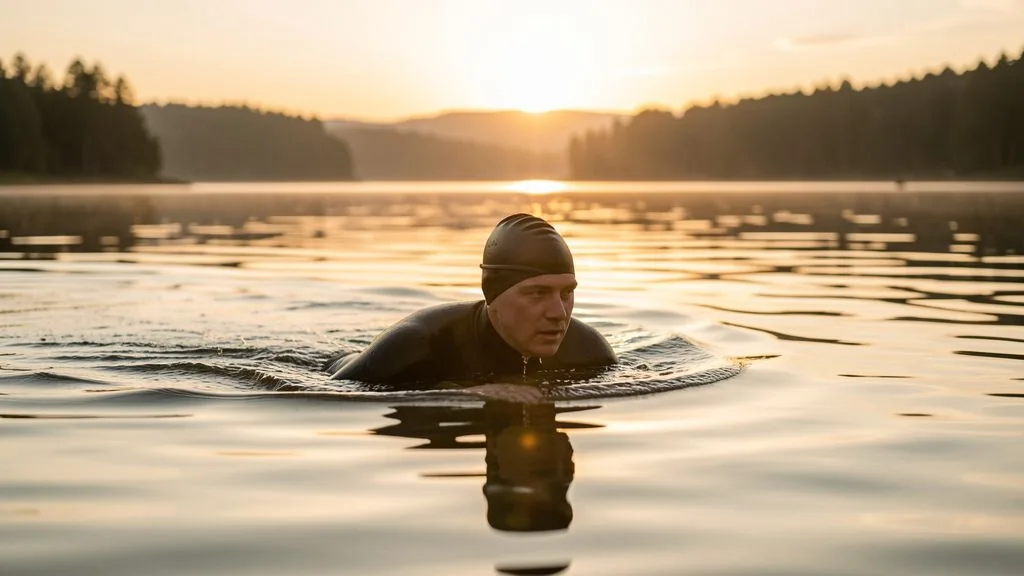
Pool time in winter is scarce. Indoor pools keep opening hours, lanes are crowded, and getting there costs more time than the session itself. That is exactly why winter is the best technique window of the year: you do not swim more metres, you swim better ones. A swimmer who leaves the water in spring gliding ten centimetres further per stroke is faster in every triathlon than someone who spent the whole winter grinding out laps.
Why winter is the technique window
In summer, swimming is a fitness window: you swim a lot because you have to, and technique work falls victim to volume. In winter the ratio flips. If you only get four to six kilometres a week in the water anyway, every one of them can have a clear purpose — and technique is the lever with the biggest payoff.
The maths is simple: water is around 800 times denser than air. Anyone swimming with poor body position pushes water downwards on every stroke instead of moving forward. A missing long stretch on the arm or hips that sink cost you more minutes over an Olympic distance than any single endurance session you skip. The gap between two swimmers of equal fitness over 1,500 metres is often five minutes and more — and that gap is ninety percent technique.
Technique is also the only area in endurance sport that costs no real recovery budget. A focused technique session stresses the cardiovascular system far less than an interval session on the bike or on foot. When your winter is already packed with base work, strength and cycling, swimming is the session that takes the least away. More on the role of technique in the whole system in improve your freestyle technique.
One technique focus instead of ten projects
The biggest mistake in the winter swim block is collecting too much: fingertip, head position, rotation, kick, breathing — all at once. Swim technique does not improve in parallel. The body can only automate one movement change at a time; once two changes come together, the movement falls back into the old pattern the moment you get tired.
So work with a single focus across a block of four to six weeks. Pick one aspect — body position, say — and close the block only when it holds under fatigue. Then move to the next focus. It feels slower than a full rebuild, but it is the only way that lasts.
The three areas with the biggest payoff for beginners are: body position (chest low, legs high, head neutral), the stretch on the stroke (glide, don't pull through) and breathing (exhale underwater, rotate the head around the axis instead of lifting it). All three are technique points you can train in short sessions too. How breathing becomes the most common limiter is covered in freestyle breathing technique.
Little pool time — use it like this
Because pool time is the scarcest resource, the structure inside a session has to be right. The proven order:
- Warm-up (200–400 m): Easy, no clock pressure. With only two sessions a week, even the warm-up must contain technique: 4 × 50 m with one fixed focus.
- Technique block (400–600 m): One drill per block, two at most. Short repeats of 25 to 50 metres with full recovery. This is not about heart rate but about movement memory.
- Main set (600–1,200 m): Anything fast happens now — intervals, stroke-rate sets, longer repeats at an even rhythm.
- Cool-down (200–300 m): Easy, long and stretched out, with the feeling of the last good repeats in the body.
The technique block works best right after the warm-up: the body is warm but not yet fatigued. Anyone who does technique at the end of a hard session rehearses mostly their mistakes.
Five drills that carry you through winter
Five drills cover everything beginners and advanced swimmers need in winter. Pick one or two per session, not all five:
- Superman (25 m): Arms stretched forward, legs quiet, swimming with only a minimal kick. The drill shows immediately whether body position holds — if the legs sink, there is no tension in the trunk. Goal: hold the position for ten seconds.
- Fists (25 m): Swim with a closed fist. Without the palm as a paddle, pressure shifts to the forearm — exactly where you should catch water in the normal stroke. Afterwards, open-hand swimming feels instantly bigger.
- Stroke counting (50 m): Count the strokes per length. The goal is not fewer at any cost but noticing where the count grows or shrinks. Stroke length is your most honest winter feedback.
- Single-arm (25 m per side): One arm stays at the body while the other pulls. The drill forces clean rotation and shows which side the position tips on. Almost every asymmetry in swimming shows up here.
- Head-up sighting (25 m): Lift the head briefly every three to four strokes as if spotting a buoy. Trains exactly the sighting that matters in open water without losing body position. More in open-water sighting.
A drill is only worth something if it shows up again in the normal stroke. After every drill, swim a short stretch normally and notice consciously what has changed.
Little volume, but high continuity
Swimming does not forgive a month off. Feel for the water — the ability to sense pressure on the arm and convert it into propulsion — builds slowly and is lost quickly. Two sessions a week maintain that feel, one session a week barely preserves it, and three weeks in a row without water puts you close to a beginner's level again.
So the right winter strategy is not "swim more" but "never stop completely". A short 30-minute session of 1,000 metres of technique does more across a winter than a single long session every three weeks. Winter is long, and the biggest progress comes from continuity, not from individual heroics.
If you really cannot get in the water — pool closed, time too tight — dryland pull work can help: stroke movement on a stretch band, shoulder strength, trunk stability. That maintains muscle but does not replace feel for the water. As soon as the pool reopens, the first sessions belong to technique, not endurance.
Strength and dryland as a supplement
Swimming is a pull-dominant movement. That is why strength training in winter is a particularly useful supplement: pull movements such as rows or pull-ups, shoulder press and cable rotations strengthen exactly the muscles that fatigue first in the water. Overhead stability pays off too, because it holds the shoulder position in the water when strength fades.
Two strength sessions a week with four to six key lifts are enough. What matters is that strength is not a substitute for water but a supplement on land. Anyone who only lifts in winter comes out of the gym with strong arms but no feel for the water. How to combine strength and endurance sensibly is in concurrent training of strength and endurance.
The shoulder deserves attention too. Winter is the ideal time to spot a budding irritation before the open-water season begins. Shoulder pain from swimming almost always comes down to technique and the strength ratio — more in swimmer's shoulder pain.
Common mistakes in the winter swim block
- Doing technique when fatigued: Anyone who does drills after 2,000 metres of endurance rehearses mistakes under fatigue. Technique belongs at the end of the warm-up.
- Too many projects at once: Five technique changes in one session do not stick: none of them. One focus per block, consistently over weeks.
- Endurance without structure: Grinding out laps feels productive but does not change the movement. Winter is the time for quality over metres.
- Two weeks off "until it gets warmer": That is exactly when you lose the feel for the water you built in autumn. Two short sessions a week are enough to keep it.
- Ignoring a shoulder irritation: A tug in the shoulder after swimming is a signal, not a trifle. Winter is the time to analyse it instead of having to pause in spring.
Frequently asked questions about winter swimming
How often should I swim in winter?
Twice a week is enough if the quality is there. One technique session with drills and short repeats plus one longer endurance session cover everything. A third short 30-minute session brings more than a third long one, because technique sticks better in short, fresh blocks.
Will I lose swim fitness if I swim less volume in winter?
No, as long as your technique is sound. Swim fitness is mostly technique and body position, and that holds even at four to six kilometres a week across two sessions. What hurts is not low volume but several weeks of a complete break with no water stimulus at all.
Should I train technique or endurance first in winter?
Technique first. Without clean body position every metre costs you strength, and endurance can be rebuilt faster later than a new movement economy. Use a window of six to ten weeks to set a single technique focus.
How many drills make sense before the technique falls apart?
One drill per block, two at most. Every drill changes the movement — too many at once and none of them stick. Set one focus per week, repeat it for four to six weeks and track progress by stroke length rather than by pace.
Can I replace swimming with strength or dryland work?
Only partly. Pull exercises and shoulder strength build muscle and prevent swimmer's shoulder, but they do not replace feel for the water. One dryland session a week supports swimming, it does not substitute for stroke length and body position.
Plan your swim block with Peakora
Peakora schedules technique, endurance and strength sessions side by side through winter — so you start the season with better body position and fewer injuries. Start for free, no credit card required.
Start for free