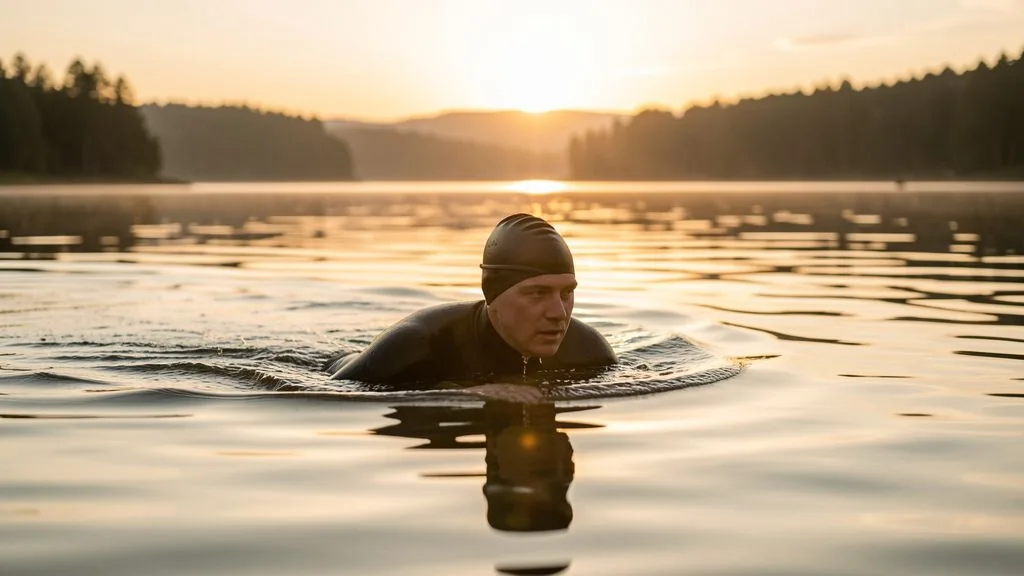
No body part takes more load in swimming than the shoulder: at roughly 2,500 arm cycles per training kilometre of front crawl, the joint has to absorb that movement just as many times in an overhead position. No surprise, then, that shoulder trouble is the most common injury in swimming — estimates put it at 40 to 70 percent of all swimming injuries. The good news: swimmer's shoulder almost never appears out of nowhere. It announces itself, it has clear causes — and it can be reliably avoided with technique, strength and sensible load management.
What swimmer's shoulder actually is
Swimmer's shoulder is an umbrella term for pain at the front or outside of the shoulder caused by the repeated overhead movement of the front crawl stroke. In most cases it is an irritation of the supraspinatus tendon or of the bursa beneath the acromion (subacromial bursitis) — at its core an impingement problem. With every stroke the tendon passes through a narrow channel between the head of the humerus and the acromion, and if that channel is narrowed further by posture or stroke factors, friction builds up.
The typical pattern is pain when lifting the arm above shoulder height or during the pull, at first only at the end of a session and when returning to the water after a break — later during swimming itself. Unlike an acute fall injury, the picture builds up over weeks, which is exactly why it is so often taken seriously too late.
The six most common causes
- Stroke errors at the catch. Entering the water far beyond the body line and pulling straight back with a locked elbow drives the head of the humerus forward into the acromion. Rotating the arm inward — entering thumb first — makes it worse. Front crawl should enter with a slight elbow bend and without internal rotation.
- Breathing on one side only. Always breathing to the same side keeps the torso rotating asymmetrically, which pulls the opposite shoulder into an unfavourable position. Bilateral breathing — or at least a conscious change of sides — spreads the load.
- Too much paddle volume. Paddles increase the surface area in the water and with it the shear forces on the shoulder many times over. They are a tool to be dosed strictly, not a volume booster — with a sensitive shoulder they should come out of the plan entirely.
- Unstable shoulder blades. Rotator cuff and scapular muscles are often undertrained in swimmers, while chest and lats are strong. The shoulder joint then loses its guidance and drifts with every pull.
- Tight chest and internal rotators. A posture with a rounded back and shoulders pulled forward permanently narrows the space under the acromion. Desk work makes this worse.
- Ramping volume too fast. Tendons need weeks to adapt to a new stimulus. Going from a weekly 2,000 to 6,000 metres because a race is approaching outpaces the tendon's capacity to adapt — a classic case in the build-up.
What to do right now — and what not to
With the first symptoms one rule matters: pain-free swimming yes, swimming through the pain no. Grinding it out usually extends time off by weeks, because the irritation becomes chronic.
- Cut volume, not technique. Reduce swimming volume to 50 to 70 percent but keep the frequency — three short, clean sessions instead of one long one with collapsing technique.
- Drop paddles and pull cords. Anything that adds pulling resistance on the shoulder comes out of the plan for now. Short fins are usually fine.
- Use a pain traffic light. Below 3 out of 10 and settling during the swim: fine. Above 3 or increasing after training: end the session.
- Heat and gentle movement. In the acute phase, cooling for 48 to 72 hours after loading; for longer-lasting stiffness, rather warmth. Complete immobilisation is counterproductive — the shoulder needs pain-free movement.
- Keep chest, back and shoulder moving. A simple sequence: cat-camel, doorway stretch for the chest, pendulum for the shoulder, gentle external rotation with a light band. Ten minutes daily, without pain.
The strength programme for stable shoulders
The most effective prevention is not a stretch but targeted strength for the rotator cuff and the scapula. The exercises are deliberately light: this is not about maximum strength but about clean guidance of the joint across hundreds of repetitions. Two to three sessions a week, each with 10 to 15 repetitions over two to three sets, add up to barely ten minutes.
- External rotation with a band. Elbow at 90 degrees against the body, band anchored at chest height, rotate the forearm outward — return slowly and under control. The single most important exercise for swimmer's shoulder.
- Y-raises. Lie prone or on an incline bench, lift the arms forward and up in a Y position, thumbs up. Trains the lower part of the trapezius, which stabilises the scapula downward.
- Single-arm rows. Pull the elbow back close to the body, consciously taking the shoulder blade with it. Strengthens the mid-back against the dominant chest muscles.
- Seated scapular retraction. Pull the shoulder blades gently back and down, hold for 5 seconds, repeat 10 times. Works as a micro-exercise at the desk too.
- Face pulls with a band. Band at eye level, pull the handles toward your face with the elbows held above shoulder height. Strengthens the external rotators under dynamic load.
Dosage matters: these exercises should be light and precise — not performed with compensations and momentum. If you want to plan two or three strength blocks alongside your endurance training, our article on strength training for cyclists gives you the structure to combine strength and endurance sensibly.
Technique fine-tuning: how the arm moves pain-free through the water
- Entry point just inside the shoulder line. The arm enters at the front, but not so far that it crosses the midline. A clean entry point takes pressure off the acromion.
- High elbow during the pull. The hand does not pull straight back; the elbow stays high and the forearm points down like a paddle. That delivers the same force without overhead pressure.
- Body rotation instead of shoulder power. The main propulsive force comes from rotating the torso. Pulling with the arm alone loads the shoulder more and makes you slower — two drawbacks in one.
- Bilateral breathing. Breathe alternately at least at the start of every session so the asymmetry does not become ingrained.
- Short reps, clean technique. With symptoms, choose many short repetitions with a technique focus (for example 10 × 50 metres) over long sets with collapsing movement quality — exactly as with interval training, which we cover in the article on how to dose interval training.
Combining strength work with your triathlon plan
In a well-built triathlon plan the swim sessions are staggered so the shoulder recovers between two stimuli — three swim sessions a week is the upper limit for most athletes. Shoulder strength blocks belong on the easy days, not before a hard water session, so the shoulder is not loaded twice a day. Plan your week properly and this sorts itself out: a look into the training glossary helps with the technical terms around supercompensation and load management.
Common mistakes
- Ignoring pain because "it's part of it". A mild irritation is not part of training, it is a signal. Ignoring it for two weeks usually costs two months instead of two weeks.
- Stretching only, not strengthening. Stretching alone does not resolve impingement — joint guidance comes from muscle. Strength is the key, stretching only the entry ticket.
- Simply switching to backstroke or breaststroke. Back and breaststroke only partially unload the shoulder because internal rotation remains. Short freestyle sessions with clean technique plus strength work are far more effective.
- Strength work in winter only. Shoulder stability is not a seasonal measure but part of year-round training — especially in the main phase, when volume is high and recovery is scarce.
Questions and answers
What is swimmer's shoulder?
Swimmer's shoulder is an overuse inflammation of the tendons and bursa in the shoulder joint, usually caused by the repeated overhead work of the front crawl arm stroke. It is the most common complaint in swimming.
Should I keep swimming with shoulder pain?
No — pain-free swimming yes, swimming through the pain no. Cut your volume to 50 to 70 percent, drop paddles and pull buoys, and stop the session as soon as the pain goes above 3 out of 10.
Which exercises help with shoulder pain from swimming?
External rotation with a band, Y-raises, single-arm rows and scapular retractions strengthen the rotator cuff and the scapular stabilisers. Three sessions per week with 10 to 15 repetitions each are enough.
How long does swimmer's shoulder last?
A mild irritation usually settles within two to four weeks of consistent load adjustment. Pain at rest, loss of strength or night pain should be assessed by a doctor before you keep training.
Peakora plans all three disciplines for you
Swimming, cycling, running, strength — Peakora builds your triathlon training plan with the right weekly structure for your distance and your level. Start for free, no credit card required.
Start for free