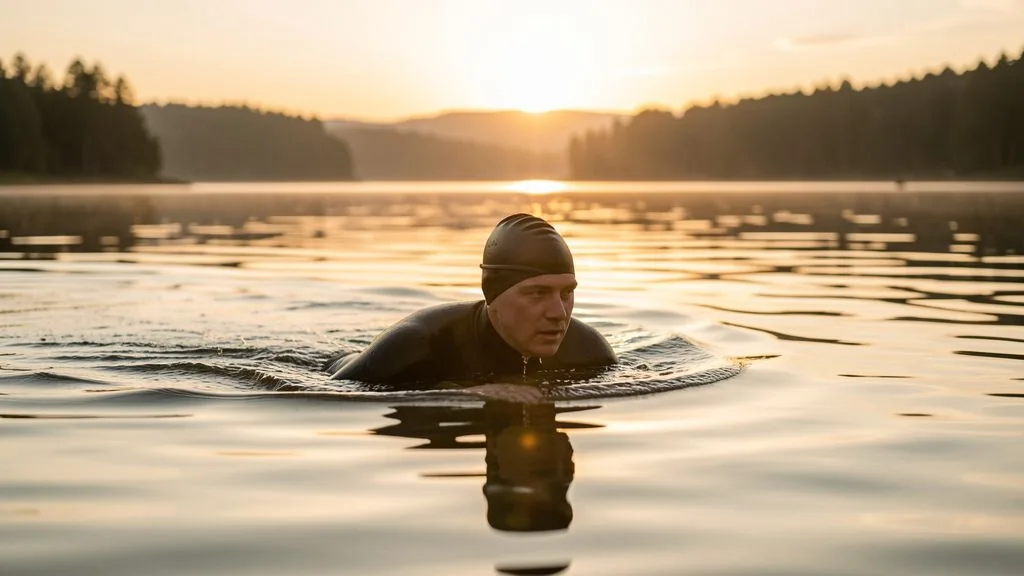
For most beginners the swim is the hardest part of a first triathlon. Not because of the distance — 750 metres is objectively short — but because water offers no ground under your feet, the breathing feels foreign, and technique falls apart the moment your heart rate climbs. This is exactly where your first triathlon is won or lost. This guide shows you how to get through the swim leg safely on two sessions a week.
Why beginners swim too hard in the water
Adrenaline at the start line is high, and in the water it is especially treacherous: unlike running, swimming too hard costs you not just energy but technique. Anyone who swims the first third in the red zone loses body position, the breathing tightens, the kick turns restless — and suddenly the rest feels endless. A beginner who attacks 750 metres for a 14-minute split instead of 18 pays that advantage back on the bike and run several times over.
There is a second effect too: good swimming technique is barely maintainable under high load. A clean pull with a high elbow works as long as you stay relaxed. The moment you tense up, you catch water with nothing, sink lower and brake yourself. That is why the most important tactical rule for a first triathlon is not a training rule but a pacing rule: start the water controlled, not fast.
That doesn't mean swim slowly — it means swim evenly. A pace you could hold at the end of the leg just as well as at the start is exactly right. Experienced triathletes call the goal "coming out of the water still feeling fresh". That is the real test of a good swim leg.
Realistic times: what can you expect?
Many beginners are frustrated because 750 metres takes far longer than they imagined. Two factors need separating: technical skill and athletic background. Someone who never swam freestyle systematically before taking up triathlon will have a different time after three months than a former swimmer. Both are fine — the time is only a marker for your own development.
- 750 m (sprint): 16 to 22 minutes is a realistic beginner range, roughly 2:10 to 2:55 per 100 metres.
- 1,500 m (Olympic): 35 to 48 minutes, provided your technique holds throughout.
- 1,900 m (half distance): 45 to 65 minutes. Economy counts for more than speed here.
- Coming from a non-swimmer background: 750 m in 25 to 30 minutes is completely normal and no cause for concern.
More important than the absolute time is consistency: can you swim evenly without stopping in between? A calm rhythm that lasts the whole leg is worth more in a beginner's race than a fast first half.
Technique before pace: the right order
The most common training mistake beginners make is pushing volume and speed immediately. That's understandable but counterproductive. Swimming is the most technical of the three disciplines, and faulty movement patterns only get grooved deeper through repetition. Two to three months of consistent technique work deliver more than a year of mindless lap counting.
In practice that means: technique work comes at the start of every session, while you are fresh. Only after 20 to 30 minutes of drills does a short pace block follow. Anyone training technique at the end of an exhausted session rehearses exactly the errors that appear under fatigue. For the details of the movement patterns — body position, rotation, high elbow, breathing — we have summarised the six core points in Improve freestyle technique.
- Session 1 (technique): 30 minutes of drills, plenty of short rest, no fatigue. Goal: feel for the water, not speed.
- Session 2 (load): 5 minutes warm-up, 8 × 50 m at a calm but controlled pace with 20 seconds rest, 5 minutes cool-down.
- From week 6: extend one session — 400 to 600 metres unbroken to build consistency.
- Every second week: move one session to open water as soon as the water temperature allows.
Stroke count per length is the best simple progress indicator. If you regularly take two or three fewer strokes per 25 metres than four weeks ago, your technique has improved — regardless of what the clock says.
Breathing: the underestimated factor
Breathing is where beginners most often fail in triathlon swimming. Not because they don't get enough air, but because they lift the head too far and destroy their body position in the process. The right way: in freestyle, breathing uses torso rotation. You turn only the head with the shoulder line until the mouth is just above the surface — no more.
For racing we recommend bilateral breathing on a three-stroke rhythm. It keeps rotation symmetrical and — more importantly — makes you flexible in open water. You can adapt your breathing side to waves, spray and sight lines instead of being rigidly fixed to one side. Anyone who can only breathe to one side has a real problem in the chaos of the start.
A practical test: swim four lengths without feeling breathless by exhaling consistently underwater through nose and mouth. If you postpone exhaling, you have no time to inhale when you surface — that is the most common reason for the feeling of getting no air at all.
From the pool to open water
Open water is a different sport. There are no lines on the pool floor, but there are waves, sighting, body contact and a wetsuit that feels different. The most important new skill is sighting: every six to eight strokes you lift the head slightly to fix on the buoy. It is tiring and must be practised — anyone who starts doing it in the race loses pace and orientation.
So plan at least three or four open-water sessions before your race. Deliberately practise the situations that occur in a race: a mass start, sighting, staying calm when someone splashes water in your face. The ability to stay relaxed under stress is worth more in open water than any second in the pool.
On the wetsuit: below roughly 20 degrees Celsius it adds noticeable buoyancy and warmth, and that buoyancy changes your body position for the better — many beginners swim faster in a wetsuit. Still, the rule holds: rent for your first race rather than buy. Only once you know you are staying in triathlon is a properly fitting suit worth the investment.
Common beginner mistakes
- Starting too hard: The number one adrenaline error. Costs technique, breathing and the second half of the race.
- Swimming without technique work: Anyone pulling laps for twelve weeks without drills repeats the same mistakes a thousand times.
- Volume before technique: More kilometres with poor form don't make you faster, just more tired.
- Ignoring open water: A 25-metre pool simulates neither waves nor sighting nor jostling.
- Misreading the legs as propulsion: The kick burns the most oxygen and delivers the least propulsion. Two kicks per arm stroke are enough over long distances.
- Buying gear before fixing form: A wetsuit does not replace body position. Technique first, equipment second.
Fitting swim sessions into your overall training
You don't train swimming in isolation. Anyone running three disciplines in parallel has to keep an eye on total load, or overtraining creeps in — and beginners in particular overestimate how much swimming their shoulders and torso can absorb. The metrics CTL, ATL and TSB help you judge whether an extra swim session fits the week or whether the load is already too high.
A second building block is combined training: pairing the swim with the bike is easier than a brick bike-run, because the transition zone sits between the disciplines anyway. Even so, it is worth rehearsing your transitions dry. The procedures around T1 and T2 often cost beginners more time than the swim itself — and are the easiest place to win minutes.
Anyone planning training systematically and spreading load across the week progresses better on two swim sessions than someone bolting on four sessions at random. In the Peakora overview you see your planned swims alongside bike and run, including the triathlon training structure — so your swimming week matches your total load.
The bottom line
Swimming in your first triathlon is not a feat of strength but a matter of system. Two sessions a week are enough when one of them is technique work. Start controlled, breathe bilaterally, practise sighting in open water and keep total load in view. Anyone who trains technique consistently for twelve weeks and adds three or four open-water sessions will exit the water safely — and still have the energy on the bike and run to actually race. That is the point: the swim leg is not the goal but the transition into the part of the race where you make your decisions.
Frequently asked questions
How often should a beginner swim for triathlon?
Two sessions a week are enough to start. One is pure technique work, the other intervals with clean form. A third session or more only helps once your technique holds — before that, extra volume just cements mistakes.
What is a normal swim time for a beginner in a sprint triathlon?
For 750 metres, 16 to 22 minutes is a realistic beginner range, which is roughly 2:10 to 2:55 per 100 metres. Coming from a non-swimming background, 25 to 30 minutes is common. The first goal is simply to swim the distance continuously.
Can I complete the triathlon swim leg with breaststroke?
Yes, it is allowed and for many beginners the pragmatic route. Breaststroke is roughly 20 to 30 percent slower but saves energy for the bike and run. If you are unsure about freestyle, work on technique in parallel, because freestyle is far more economical in the long run.
Why do I have no energy left for the bike and run after swimming?
Usually the swim leg is attacked too hard. The race starts in the water, but it is decided on the bike and run. Start controlled and five to ten percent slower than in training — that pays back double in the final kilometres.
Do I need a wetsuit for my first triathlon?
Only if the water is cold. Below roughly 20 degrees Celsius a wetsuit adds noticeable buoyancy and warmth; in warm water it is optional or even banned. Rent one for your first race instead of buying straight away.
Plan your triathlon training with Peakora
Swim, bike and run in one weekly structure with real load management — start free, no credit card required.
Start free