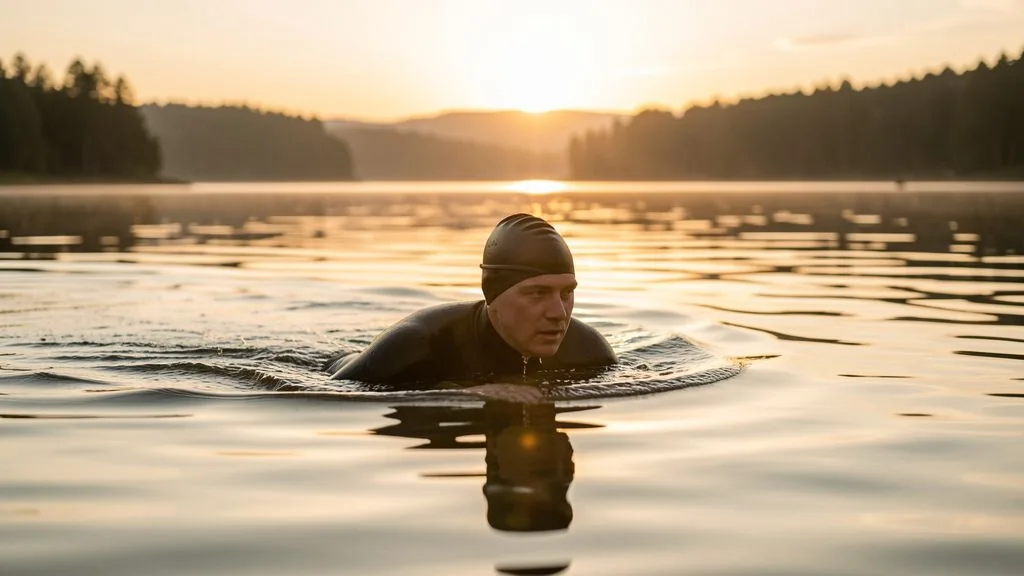
No endurance race stresses your fueling plan like a triathlon: you eat on a moving bike, drink at 40 km/h, switch sports mid-race — and your gut is supposed to keep up the whole time. In a middle-distance triathlon, your nutrition strategy often decides more minutes than any gain in fitness. This article gives you the complete race-day plan: breakfast, fueling on the bike, the handover to the run, and the mistakes that most often cost races.
Why triathlon nutrition is different
In a pure marathon you can eat and drink on almost any stretch of road with relative ease. In a triathlon it works differently: swimming rules out any food intake, the bike leg is the big eating window — and the run is when your gut is most sensitive under load. Gastric emptying works considerably worse at high running intensity than at a controlled bike pace. Anyone who pushes their fueling back to the run pushes it into the window with the worst absorption. The basic rule is therefore: as much as possible on the bike, on the run only essential maintenance.
Then there is the sheer duration: for a middle-distance race of 4 to 6 hours, the long-distance recommendations apply — 60 to 90 grams of carbohydrates per hour, plus 400 to 800 ml of fluid and 300 to 600 mg of sodium. For an Olympic-distance race around the 2-hour mark, 30 to 60 g/h is enough; there, race-morning breakfast and one gel on the bike do most of the work. The numbers for the whole race week are covered in the article on carb loading.
Race morning: breakfast and the start window
Three to four hours before the start, eat 1 to 3 grams of carbohydrates per kilogram of body weight — at 70 kg that is 70 to 210 grams. Proven choices are low-fibre, low-fat sources: white bread with honey, oatmeal with banana, rice with a pinch of salt, or a pancake. Keep protein and fat minimal, because both delay gastric emptying. If you start at 7 a.m. and cannot face food at 5:30, shift the intake to the evening before — then eat an earlier, smaller breakfast.
- From 90 minutes before the start: no more large meals; small sips of sports drink or water are fine.
- From 60 minutes before the start: reduce drinking to small amounts, no more gels — otherwise the blood-sugar peak lands exactly at the swim start.
- 10 to 15 minutes before the start: optionally half a gel plus a few sips of water, especially with a late start wave in large fields.
And the iron rule that outranks everything else: nothing new on race day. Every product — breakfast, gel, drink mix — has to be tested beforehand, in training camps and long sessions. Ideally in combination: exactly the way you plan to use it on race day.
On the bike: the big eating window
The bike leg delivers the calories for the whole race — it has the highest gut tolerance because your upper body is stable and the intensity is controllable. Your routine at the handlebars should look like this:
- Gels or energy bars at fixed intervals: at 60–90 g/h that means, for example, two 40 g gels per hour plus a carbohydrate-rich sports drink — set your watch or use a bike-computer alert.
- Drink to a plan, not to thirst: 400 to 800 ml per hour, towards the upper end in the heat. A drinking plan on the top tube (20/40/60 minute marks) keeps drinking from getting lost in the group.
- Plan your sodium: 300 to 600 mg per hour via sports drink or salt tablets — especially in sweaty conditions.
- No unknown food from aid stations: bananas and cola at the station are fine; unfamiliar bars and gels are not.
Your gut's absorption capacity is trainable: anyone who regularly practises 80 to 90 g of carbohydrates per hour on the bike in training tolerates far more on race day than someone who trained at 40 g/h. Details on building this up are in the article on gut training. The timing of your last big gel is also tactical: take it about 10 to 15 minutes before T2 so that it is partly absorbed by the time you change to the run.
Into transition: take T2 seriously
Transition is a nutrition transition too. A proven little ritual: a few sips of water or cola as you rack the bike, one gel in the transition bag for the first run kilometres. Keep the early run pace deliberately moderate — after the bike, gastric emptying needs a few minutes to get going again. Anyone who sprints out of T2 at full throttle while swallowing a gel often buys themselves GI shutdown in the final third of the run. The full transition tactics are in the article on T1 and T2.
On the run: maintain, don't load
On the run the logic of the bike reverses: at high running intensity the gut tolerates considerably less. Realistically you will manage 30 to 60 g of carbohydrates per hour — smaller gels at shorter intervals, sipped in small portions, with water at every aid station. Cola at the aid stations is a proven classic at long distances: sugar plus fluid plus a small caffeine push, easy to digest.
Optionally, caffeine in the final third is worth it: about 3 mg per kilogram of body weight — at 70 kg roughly 200 mg, about a large coffee — reduces the perception of fatigue. But be sure to test the dose in advance; it can cause stomach upset and a racing heart. Also keep the maximum dose of 6 mg/kg in mind, which is considered the upper threshold.
A worked example: middle distance in 5 hours
Concretely, for 70 kg body weight, a target of around 5 hours, planned intake of 75 g of carbohydrates per hour on the bike and 40 g/h on the run:
- 5:00 a.m. — breakfast: oatmeal with banana and honey, white bread with jam (~120 g carbs), 300 ml water.
- 6:45 a.m. — swim start (1.9 km): no gel; your last fluid was 45 minutes ago.
- 7:15 a.m. — T1, onto the bike: drink calmly in the first kilometre, then start the clock.
- 7:30–10:15 a.m. — bike (90 km): a 25–30 g gel or bar every 30 minutes, plus sports drink at 60–80 g/l with sodium; every full hour ≈ 75 g carbs, 500–700 ml fluid.
- 10:00 a.m. — last bike feed: one gel 10–15 minutes before T2.
- 10:15 a.m. — T2: a sip of water or cola, pocket the run gel.
- 10:15 a.m.–12:15 p.m. — run (21.1 km): half or small gel (~15–20 g) every 20–25 minutes, cola and water at the stations; from halfway, optionally a caffeinated gel (~100 mg caffeine).
That adds up to around 300 g of carbohydrates during the race plus 120 g at breakfast — a quantity that only works if you have reheated it in training. The fluids belong in that rehearsal too: drink exactly as you will on race day, not less "just to test".
The most common nutrition mistakes on race day
- Too little on the bike, too much on the run. The classic pattern: eating gets "forgotten" on the bike, gels get chased on the run, and the gut can no longer absorb them. The eating window is the bike.
- Fueling without gut training. Only those who have trained 90 g/h can absorb it — otherwise GI shutdown follows on the run. Details in the article on marathon fueling.
- Drinking by feel. Thirst is a late signal. Without a plan you end the run dehydrated — or vomiting at an aid station because too much went in at once.
- New products from the expo or the goodie bag. Anything you have not tested in training camps and long sessions has no place on race day.
- Caffeine for the first time on race day. If you have not tested 3 mg/kg beforehand, you are gambling with stomach upset and a racing heart.
How Peakora plans your triathlon fueling
The fueling calculator in Peakora thinks in sports and transitions: based on your estimated finish time you get carbohydrates, sodium and fluids per hour — separately for bike and run, including a caffeine recommendation for the final third. Exported as a PDF, the plan stays reachable in your race bag even without your phone. That turns "eating somehow" into a concrete minute-by-minute plan.
Frequently asked questions about triathlon race-day nutrition
What should I eat on the morning of a triathlon?
Three to four hours before the start, eat 1 to 3 grams of carbohydrates per kilogram of body weight — low in fat and fibre, for example white bread with honey or oatmeal with banana. Only products you have tested in training. No large meal within 60 to 90 minutes of the start.
Can I really absorb 90 grams of carbohydrates per hour on the bike?
Yes, but only with a glucose-fructose mix (2:1), because the gut uses two separate transport proteins — and only with training: regular practice can raise absorption capacity to 90 g/h and beyond. Untrained, the limit is around 60 g/h.
How much should I drink in a middle-distance triathlon?
A guideline of 400 to 800 ml per hour, depending on heat and your personal sweat rate. You measure your sweat rate by weighing yourself before and after a training hour: every kilogram lost equals roughly one litre of fluid. Never exceed the upper limit.
How many carbohydrates do I need on the bike leg of a middle-distance triathlon?
For a total race of four to five hours, the target is 60 to 90 grams per hour. On the bike that means spacing gels and drinks so that every full hour delivers about 60 to 90 grams — for example two 40 g gels plus sports drink. Keep the remainder for the run in mind.
Is caffeine worth it in a triathlon?
Yes — about 3 milligrams per kilogram of body weight in the final third of the race reduces the perception of fatigue. At 70 kilograms that is roughly 200 milligrams, about a large coffee. Important: test the dose in training first, not on race day.
The complete triathlon plan — from transition to the finish line
Peakora builds your triathlon training plan and calculates your fueling for bike and run separately. Start for free, no credit card required.
Start for free