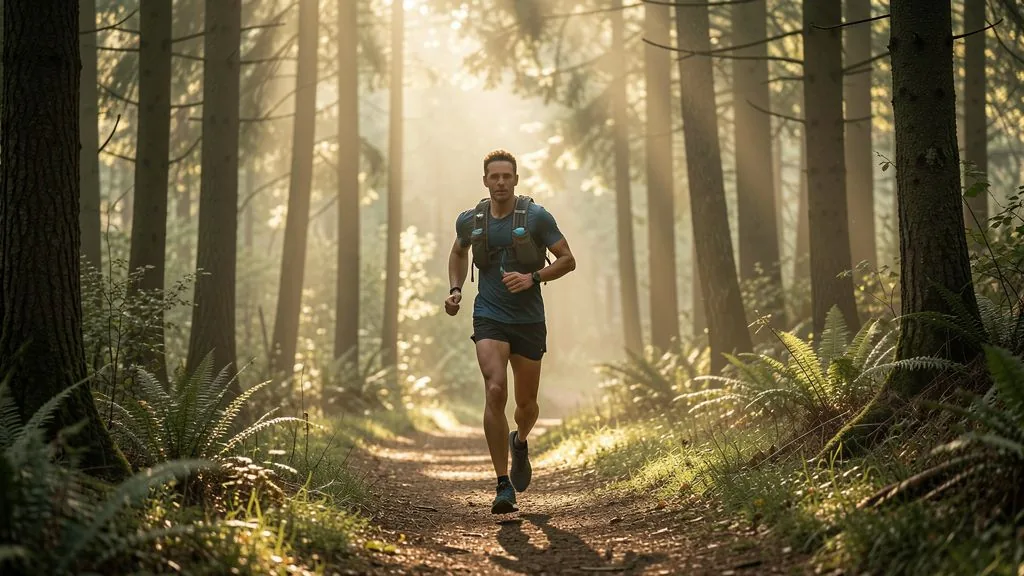
Travel is the most common reason training plans fall apart mid-build: three days on a city break, a week on business, two weeks of family holiday — and suddenly 14 straight days are missing. Yet a trip is not a hole in the plan, it is a phase with different boundary conditions. Know them in advance and you keep your fitness almost fully intact with two to three sessions per week.
Why travel does not ruin your training
The most important fact first: fitness does not decay as fast as most people fear. Measurable decline only begins after roughly 10 to 14 days without any stimulus — and even then the first weeks are relatively gentle, at three to seven percent. What matters is therefore not whether you complete every session on holiday, but whether the travel week contains any stimulus at all.
Surprisingly little is needed for maintenance: two to three sessions per week, one of them long and easy, keep VO2max, threshold power and running economy largely at level. If your weekly volume drops to a third during the holiday week, that is entirely sufficient — what you should avoid at all costs is 14 days of nothing. That gap is the difference between a slight setback and a restart that costs weeks.
While travelling, the focus therefore shifts sensibly: you are not training for progress, you are training for maintenance. The goal is a week you finish rested and still with three solid sessions in the log. Anyone who understands this stops trying to squeeze a training camp into a holiday week — the classic mistake that actually creates the break.
The four factors that matter on the road
In an unfamiliar place exactly four things change that determine your training quality. They should be checked in a fixed order:
- Climate and heat. At 28 degrees and high humidity the same pace costs five to ten seconds per kilometre more and your heart rate sits ten to fifteen beats higher. In the first week steer by duration and heart rate, not by pace, and train in the cool morning hours. Step-by-step acclimatisation is covered in the article on heat training.
- Altitude above sea level. From about 1,200 metres the training load changes noticeably, from 2,000 metres markedly. The first two to three days belong to adaptation: easy, short, no quality stimulus. For longer stays, the full logic is in the article on altitude training.
- Time windows and daily life. A rigid weekly structure does not work while travelling. Put the time straight into your calendar, ideally in the morning — the day is the most stable window on the road because nobody wants anything from you yet. A 40-minute window is more realistic than 90.
- Kit. Two pairs of running shoes are a luxury, one is mandatory. Add a technical shirt, shorts, socks — and the golden rule: everything you wear on holiday you have already worn at home.
Jet lag and night flights: the first 48 hours
A night flight east is worse for your training plan than any time crunch. Across five time zones your inner rhythm shifts by only about one hour per day — so the body needs almost a week to arrive. In this phase reaction time and coordination drop while perceived effort rises. That is exactly the window in which strains and ankle rolls accumulate.
In practice: no session on arrival day, just a walk and daylight at local time. On day two a short easy session of 30 minutes. Your first quality stimulus comes only once you have slept reasonably normally for two nights. Travelling west is considerably easier — the day is lengthened, you stay up later in the evening and can usually train easily after just 24 hours.
For the return trip the same build-up applies in reverse: in your first week back home, plan no hard session but an easy re-entry week. Anyone who builds in this buffer loses fewer training days than someone who schedules a tempo run the day after returning and then has to abandon it.
Kit: the minimal set in your carry-on
- Shoes: one broken-in pair in your carry-on (not in checked luggage — bags regularly arrive late). On longer trips with planned tempo sessions, a second, lighter pair is worth it.
- Clothing: two technical shirts, one pair of shorts, three pairs of sports socks, a light rain jacket. The 3-2-1 rule covers a week with daily washing, and hand-washing with travel detergent takes 15 minutes.
- Heart rate strap: if you steer sessions by heart rate, bring the chest strap — optical wrist sensors are noticeably less accurate in heat and with arm movement.
- Fuel: one or two gels or bars for the long session, a collapsible bottle. Unfamiliar places do not always have water fountains — the route planner helps you mark them in advance.
- Small items: blister plasters, tape, high-factor sunscreen, electrolyte tabs. In heat, sodium is the limiting factor, not water.
A 7-day pattern for the hotel week
A travel week does not need a complicated structure. This proven pattern with three sessions looks like this:
- Day 1 (arrival): no running session. A 30-minute walk, 10 minutes of mobility, plenty of water.
- Day 2: 30–40 minutes easy (heart rate zone 2), very early if it is hot.
- Day 3: rest day or 20 minutes of mobility and foot strength in the room.
- Day 4: tempo session — 10 minutes warm-up, 4 × 2 minutes brisk with 2 minutes jog recovery, 10 minutes cool-down. Short, controlled, no all-out effort.
- Day 5: rest day.
- Day 6: long session 60–90 minutes easy, by feel, with a bottle. The most important session of the week.
- Day 7: rest day, or 30 minutes very easy if the legs feel good.
That is around two hours of training across three stimuli — more than a maintenance week does not need. On top, a ten-minute core routine every second evening is worth it: 3 × 45 seconds plank, 3 × 20 seconds side plank per side, 3 × 15 calf raises. The core training article has the full exercise selection, and if you want even more context, the Peakora encyclopaedia (German) defines TSS, TSB and training zones for steering on the road.
Nutrition and hydration on the road
While travelling the biggest nutrition trap is not the buffet but the combination of heat and a changed eating rhythm. Two rules are enough. First, drink deliberately, because the thirst signal arrives too late in heat — budget an extra 500 to 750 ml per training hour, and more above 30 degrees. Second, keep protein intake stable so that maintenance reaches your muscles and not just your cardiovascular system.
Before the long session, the same applies as at home: a carbohydrate-focused meal you know, two to three hours beforehand. A holiday is the worst possible moment for your first big curry or first street-food experiment right before a long run. The evening before offers more room — the day before belongs to experimenting, not the night before. Details on amounts and timing are in the article on post-workout nutrition.
Safety and routes in an unfamiliar place
The most common travel injury has nothing to do with overtraining but with unfamiliar ground: cobblestones, kerbs, poorly lit streets. Three rules prevent most of it. First: your first session in a new place is always an exploratory lap at easy pace, where you learn the route instead of completing it. Second: run at the roadside against the flow of traffic so you can see the vehicles. Third: take a map on the first run, either saved offline or as a route suggestion — a 5 to 8 kilometre loop from the hotel is the most reliable structure.
For dark mornings or evenings, visibility and identification belong in your pocket: a light vest or blinker, plus a card with the hotel name and emergency number. If you run alone abroad, tell a trusted person your route and expected return time. That sounds pedantic, but in an unfamiliar environment it is exactly the effort that pays off.
Common mistakes
- Treating the holiday week as a training camp. Raising volume and intensity at precisely the moment recovery, climate and jet lag converge — the result is exhaustion instead of progress.
- Not training at all. The opposite mistake. Two weeks of complete rest cost more fitness than three easy stimuli you could fit into any day of the week.
- Staying in the hotel room. The treadmill is a good tool in bad weather, but doing the whole holiday week indoors wastes the best training scenery of the season.
- The long run on arrival day. After a night flight, time shift and little sleep this is exactly the riskiest session. Arrive first, train second.
- New shoes for the holiday. A new shoe needs 40 to 60 kilometres of breaking in. Unpack it for the first time at your destination and you get blisters instead of training kilometres.
How Peakora handles travel
In Peakora you can mark a travel week directly in the calendar. The engine responds to it like any other plan adjustment: it reduces the planned sessions to a maintenance dose — short easy runs and one long session, volume drops, the weekly structure stays intact. Quality sessions are not deleted but shifted into the following week so that periodisation remains intact.
Because the recovery monitor tracks form and load (TSB, ATL, CTL) in parallel, you can see exactly where you stand after returning — and whether an easy re-entry week is needed or you can go straight back into the planned build. That is precisely the difference between a plan that survives a trip and one that starts over after every holiday.
Frequently asked questions about training while travelling
How many sessions do I need while travelling to keep my fitness?
For one or two weeks of travel, two to three sessions per week are enough, one of them a long session. Fitness stays essentially intact — measurable decline only begins after roughly 10 to 14 days without any stimulus.
Can I just run easy every day on holiday?
No — running easy every day is usually the worse option while travelling. Two to three sessions with a clear purpose work better: one long easy run, one short tempo stimulus and one strength or mobility session. Real rest days in between, or adaptation is missing.
How should I deal with heat at my destination?
Schedule sessions in the cool morning hours, deliberately hold your pace back and steer by duration and heart rate rather than speed. Expect five to ten seconds per kilometre extra and drink an additional 500 to 750 ml per hour.
Should I train in the hotel gym while travelling?
Yes, as a complement. The treadmill is the most reliable session when streets are unfamiliar, dark or the weather is bad, and gym machines maintain your strength stimulus. For longer runs, road or waterfront remains first choice because it mirrors race specificity best.
How does a night flight affect training quality?
Significantly. After a night flight your reaction time is reduced and injury risk is higher. On arrival day do only light movement or nothing at all, easy sessions from day two — and your first quality stimulus only once you have slept normally for two nights.
Plan your training with Peakora
Mark travel weeks, get the maintenance dose automatically, keep load and form in view. Start for free, no credit card required.
Start for free