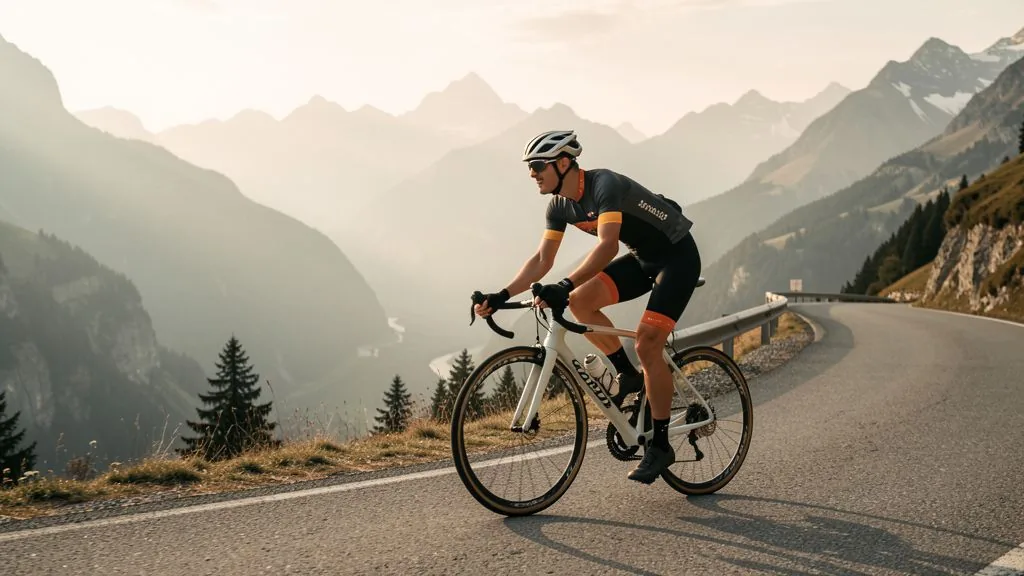
When elite athletes move to 2,000 metres for three weeks before a major race, it is not a ritual but physiology: at altitude, oxygen partial pressure drops, the body responds by producing more red blood cells — and back at sea level, every litre of blood carries more oxygen. The effect is real, but small, expensive and easy to get wrong. This article explains how altitude training works, who it is worth it for, and what to do instead when a mountain training camp is not on the cards.
What altitude does inside your body
At 2,000 metres, every breath contains roughly 20% less oxygen than at sea level — air pressure falls, oxygen partial pressure drops, and blood oxygen saturation slips from about 98% to 92–94%. Precisely this mild shortage is the training stimulus: the kidneys release more erythropoietin (EPO), the bone marrow builds new red blood cells, and Hb mass — the total amount of haemoglobin in the body — rises.
The rule of thumb from research: per 100 hours of altitude exposure, Hb mass increases by about 1%. Across three weeks around the clock, that is theoretically up to 5% — well-designed studies typically measure 2–4%. Since haemoglobin is the oxygen carrier, oxygen transport capacity rises directly with it, one of the central drivers of VO2max and endurance performance. The effect persists for roughly two to three weeks after returning, before the extra red blood cells are broken down again.
Important to know: there are responders and non-responders. In about one in five athletes, the Hb mass response fails to materialise despite a correct protocol — often because iron availability is inadequate or the altitude exposure was too short.
Live High – Train Low: the proven protocol
The best-evidenced model is Live High – Train Low (LHTL): you live, eat and sleep at 2,000–2,500 metres — the altitude stimulus works around the clock. Hard quality sessions (intervals, threshold work) are done down in the valley or at 1,200–1,500 metres, where enough oxygen is available for genuine race pace. The reason: at 2,200 metres your top pace is blunted by several percent — train everything up there and you lose speed and training quality without gaining any extra blood benefit.
The core protocol in numbers:
- Elevation: living height of 2,000–2,500 m. Below that, hardly any effect; above, more side effects than benefit.
- Duration: at least 14, ideally 21–28 days. The target is 250–400 hours of exposure — a long weekend is not enough.
- Ramp-up: only easy aerobic training for the first 4–6 days. The body needs this time for plasma adaptation; hard sessions in the first altitude week are the classic entry mistake.
- Iron: get ferritin checked before departure (target: above 50 ng/ml). Without sufficient iron, bone marrow cannot build new red blood cells — the camp fizzles out. Many doctors recommend 100–200 mg of elemental iron daily during the camp.
- Return: depending on the source, the performance peak occurs 10–20 days after coming back down — but some athletes also feel great in the first days. Test both in training, not on race day.
Who altitude training is worth it for — and when it is not
Let's be honest: the expected gain is 1–2% of performance — pure gold for a pro fighting for podiums. For an age grouper running a 3:45 marathon, 1–2% is roughly two to four minutes — achievable, but only if base training, recovery and race fueling are already dialled in. Altitude training is the fine-tuning, not the foundation.
Then there is the cost: three weeks at 2,000 metres means time off work, accommodation, logistics — plus an elevated risk of illness and poor sleep. If you race once a year and train eight hours a week, the same energy is better invested in a consistent 16-week periodisation like the one in our marathon training guide. Altitude training pays off when you are already at the limit of your training capacity, an important A-race is coming up, and time plus budget are available.
Alternatives at home
- Altitude tent or room: nitrogen dilution simulates 2,000–3,000 metres overnight. Physiologically it works like LHTL, but demands 12–16 hours of exposure per day for at least three weeks — and it is expensive. Sleep in the tent often suffers, which erodes the net benefit.
- Altitude mask: not a substitute. It only restricts airflow, not oxygen partial pressure. Respiratory muscle training, yes; blood values, no.
- Heat training: the most pragmatic alternative. Ten to fourteen days of heat acclimatisation expand blood plasma by up to 10% and deliver 3–5% performance gains in studies — even in cool race conditions. Details in our article on heat training in summer.
- IHH sessions (hypoxic intervals): short interval blocks in hypoxic air on the ergometer show small effects on mitochondrial capacity in studies. Rarely practical for recreational athletes, but a genuine option in a lab setting.
In practice: how an altitude camp runs
If you plan a real camp — St. Moritz (1,800 m), Font-Romeu (1,850 m) or Flagstaff (2,100 m), for example — treat it as a training block of its own:
- Week 1: arrive. Only easy aerobic volume, heart rate cap about 5 beats below your home easy-zone value. Prioritise sleep — altitude sleep is shallower, so go to bed earlier.
- Weeks 2–3: normal volume, quality sessions "train low" wherever possible. Expect your pace to be 20–30 seconds per kilometre slower at the same heart rate up high — that is physics, not lost fitness.
- Final days: no farewell fitness test. The journey and the switch back to sea level are a load in themselves.
Nutrition is underestimated: at altitude, basal metabolic rate rises, appetite often drops, and iron as well as carbohydrate needs increase. If you lose weight during the camp, you are probably losing muscle — and giving part of the gain straight back.
Common mistakes
- Living too low, training too high. 1,200 m is not enough for the blood effect, while intervals at 2,400 m destroy training quality. Live high, quality low — not the other way round.
- Camps that are too short. Five days at altitude create fatigue but no Hb mass. Either 14+ days or skip it.
- Ignoring iron. Without a ferritin check before departure, you risk spending three weeks in the mountains only to come back more tired.
- Mistiming the peak. Racing the day after returning works for some, others only peak two weeks later. If you have not tested it, you are gambling.
- Underestimating altitude sickness. Headache, nausea and dizziness above 2,500 m are not weakness but warning signs. Symptoms mean: descend, don't push through.
How Peakora puts altitude stimulus in context
An altitude camp changes your load values noticeably: at the same pace your heart rate rises, the Training Stress Score climbs, and form (TSB) drops faster than at home. Peakora's recovery monitor makes exactly that visible — you see in the data that "heavy legs" in altitude week one are expected, and you can dose volume and intensity cleanly instead of overreaching out of frustration. After your return, adaptive planning helps place the freshness peak on race day rather than letting it evaporate during the travel week.
Frequently asked questions about altitude training
At what elevation does altitude training start to work?
The optimal range is 1,800 to 2,500 metres. Below that the stimulus is too weak; above it, sleep disturbances and training losses grow disproportionately. For most athletes, 2,000 to 2,300 metres is the sweet spot.
How long does an altitude camp need to last?
At least two, ideally three to four weeks. The rule of thumb is 250 to 400 hours of altitude exposure for a measurable rise in Hb mass. Short weekend camps deliver almost nothing physiologically.
What does Live High – Train Low mean?
You live and sleep at 2,000 to 2,500 metres to trigger the blood adaptation, but complete your hard quality sessions lower down, where enough oxygen is available for true race pace. That way you combine the blood benefit with training quality.
Does an altitude training mask work?
No. Breathing masks restrict airflow, not oxygen partial pressure — they do not simulate altitude. At best they train the respiratory muscles. There is no EPO or Hb mass effect.
Plan your training with Peakora
Periodisation, load management and recovery tracking — so every training block lands. Start free, no credit card required.
Start for free