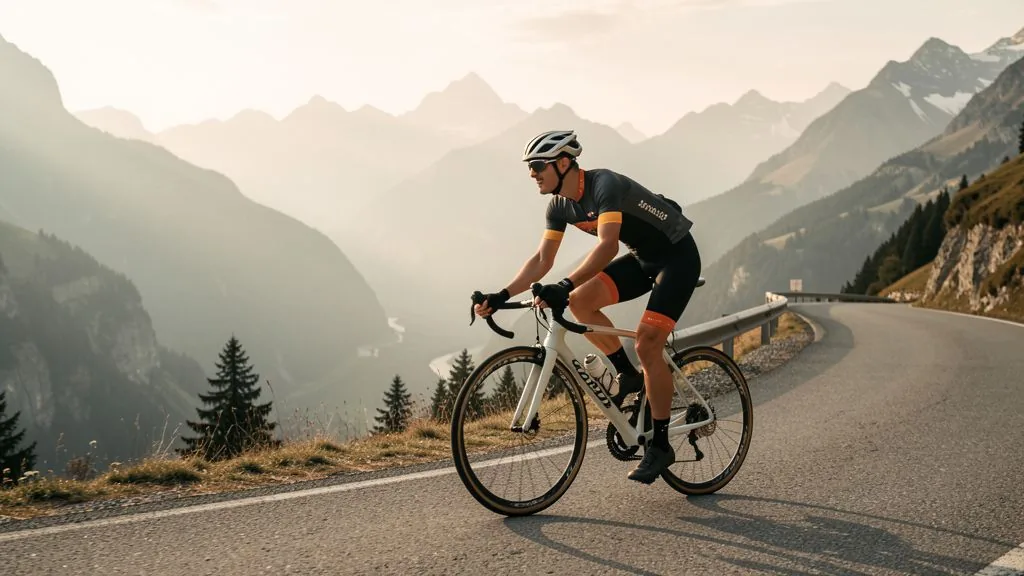
Few components are debated as emotionally as the wheelset — and few are bought as wrongly. The truth sits between two extremes: wheels really are the most effective aero upgrade on a bike, but nowhere near as effective as the price lists suggest. Get rim depth, internal width, tyre width, bearings and weight right and you buy the most speed per euro. Buy on looks and you pay four figures and notice nothing on your usual loop.
Why wheels are the most rewarding upgrade
At any speed above roughly 30 km/h, air resistance is the single largest force you fight — and on a bike, the wheels and tyres are the easiest part of that to improve. At 40 km/h, a classic shallow-rim wheelset with round spokes costs roughly 10 to 15 watts more than a 50-millimetre aero wheelset with bladed spokes. At 250 watts of output that is about four to six percent, and it goes straight into speed.
The effect scales with the third power of speed: what is worth 15 watts at 40 km/h is only five to seven watts at 30 km/h and three to four at 25. That is exactly why an aero wheelset feels spectacular on a fast evening ride and like nothing at all during base training in hilly terrain. The rule of thumb: the speed band in which you spend most of your training time decides which wheels make sense for you — not the price tag.
Rim depth: the real lever
Rim depth is the single most important number on a wheelset. Shallow rims of 24 to 30 millimetres are light, comfortable, neutral in crosswinds and the right choice for climbers, gusty days and training bikes. All-round rims of 35 to 45 millimetres deliver most of the aero benefit while remaining controllable in wind — the best compromise for most riders. True aero wheels from 50 millimetres add another two to five watts but demand nerves in wind and weigh more.
Most of the aero advantage sits at the front wheel: it meets undisturbed air while the rear wheel works in the rider's wake. If you want to save money, invest in the front wheel first — 50 millimetres at the front with 35 at the rear is a legitimate and fast combination. In crosswinds it is not rim depth alone that decides, but rim shape: a wide, toroidal rim with 27 millimetres of external width stays more predictable in gusts than a narrow 60-millimetre rim. Aerodynamics is always a combination of wheel, tyre and frame.
Weight: less important than everyone thinks
A wheelset weighs between 1,400 and 1,900 grams. Saving 300 grams sounds like a lot but means little in practice: 300 grams off the bike costs you roughly four to five seconds per kilometre on an eight percent climb at 250 watts — against a total system mass of 75 kilograms for rider and bike, 300 grams is just 0.4 percent. On climbs it is system weight that counts, and there the rider's body weight is the bigger lever. Losing two kilograms gains you more than the most expensive climbing wheelset.
Acceleration is a different story: rotating mass at the rim has to be accelerated with every surge, and it counts double. 200 grams less at the rim periphery is worth about 400 grams on the frame when you jump out of a corner. On circuits with many turns and accelerations that is noticeable; in a steady time trial it is practically irrelevant. So the order is: aerodynamics first, then reliability, then weight. Weight sells best but delivers least.
Internal width, tyre width and pressure
The internal width of the rim decides how the tyre sits and how wide it really measures. Modern road rims sit between 19 and 25 millimetres, with 21 to 23 millimetres the current standard for 25 to 32 millimetre tyres. Mount a 25 millimetre tyre on a 21 millimetre rim and it measures 26 to 27 millimetres in reality: the tyre gets wider, rolling resistance drops, comfort rises. Rule of thumb: tyre width roughly equal to the rim's external width, or one to two millimetres narrower.
The trend towards 28 to 30 millimetre tyres is not fashion but measurable: at the same pressure, a wider tyre rolls faster on rough asphalt because it climbs fewer bumps and passes less vibration into the frame. More important than width is pressure, and that depends on system weight, tyre width and surface. In practice: 28 millimetre tyres at 5.5 to 6.0 bar with 75 kilograms of system weight on normal asphalt, two to three tenths of a bar less in the wet. How pressure, width and rolling resistance interact is covered in the article on tyre pressure on the road bike.
Hubs, bearings and spokes
The hub decides how long a wheelset lasts, not how fast it is. Four points count:
- Freehub: ratchet freehubs with 36 to 54 engagement points bite faster but are more sensitive to dirt than pawl systems with 18 to 24 teeth. Both work; regular maintenance matters more than the system.
- Bearings: industrial cartridge bearings are serviceable and cheap to replace, cup-and-cone bearings need adjustment. Ceramic bearings cost several times more and deliver one to two watts on paper — lost in the noise of air resistance.
- Spoke count: 20 to 24 bladed spokes at the front and 24 to 28 at the rear are standard. Fewer spokes are more aerodynamic but stiffer and harsher in comfort; light riders under 70 kilograms benefit more from a reduced count than heavy ones.
- Thru-axle or quick-release: 12 millimetre thru-axles front and rear are today's standard and stiffer. Check before buying: the frame has to use the same system.
Carbon or aluminium
Aluminium is cheaper, more robust and still the sensible choice for training wheels, winter and rim brakes. Carbon, by contrast, can be shaped freely for aerodynamics, is lighter and damps vibration better — but costs three to five times as much, and with rim brakes the braking track wears over time, which is disproportionately expensive on carbon. If you ride mostly in the wet and through winter, you are well served by aluminium wheelsets or a second training set. If you want more than 35 millimetres of depth, you end up in carbon anyway — that is where the surcharge pays off.
When buying used carbon wheels, three checks are mandatory: the braking tracks for scoring and deep wear grooves, the spoke tension (an even tone in the tap test, no loose spokes at the valve hole) and the hub bearings, which must show no rumbling and no lateral play when installed. A wheel with a cracked rim hook or delamination cannot be repaired.
Tubeless, tubes or TPU
Three systems are on offer. The classic butyl tube is cheap and always repairable but has the highest rolling resistance. Tubeless does without a tube, allows lower pressure, seals small punctures itself and rolls best — but requires tubeless-ready rims, 30 to 60 millilitres of sealant every two to three months and some practice when mounting. Tubes made of thermoplastic polyurethane (TPU) are the pragmatic middle ground: 30 to 45 grams instead of 100 grams, mechanically robust and swapped in two minutes.
For the full comparison, see the article on tubeless tyres on the road bike. The decision aid is simple: if you ride a lot on poor roads in winter and have no appetite for sealant, use TPU. If you race or work with low pressure and wide tyres, tubeless gains you the most. Tubeless-ready rims additionally require matching rim tape, and the tyre beads must sit cleanly — a pop when inflating is normal, a tyre sitting crooked is not.
The eight buying criteria in order of impact
- 1. Tyre and pressure: the most effective and cheapest lever of all. A good tyre at the right pressure delivers roughly as much as an aero set at 30 km/h and costs 60 to 90 euros.
- 2. Front rim depth: 45 to 50 millimetres at the front delivers the largest part of the aero gain.
- 3. Rim shape and external width: a toroidal shape with 27 to 30 millimetres of external width stays predictable in wind and matches 28 millimetre tyres.
- 4. Internal width: 21 to 23 millimetres as the standard; anything narrower wastes comfort and rolling resistance.
- 5. Compatibility: brake type (rim or disc), axle system, freehub standard (Shimano HG, SRAM XDR, Campagnolo N3W) — the wrong hub makes the best wheelset unusable.
- 6. Tubeless readiness: tubeless-ready is mandatory today, otherwise you lose the option of low pressure.
- 7. Hub quality and service: spare part availability for bearings and freehub bodies matters more in the long run than a gram of weight. A wheelset without spares is electronic waste after three years.
- 8. Weight: last, and only in the range where you actually ride.
What it costs and what it delivers
Aluminium training wheelsets sit at 250 to 600 euros, solid carbon wheels with 40 to 50 millimetres of depth at 900 to 1,800 euros, branded aero wheelsets at 2,000 to 3,500 euros. The gain does not grow linearly: the jump from 300 to 1,000 euros is far bigger than the one from 1,800 to 3,000. A simple calculation shows the order of magnitude: 15 watts saved at 35 km/h is about two minutes over 40 kilometres, while at 28 km/h it is only around one minute.
As a training planner, the question is therefore better turned around: not "which wheels make me faster" but "in which speed band do I spend my training time, and how many hours per week is that". If you mostly ride base at 25 to 28 km/h, you are better off putting the money into tyres, a bike fitting session or a power meter — you get more per euro there. If you regularly ride gran fondos and sit in groups above 35 km/h, you feel the difference of an aero set immediately.
Common buying mistakes
- Buying on looks. A 60 millimetre set looks fast but is the wrong choice for 90 percent of riding profiles — in crosswinds it costs more safety than it gains in aero.
- Comparing weight only. Manufacturer figures with and without thru-axles, rim tape and valves cannot be compared. If you compare two sets, weigh the real numbers with identical components.
- Overlooking compatibility. The most common expensive mistake: freehub standard or axle system does not match. Always align brake system, axle and cassette type before buying.
- Rims too deep for everyday riding. A set you fear in every gust gets ridden less — and therefore loses against a 40 millimetre set that comes along on every ride.
- Not thinking about tyres. An aero set with a cheap 25 millimetre tyre is slower than a shallow rim with a top tyre in 28 millimetres. The tyre is part of the system.
- Two wheelsets without a plan. A second set only pays off if it has a clear job: a shallow aluminium set for winter and mountains, an aero set for the season. Two semi-aero sets are wasted money.
Where this fits in your training plan
Equipment is the smallest of the three variables. Training volume, intensity distribution and recovery come before aerodynamics — if you burn your base with too-fast easy runs and rides, the most expensive wheelset will not win back what a clean intensity distribution gives you. More on this in the overview of gran fondo training and in the basics of structured winter work.
Frequently asked questions about road bike wheels
Are expensive wheels worth it for amateur riders?
Only to a limited degree. A good tyre at the right pressure delivers a similar gain at 30 km/h and costs a fraction of the price. Riders who regularly go above 30 km/h, ride long flat routes or race do profit clearly: 10 to 15 watts saved is about two minutes over 40 kilometres at 35 km/h.
How deep should a rim be?
35 to 45 millimetres of rim depth is the best compromise for most riders: measurably faster than a shallow rim and still manageable in crosswinds. 50 to 65 millimetres pays off in races and at high speed but demands confident bike handling. Anything above 65 millimetres is time-trial territory.
Carbon or aluminium?
Carbon pays off from about 35 millimetres of rim depth and for aero demands, aluminium for training wheels, winter and rim brakes. Aluminium is cheaper and more robust, carbon is lighter and can be shaped aerodynamically, but costs three to five times as much. With rim brakes, a carbon rim wears at the braking surface over time.
Tubeless or inner tube?
Tubeless allows lower pressure without pinch flats and seals small punctures by itself. It requires compatible rims, 30 to 60 millilitres of sealant every two to three months and patience when mounting. If you want fast changes on the road, stay with tubes or switch to TPU.
What does a good wheelset cost?
Aluminium training wheelsets cost 250 to 600 euros, solid carbon wheels with 40 to 50 millimetres of depth 900 to 1,800 euros, and branded aero wheelsets 2,000 to 3,500 euros. The gain does not grow linearly: the jump from 300 to 1,000 euros is much bigger than the one from 1,800 to 3,000 euros.
Train what you actually ride
Peakora builds base, threshold and race preparation from your real paces and watt values, and tracks load and recovery through TSS, fitness and form. Start free, no credit card required.
Start free