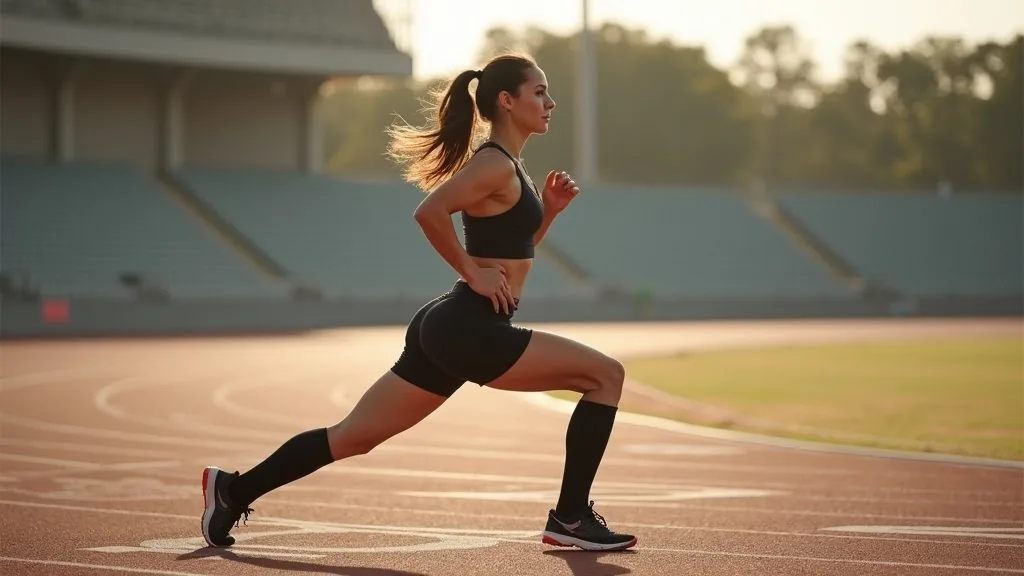
Pilates has a reputation among runners as a gentle class programme for people with back trouble — slow, soft, somehow not quite sport. That is an expensive misunderstanding. Running is a continuous single-leg chain, and every push-off force has to pass through pelvis and trunk before it becomes forward motion. That is exactly where Pilates works: not on endurance, not on maximal strength, but on the question of how much of what your legs produce actually turns into propulsion. Two 15-minute sessions per week is the realistic cost, and they conflict with no training plan.
Why Pilates is more than ab work for runners
With every step, ground reaction force travels from the foot through ankle and knee to the hip and onward into the trunk. That chain is only as strong as its weakest link, and for most runners the weakest link is not the leg but the pelvis. When the pelvis drops to the side during stance — a pattern you see regularly in tired runners after 30 kilometres — the hip musculature loses its mechanical advantage: the knee collapses inward, the push-off direction becomes oblique, and part of the force is lost as sideways movement.
At the same time the trunk works as a counter-rotation machine. Shoulders and pelvis rotate in opposite directions when running, and the oblique and deep abdominal muscles brake that rotation so it does not destabilise the upper body. With too little control here, runners compensate with shorter steps, higher stride-to-stride variability and visibly more vertical oscillation — measurable as worse running economy, meaning higher oxygen cost at the same speed. Studies on core strength training in runners report improvements in the range of two to four percent, which over a half marathon is worth several minutes.
The third effect is the least spectacular and the most important in daily life: control at the hip means less shear load on knee and sacroiliac joint. Runner's knee, piriformis problems and stubborn hip pain rarely come from one wrong movement but from a thousand repetitions of a moderately controlled one. More on that in hip pain when running.
The principles that separate Pilates from calisthenics
Pilates is not an exercise collection but an execution method. Without the principles, little remains of the exercises — so it is worth understanding them once instead of skipping them.
- Breathing: Breath is coupled with movement, not held against it. Exhale during the effort phase — typically as the abdominal wall contracts — and inhale on the return. This generates intra-abdominal pressure that stabilises the lumbar spine from the inside.
- Centring: The "powerhouse" in modern language is the trunk cylinder — deep abdominals, pelvic floor, diaphragm and the deep spinal extensors together. Every movement starts from that cylinder tension, not from the limbs.
- Concentration and control: Few deliberate repetitions instead of many. Six clean reps with the pelvis neutral beat twenty shaky ones. For runners this is the key point, because running is already a repetition sport — more repetitions are not a new stimulus.
- Precision and flow: No momentum, no bouncing, no pause at the end of the range. The movement runs at a tempo you could stop at any moment.
In practice: if an exercise only works with momentum or with a rounded lower back, the level is too high. Back pain during Pilates is almost always a sign of compensated execution — usually a pelvis that drops while the legs are extended.
Six exercises for runners, ordered by difficulty
The selection is deliberately narrow: these are the exercises with the biggest transfer to running — hip extension, pelvic stability, counter-rotation control, foot and calf strength. One mat is enough. Start at 1 and only move on when the current level runs cleanly without substitution.
- 1. Dead Bug. Supine, arms vertical, legs in tabletop. Extend one leg slowly until the heel is just above the floor, return, then the other side. 2 × 8 per side. The decisive point: the lumbar spine stays neutral, the back does not lift off. This is the base exercise for pelvic control in a single-leg chain.
- 2. Shoulder Bridge. Supine, feet hip-width apart, lift the pelvis vertebra by vertebra, hold two seconds at the top, roll down slowly. 2 × 10. Trains hip extension without lumbar hyperextension — precisely the ability that keeps the hip extended while running instead of pushing it into an arch.
- 3. Clamshell. Side lying, knees bent 90 degrees, feet together, pelvis neutral. Open the top knee without letting the pelvis roll backwards, close slowly. 2 × 12 per side. The classic for the glutes, which are regularly underactive in runners — see gluteal amnesia.
- 4. Side-Lying Leg Lift. Side lying, legs extended, bottom leg stable, lift the top leg 30 to 40 centimetres and lower it under control, 2 × 12 per side. Important: the foot stays neutral and the hip does not rotate forward. Covers the lateral hip musculature that keeps the pelvis level during stance.
- 5. Swimming. From a four-point kneeling position, extend the right arm and left leg without the pelvis or the line of the hip crests twisting, hold, return, switch sides. 2 × 8 per side. This is the direct test for counter-rotation control — if the pelvis tips, you do not have it yet.
- 6. Single-Leg Stretch and Spine Twist. Supine, one leg extended, the other drawn in at 90 degrees, switch against hand resistance; then sitting with legs extended, rotate the spine to the side and open the arms. 2 × 10 and 2 × 8 per side. The rotation part is what runners underestimate most: a thoracic spine that cannot rotate forces rotation into the lumbar spine — a frequent cause of one-sided back pain.
Progression: what you increase, and what you do not
In Pilates the demand increases not through load but through four other variables: longer levers (leg extended instead of bent), an unstable surface, slower execution, and removing support. That order makes sense, because each step raises the control demand without overloading the tissue.
- Levers first, then surface. An extended leg in the Dead Bug is markedly harder than a bent one. Only when that is solid does a folded blanket go under the pelvis.
- Tempo as a stimulus. Four seconds out, two seconds hold, four seconds back — at the same rep count that is a much higher demand on motor control.
- Do not train into fatigue. Pilates is control training. As soon as execution gets sloppy, the set is over — not when the muscle burns.
Fitting it into the training week
The most common argument is timing. The simple rules:
- After the easy session. After an easy run the body is warm but control is still good — ideal for 15 minutes on the mat as a cool-down.
- Not before quality. A core session the evening before an interval workout costs no endurance but does cost local fatigue in hip and trunk. The effect is small, but it adds up over weeks.
- Twice 15 rather than once 40. The stimulus works through frequency. Two short blocks per week beat one long Sunday block, because control is retrieved more often.
- Reduce in hard weeks, do not cut it. When volume rises, shorten Pilates to one 10-minute session. The block is too cheap to drop entirely at peak load — that is exactly where hip control goes first.
If you also do heavy strength training for runners, do not stack the two on the same day. Loaded strength work creates fatigue; Pilates is meant to build control — in that order both benefit, the other way round they do not.
What the evidence says
Pilates itself is poorly studied as a standalone method in runners — the evidence comes almost entirely from research on core and hip strength training, which addresses the same mechanism. The finding is consistent across several reviews:
- Running economy: Core and hip stability programmes over six to eight weeks improved running economy by two to four percent in several controlled studies and extended time to exhaustion. The effect is small, but it arrives without extra running volume.
- Pelvic control: In runners with patellofemoral pain, most cases show reduced hip abduction and external rotation — the same muscle group that clamshells and side-lying leg lifts train. Core and hip programmes reduced pain scores significantly in studies, comparable to knee-only strengthening.
- Limits: More than two or three control sessions per week produced no additional benefit. And anyone doing only Pilates without moving heavy loads does not improve bone density or tendon stiffness — that needs weight-bearing load.
- Back pain: For non-specific low back pain, exercise therapy in general is well supported, and Pilates performs comparably to other active programmes in reviews — not better, not worse, but with high adherence.
The bottom line: Pilates is no miracle cure, but a very efficient block — 15 minutes twice a week is 30 minutes out of 168 hours. No other training element has a better ratio of time cost to effect on force transfer.
Pilates, yoga, strength training — drawing the lines
The three get confused constantly although they target different things. Yoga works largely through range of motion and longer holds, so primarily mobility and parasympathetic tone. Strength training works through load and maximal tension, so strength, tendon stiffness and bone density. Pilates sits in between, with a clear focus on control in neutral joint positions.
In practice: a complete plan needs all three — but not in equal amounts in the same week. In the base phase, twice Pilates plus once strength fits. In the race phase you cut Pilates to once and keep the strength session, because strength decays more slowly than control. Mobility runs as a short daily block, not as its own session. The same logic sits in mobility for runners.
Common mistakes
- Treating Pilates as a strength substitute. Without external load there is no stimulus for bone and tendon. Mat work makes you more controlled, not more resilient.
- Too many repetitions. Pilates is not endurance training. Twenty shaky reps achieve less than eight clean ones.
- Losing the neutral pelvis. The most frequent execution error: the back lifts as the leg extends, or the pelvis rolls back in the clamshell. Both take the stimulus out of the target muscle and put it into the lower back.
- Doing the exercises but not the breathing. Without coupling breath to movement you lose the stabilising effect — and that is exactly what matters when running under load.
- Cutting it at peak load. Pilates is the first block to go under time pressure and the last one that should. Ten minutes count as a minimum dose.
- Years without progression. The same six exercises at the same level become a routine stimulus within weeks. Lengthen levers, slow the tempo, remove support.
Pilates in the Peakora training plan
In a structured plan Pilates is not a separate focus but part of the stability blocks Peakora schedules alongside the running sessions. The engine places these blocks on easy days or as a short addition after an easy session — never the day before a quality session, and in weeks with a steep TSB drop it shortens them automatically rather than deleting them.
The reason is the same as in all load management: control training costs almost no recovery but stabilises exactly the ability that fades first under fatigue. How load and adaptation interact is covered in supercompensation; the periodisation behind it in training periodisation.
For beginners: two weeks of exercises 1 to 3 only, then progress. For anyone with a race calendar: Pilates stays in during the taper too, reduced to ten minutes — control without fatigue is exactly right in race week.
Frequently asked questions about Pilates for runners
Does Pilates actually help with running?
Yes, as a supplement. Core and hip stability improve force transfer between push-off and forward propulsion; studies on core training report running economy gains in the range of two to four percent. Pilates does not replace running volume or heavy strength work, though.
How often should a runner do Pilates?
Twice a week for 15 to 20 minutes is enough. The stimulus works through consistency, not duration. More than three sessions per week gives runners no extra benefit but costs recovery that the running sessions need.
Can Pilates replace strength training?
No. Pilates works almost without external load, so it improves control and endurance of the core muscles, not maximal strength. Bone density, tendon stiffness and sprint power need heavy loading above body weight as well.
Do I need a studio or a class for Pilates?
No. Six exercises on a mat are enough to start and cover what runners need. A class helps at the beginning to learn pelvic tilt and rib position; after that a 15-minute block at home does the job.
Where should Pilates go in a training plan?
After an easy run or on a rest day, never the day before a quality session. Right after hard intervals your control is too poor to work cleanly, so five minutes of easy jogging and then the mat is a good compromise.
Stability and mileage in one plan
Peakora combines running sessions with stability and strength blocks and adapts both to your current form. Start for free, no credit card required.
Start for free