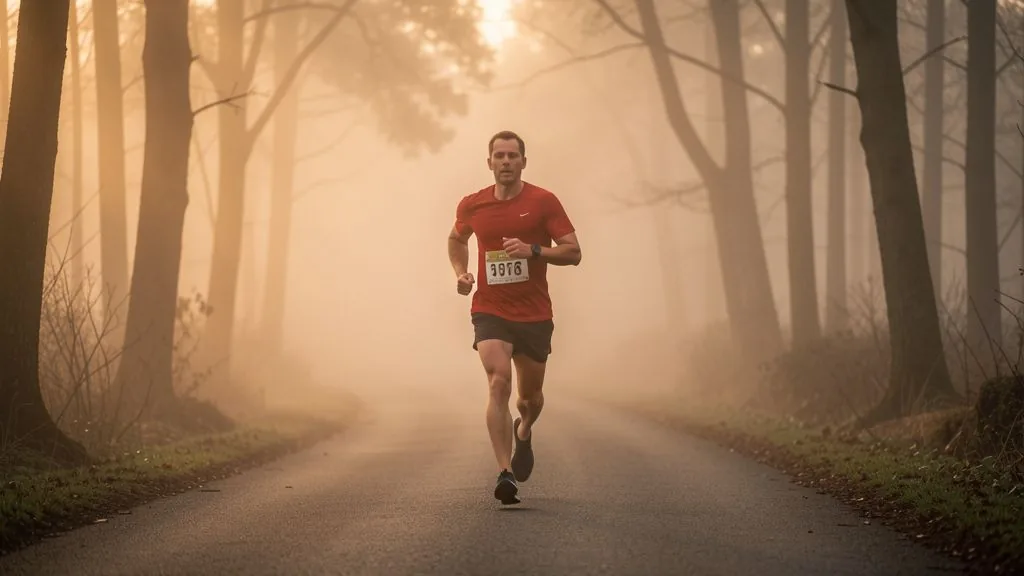
Most beginner runners do not struggle with a lack of fitness — they struggle with the inability to hold one pace for more than ten minutes. The first kilometre feels easy, twenty minutes in everything falls apart. Pacing is the skill that prevents this: the distribution of your energy across the entire distance. It can be trained like any other skill — not through maximum effort, but with system.
Why pacing is the most important beginner skill
Field studies of marathon fields consistently show the same pattern: more than two thirds of recreational runners run the second half of the race significantly slower than the first. The cause is rarely a lack of endurance — it is an opening pace that drains glycogen stores prematurely and fatigues the muscles earlier. Going out just 20 seconds per kilometre above your realistic pace for the first ten kilometres often costs minutes at the end.
That is exactly why pacing is not an advanced topic. It is the foundation everything else builds on — including training plans themselves: anyone following structured easy runs or run-walk intervals needs a sense of what "easy" actually means for their own body. Without pace calibration, any training plan is just a sheet of numbers.
The beginner trap: constant pace is not constant effort
The most common misconception: "I want to run the same pace on every kilometre." That only works on flat, windless courses in neutral temperatures — which in practice never happens. The same kilometre pace costs far more energy uphill, and the same applies to headwind and heat. Whoever stubbornly clings to the pace number drifts into the anaerobic zone on climbs and ruins the session.
The right reference point is therefore effort, not the clock. Constant effort means heart rate, breathing and conversational ability stay the same — while pace may vary with terrain, wind and temperature. On a hilly course, an "even" run can legitimately show splits 15–30 seconds per kilometre slower. That is not failure, it is correct pacing.
The talk test: pacing without any technology
The simplest and most reliable intensity test costs nothing: speak a full sentence out loud while running. In the easy base zone you can speak complete sentences, only slightly broken by breathing. If you drop to single words, you are in the threshold zone — too fast for a long run. If you could sing, it is very easy, which is perfectly fine for long runs.
As a numerical frame for most beginners: the long run sits about 60 to 90 seconds per kilometre below your 10K race pace. More important than any number, though, is acting on the test: if talking gets hard, take pace out immediately — not at the end of the loop, but in the very next kilometre.
It is also worth looking at heart rate if your watch records it. The zone logic is explained in detail in our article on heart rate zones. For day-to-day pacing, however, the talk test comes first because it works without any device and is instantly applicable.
The three distribution strategies at a glance
- Even pace — constant speed. Every kilometre should take the same time. Realistic only on flat courses in neutral weather. For flat 5K and 10K races this is the standard strategy: it reliably produces the fastest overall times when the target pace is realistic.
- Negative split — faster second half. You deliberately start 10–20 seconds per kilometre below target pace and pick it up once your body is warm and your mind has built confidence. For beginners this is the best race strategy because it structurally prevents the classic mistake of going out far too fast. For a deep dive, see our article on marathon pacing strategy.
- Positive split — fading on purpose. The second half becomes slower. As a planned strategy it rarely makes sense, but as race reality it is normal when the course climbs, the wind turns or the target pace was optimistic. What matters is the difference between a planned fade and an uncontrolled collapse — the latter usually signals a target pace that was too aggressive from the start.
For training, one rule applies throughout: run easy sessions as negative splits — the final loop deliberately a touch faster than the first. This trains your internal sense of pace and anchors the habit of starting controlled before you need it on race day.
Adjusting for hills, heat and wind
- Climbs: As a rule of thumb, every 1 % gradient costs about 10–15 seconds per kilometre if effort is to stay constant. So do not fight the hill — hold the effort, let the pace fall, and on the descent do not overcompensate; run relaxed.
- Heat: From about 20 degrees upwards, every further step costs performance. Allow roughly 10–20 seconds per kilometre for every 5 degrees above your normal training temperature. A drinking plan and headwear belong in long sessions from this threshold; details in our article on running hydration.
- Headwind: Wind costs more than it gives back: the tailwind on one half of the route never fully offsets the headwind on the other. In strong wind, use time windows rather than average pace as your reference.
- Surface: Forest trails and gravel are usually 5–15 seconds per kilometre slower than asphalt without any extra effort. When comparing paces, compare course profiles, not just the clock.
Three concrete drills to train pacing
- The even-pace long run. On a 60–90 minute long run: first half at talk-test pace, second half at exactly the same speed — or marginally faster. Goal: kilometre splits within ±10 seconds of each other. This sharpens your internal clock better than any app.
- Pace guessing. Run 400 metres at an estimated pace — without looking at your watch. Then check: how far off were you? Repeat across different sessions and pace ranges. After a few weeks the deviation often shrinks below 5 seconds per kilometre, and you can pace yourself even without a watch.
- The control kilometre. In an easy session, run one kilometre deliberately at exactly your planned race pace — not faster. It sounds trivial, but it is the drill that prevents the adrenaline kilometre on race day.
Common pacing mistakes among beginners
- The adrenaline kilometre. On race day, excitement suppresses perceived effort in the first minutes — everything feels easier than it is. Counter-measure: run the first 3 kilometres deliberately 10 seconds per kilometre slower than planned and accept being overtaken. Whoever overtakes dozens of runners in the first kilometres usually wins them all back later — with interest, just in reverse.
- The watch as the only reference. On unknown, hilly or windy courses, average pace is a poor intensity gauge. Effort and heart rate are more reliable — even when they deliver less flattering numbers.
- Confusing training and race pace. Many beginners run their easy sessions too fast and their hard sessions not hard enough — leaving every session medium. These "grey sessions" deliver less than cleanly separated intensities; the logic behind this is explained in our article on polarized training.
- Choosing a target pace that is too fast. Race pace should not come from gut feeling but be derived from a real personal best — for example your 10K time plus a realistic conversion. Whoever runs a 55-minute 10K and gambles on a 4:30/km marathon pace will fade regardless of pacing.
- Training pacing only in your head. A feel for pace comes from repetition in the body, not from calculation. Whoever never ran at goal pace before the race has no reliable reference point on race day.
How to build pacing into your training week
Pacing does not need dedicated sessions — it needs attention inside the sessions you already run. Three fixed anchors are enough. First: the long run as talk-test and even-pace practice. Second: a pace-guessing block (400 metres without the watch) in one easy session per week. Third: a control block at planned race pace before every race, ideally 10–14 days out within a race simulation. If you are looking for a structured plan for a first race, our article on the marathon training plan for beginners covers it — pacing guidance is part of every session description there.
The long-term perspective matters too: pacing gets more precise over time because your body builds a growing library of pace memories. After a year of consistent training, experienced runners can usually estimate their pace to within ±5 seconds per kilometre — without looking at the watch. That skill is free, cannot be lost, and still works when the GPS watch fails in the forest.
How Peakora integrates pacing practice
Peakora does not prescribe pace targets for easy runs — deliberately. What the engine does instead: it sets the intensity distribution of your week and describes in every session what it is for, including pace benchmarks where they make sense. Easy sessions stay genuinely easy thanks to load control, hard sessions are hard — and the race simulation gets its control pace derived from your real fitness rather than wishful thinking. Pacing gets trained as a side effect: through cleanly separated intensities instead of grey medium-effort sessions.
Frequently asked questions about pacing
What does pacing mean in running?
Pacing means distributing your energy evenly across the entire distance. You choose a speed that matches your fitness, the course and the weather — instead of starting too fast and falling apart at the end. Good pacing shows up as constant effort.
How fast should a beginner run long runs?
Slow enough that you could hold a conversation throughout the entire run — as a rule of thumb, roughly 60 to 90 seconds per kilometre slower than your 10K race pace. If the talk test becomes hard, you are running too fast and should slow down immediately.
What is a negative split?
A negative split means the second half is faster than the first. You deliberately start controlled — about 10 to 20 seconds per kilometre below your target pace — and then speed up. For beginners this is the best strategy because it prevents going out too hard.
How do I adjust my pace for hills and heat?
Not through pace but through effort: on climbs let the watch drop and keep heart rate and breathing constant — the pace may fall. In heat, allow roughly 10 to 20 seconds per kilometre for every 5 degrees above your normal training temperature.
Plan your training with Peakora
A structured training plan with clear intensities, pace benchmarks and automatic adjustment. Start free, no credit card required.
Start for free