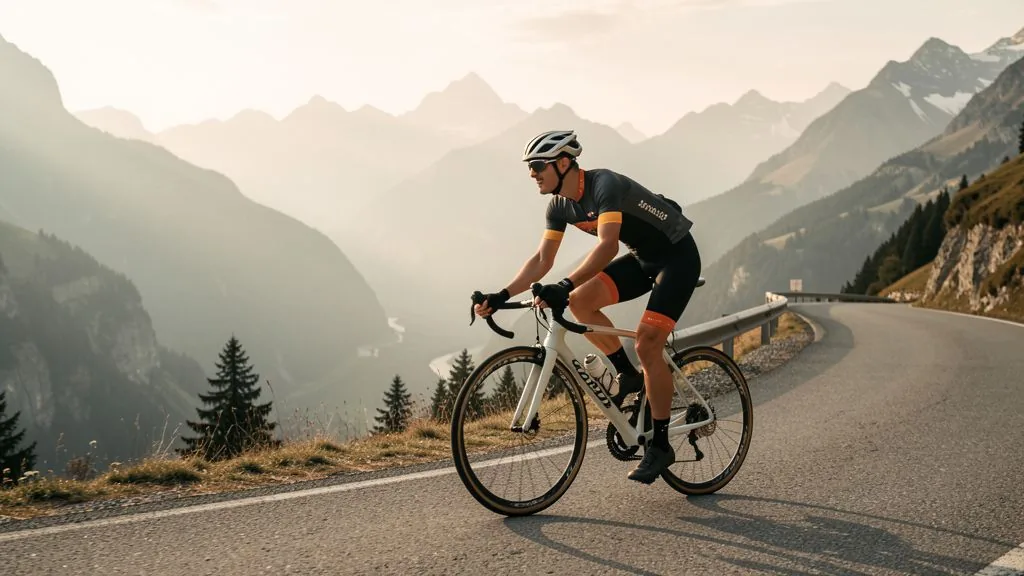
Hills are the most honest training device in cycling: they cannot lie. On flat roads you need discipline to stay at threshold — on a climb it just happens. That is exactly why a hilly loop is the most efficient route to more power for many amateur riders. But it is no substitute for an easy base, and get the dose wrong and you can wreck your whole season. This article shows how much elevation makes sense, what cadence and watts to ride on a climb, and when you are better off staying flat.
What a climb physically demands
Going uphill you are not fighting air resistance, you are fighting gravity. The lifting work is calculable: a 78-kilogram system of rider and bike needs roughly 76 kilojoules of pure lifting work for 100 metres of elevation. At 3 watts per kilogram — about 210 watts for a 70-kilogram rider — around 180 watts remain for the climb itself after rolling and air resistance. That works out at about seven minutes per 100 metres. At 2.5 watts per kilogram you need nine to ten minutes.
That number is the most important one in all of hill training, because it tells you what a gradient actually costs. The rule "1,000 metres of climbing equals one hour of work" only holds for strong riders. For most amateurs, 1,000 metres of elevation is closer to one and a half to two hours of hard work. Plan your weekly elevation without accounting for that and you systematically overestimate your training volume.
Why climbs make you stronger: intensity comes for free
On flat roads the decisive variable is not power but discipline. A 20-minute threshold block on the flat requires you to know exactly what 95 percent of your threshold power is and to hold it for the full duration without going out too hard. On a climb, the road does that pacing for you. Ride a given speed uphill and the power lands in the right zone almost automatically — all you have to do is hold your cadence. That is why hill intervals end up above threshold more reliably than flat ones, even for riders without a power meter.
The second effect is neuromuscular. On a climb cadence drops and torque per pedal stroke rises. That is a stimulus you can hardly create on the flat without forcing yourself into the biggest sprocket — and it is exactly what matters in a race when a climb forces you out of the saddle or you accelerate over a crest in a big gear.
The four stimuli you get from a climb
- Threshold stimulus: A climb of 8 to 20 minutes ridden at a controlled pace is a threshold interval with built-in pacing. Ideal in the build phase, two or three times a week.
- VO2max stimulus: Hills of 2 to 4 minutes ridden clearly above threshold are sprints with an afterburn. Eight to six repetitions is standard — details on dosing in the article on interval training for cyclists.
- Torque and strength: On steep ramps at 55 to 65 revolutions per minute the muscle works against high resistance. Three to five repetitions of 2 to 4 minutes build more strength endurance than the same time on the flat.
- Race pace on climbs: For gran fondos with long ascents, the gradient is the only place where you can test true race pace. This is the one stimulus that simply cannot be simulated.
Two conditions apply. Strength intervals at very low cadence belong in the plan no earlier than four to six weeks into the base phase — before that the load on knees and tendons is too high. And if you ride several climbs back to back, roll easy for at least ten minutes between two hard ascents, otherwise a VO2max block turns into a single long grey-zone block. Why grey-zone training is so damaging is explained in the article on polarized training. The descent is part of the training too: ninety percent of road crashes happen going downhill, and a 500-metre descent is a good opportunity to work on cornering technique.
Dosing your elevation: the numbers that matter
The most useful figure for planning is 100 metres of elevation per training hour in the build phase. At eight to twelve hours per week that is 800 to 1,200 metres — a range that suits most amateur riders without recovery collapsing. In the race phase the figure can rise to 120 to 150 metres per hour; in the base phase it sits lower.
Progression follows the same rule as volume: no more than 5 to 10 percent per week, plus a recovery week with around 40 percent less elevation every fourth week. That deload matters more on climbs than on the flat, because eccentric muscle loading on every descent is added on top. Increase for three weeks in a row and you will not notice the next day but in week five — when your legs suddenly will not cooperate on a climb you have ridden a hundred times.
A word on measurement: elevation from computer-generated profiles is often 5 to 15 percent too high because GPS altitude is noisy. The same loop can show 900 or 1,050 metres depending on device and software. So only ever compare your own numbers with your own numbers, never with another rider's figures.
Cadence and watts on a climb
On a climb, cadence decides which stimulus you create. For long ascents, 70 to 85 revolutions per minute is a good range: fast enough to spread the load across more muscle fibres, slow enough that intensity does not tip into the anaerobic range. On ramps steeper than ten percent cadence naturally drops to 60 to 70. Below 55 revolutions the pedal stroke becomes a pure force push that loads knees and tendons without producing more power — here a lighter gear is almost always the faster decision.
If you ride with a power meter, steer a climb by watts per kilogram rather than absolute watts. A threshold of 3.2 watts per kilogram on the flat does not equal the same speed on a climb, but it does equal the same relative load. The practical rule: on climbs you ride threshold intervals at the same watts per kilogram as on the flat; on gradients above eight percent, two to five percent lower, because the lower cadence raises the load per stroke. Without a power meter, use breathing to steer: at the end of a threshold climb you should still be able to speak one or two sentences, but no longer hold a conversation.
Three example sessions
- Hill repetitions (VO2max): Twenty minutes easy to warm up, then 6 × a climb of two to three minutes clearly above threshold. Between reps, roll easy until breathing is calm again. Fifteen minutes to cool down. Total load including the approach: 90 minutes, 300 to 500 metres of elevation.
- Threshold climb (build phase): One single long climb of 15 to 25 minutes, even at threshold, without a fast start. Do not go out too hard in the first three minutes — the most common mistake on climbs. Then 40 to 60 minutes easy. Total load: 90 to 120 minutes, 400 to 700 metres of elevation.
- Strength endurance on a steep pitch: After the warm-up, 4 × 3 minutes on a steep section at 55 to 65 revolutions, with five minutes easy between. This session only from week six onwards, and no more than once per week. No further intense training on the same day.
For gran fondos with long ascents, the race phase should include a longer mountain ride close to race pace. How to combine that session with the rest of your week is described in the article on gran fondo training — it also explains how elevation feeds into total load (TSS). Anyone preparing systematically for a race with lots of climbing will find the broader structure in the gran fondo training overview (German).
When flat training is the better choice
Hills are a tool, not a training principle. Around eighty percent of your volume belongs in low intensity, and you steer that far more precisely on the flat. On a climb it is almost inevitable that you ride the easy range too hard — the gradient tempts you to "just get over it". Four situations where flat is the better decision:
- Recovery and easy sessions: When the target is zone 1 to 2, you need a route where you do not have to fight. A hill silently turns that into a threshold session.
- Precise time-trial intervals: For an exact watt target over 20 minutes, the flat road wins, because gradient makes power output fluctuate.
- Weeks with high total load: In an intense week with a lot of TSS, extra elevation is the fastest route to overload. TSS (Training Stress Score) does not automatically account for gradient — 1,000 metres of climbing feels considerably harder than 30 flat kilometres.
- When you have neither power nor a fixed route: Measure first, then dose. Without reference values, even the most beautiful hilly loop quickly becomes random training.
Common mistakes
- Going out too hard. Above threshold for the first minutes, then blowing up. A climb is won at the foot, not the summit: start deliberately two to three percent below your target intensity.
- Confusing elevation with volume. For an amateur, 1,000 metres of climbing is not one hour but closer to one and a half to two. Count it as time and you plan too much.
- Only training uphill. Descending costs concentration and is technically trainable. It is also not a recovery segment: brake your way down a 500-metre descent every time and you lose the rhythm of the entire loop.
- No easy gear. A cassette with a 34-tooth sprocket is not a sign of weakness. A 1:1 ratio lets you ride gradients above twelve percent under control instead of just surviving them.
Frequently asked questions about hill training
How much elevation gain per week makes sense?
As a rule of thumb, 100 metres of elevation per training hour in the build phase, so 800 to 1,200 metres per week at 8 to 12 hours. Increase weekly elevation by no more than 5 to 10 percent and add a week with around 40 percent less every fourth week.
Can hill training replace interval training on flat roads?
For most amateur riders yes. A hill of two to five minutes delivers the same stimulus as an equally long interval on the flat, because intensity is automatically high. Only for precise time-trial sessions with an exact watt target is the flat road better, since gradient makes the target harder to hold.
What cadence should I ride on a climb?
Seventy to eighty-five revolutions per minute on long climbs, sixty to seventy on steep ramps. Below fifty-five revolutions the pedal stroke becomes a pure force push that loads knees and tendons without producing more power, so a lighter gear is almost always faster.
Is flat training more important than hill training?
For your base, yes. Around eighty percent of your volume belongs in low intensity, and you steer that far more precisely on the flat than on a climb. Hills are a tool for intensity and race pace, not a replacement for easy kilometres.
How Peakora plans your elevation
In the Peakora engine, elevation is not a separate metric but feeds into weekly load through the TSS calculation. Complete a hilly session and the computed load rises accordingly — and the recovery monitor shows you whether recovery is still sufficient. The planner proposes intensity sessions on climbs or on the flat depending on which routes you have saved in your profile. That prevents the most common hill-training mistake of all: declaring a beautiful mountain loop as a recovery ride when it was in fact a threshold session.
Plan your elevation, not just your kilometres
Load from climbing and duration, automatic recovery monitoring and a plan that accounts for the hills on your target event. Start free, no credit card required.
Start free