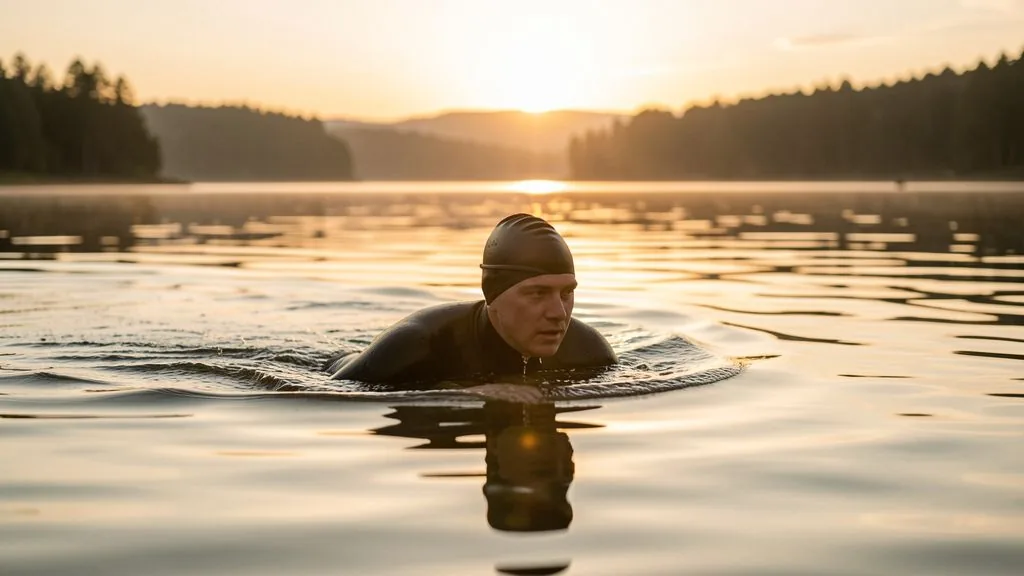
Drafting is the only legal performance gain in triathlon that costs nothing: no carbon, no power meter, no training camp. Behind another swimmer, oxygen cost drops by up to 30 percent — on the bike the same effect is forbidden in most races, yet how you handle that ban decides placings. Anyone who reads drafting as nothing more than "keep your distance" gives away minutes in the water and in bike tactics.
Why the slipstream in water beats any piece of equipment
Water resistance rises with the square of speed — at 1:20 min per 100 m, several dozen kilograms of drag already act on the body. That is exactly why any reduction of that force is immediately noticeable. Laboratory measurements using oxygen analysis show that directly behind someone's feet energy demand drops by 18 to 31 percent, and offset to the side at hip height still by 10 to 25 percent. At a swim time of 1:30 min per 100 m that is 5 to 10 seconds per 100 metres — over 1,900 m, one to three minutes, without a single extra training kilometre.
The effect has two causes. First the bow wave: the swimmer ahead pushes water to the sides, and in the wake a wave forms on which you can lie as if on a cushion. Second the actual suction — displacement creates a lower-pressure zone behind the body that pulls you along. Add the psychological factor: you swim faster without working correspondingly harder, and you start the bike leg with measurably less lactate.
Compared with a wetsuit the technical share is surprisingly large too: a well-fitting suit buys 2 to 5 seconds per 100 m, a cleanly swum slipstream often double that. Open-water technique therefore matters more than gear.
The three positions in the water
- Feet-on: the strongest position but technically the most demanding. You see nothing, have to navigate off the wake of the feet, and must avoid contact — touching counts as interference and can bring a warning or time penalty. Keep 30 to 50 centimetres of distance and correct using stroke length only.
- Hip-line: the best compromise for most age-group athletes. Offset roughly 50 to 80 centimetres to the side with your shoulder level with the leader's hip — here you can breathe, see ahead and still save about a fifth of your energy. This is the right position for choppy groups and for a first open-water start.
- Bow-wave riding: in the crest of the wave, offset behind the swimmer, technically the most relaxed variant. It only works in calm water with a well-formed wave — rarely in a choppy lake, very well in a pool or calm freshwater.
Drafting on the bike: 12 metres, front wheel to front wheel
The decisive rule is unspectacular and still constantly misapplied: in non-draft-legal races — Ironman, 70.3, Challenge and most age-group events — a minimum distance of 12 metres applies, measured from the front wheel of the trailing bike to the front wheel of the one ahead. Many national rulebooks say 10 metres, some organisers 12. The number is in the race instructions, and it is the only one that counts.
The gap is not a safety buffer but a performance buffer. Wind-tunnel and road measurements show the slipstream benefit at 10 metres is around 10 percent, at 12 metres about 7 percent, at 20 metres 3 to 4 percent. That is the real point — the rule permits a small part of the effect. Riding at 12 metres still collects a few seconds per kilometre with no risk at all. Riding at 6 metres gains perhaps 10 seconds per 10 kilometres and risks 30 to 60 seconds of penalty.
The maths almost always argues against breaking the rule. In a 40 km time trial at 38 km/h the difference between 12 and 6 metres is roughly 20 to 30 seconds. A 30-second penalty plus stopping and restarting costs 40 to 50 seconds. On top of that comes the risk of a second offence: with many organisers, the second drafting call means disqualification.
Draft-legal vs. draft-illegal: what applies where
- Draft-legal: ITU short course (sprint and Olympic) in the pro and junior ranks, some national championships, explicitly designated draft-legal age-group categories. Riding in a group is allowed here and tactically decisive — the bike leg becomes a team sport with rotation.
- Draft-illegal: all Ironman and 70.3 races, practically all middle-distance events, gran fondos with timing, the vast majority of mass-participation races. 12-metre rule, complete the pass within 25 seconds, then immediately re-establish distance.
- The "following at distance" grey zone: even without true drafting you benefit from a rider ahead if you stay 12 metres back — you sit in the region of reduced turbulence. Legal, measurable, and the reason large fields are collectively faster than solo starters.
When passing, a clear sequence applies: close up, pass, ride out at least 12 metres of advantage, only then move back in. Swinging in right after the pass creates precisely the situation that is scored as blocking.
The penalty and how to avoid it
Drafting is policed by motorcycle marshals. The usual sequence: yellow card plus number, penalty time in the penalty box on the run course (mostly 30 or 60 seconds depending on organiser and repeat offence), disqualification for gross blocking or a third offence. Some races serve the penalty on the bike by stopping you — then braking, standing and restarting add up to 60 to 90 seconds of real time loss.
In practice this is avoidable with three habits: first, never sit on a wheel in training but always ride with distance — otherwise the reflex is there in the race; second, let the computer or watch monitor distance and ease off immediately when closing rather than swinging out sideways; third, hold deliberately more gap on climbs and in corners, where distances shrink unnoticed. How to solve such situations tactically overall is covered in the article on triathlon race tactics.
Training drafting: three sessions that make the difference
- Pool slipstream (once a week): 6 × 100 m, the first 50 m in the slipstream and the second 50 m free, at an identical pace feel. The goal is not faster but the same speed at less effort — check it via breathing rate: after the slipstream segment you must breathe more calmly than after the free one.
- Open-water rotation (once a week in open water): 4 × 400 m with the lead changing every 100 m. Whoever leads swims 5 seconds per 100 m harder than the group — that teaches you to hold the slipstream and still lead when it is your turn.
- Bike pacing with distance control (once a week): 3 × 10 min at target pace with a partner 12 metres behind and the lead changing every 2 minutes. The stimulus here is not the slipstream but the ability to hold constant pace without a drafting reference.
In a Peakora plan these sessions appear as dedicated swim and bike blocks when your goal race has an open-water start and a draft-illegal bike leg. The load values distinguish cleanly between slipstream swimming (a notably lower TSS for the same time) and free swimming — otherwise you systematically overestimate your swim fitness.
Common drafting mistakes
- Swimming too close. Touching the feet ahead gets you checked and loses more than it gains — body contact is also the most common reason for warnings in the water. 30 to 50 centimetres is the right distance.
- Breathing forward instead of to the side. In the slipstream position, lifting the head pulls the body down and destroys exactly the body position that creates the advantage. Breathe to the side and navigate off the leader's legs.
- Using a slow bike as a slipstream. Staying 12 metres behind someone clearly slower loses more through the suppressed pace than turbulence ever returns. The slipstream only pays off at the same or a higher target speed.
- Trying to judge the gap in a wind tunnel instead of on the road. Twelve metres is hard to estimate in wind and in corners. A distance alert on the bike computer or a fixed landmark every kilometre is more practical than any theory.
- Using drafting as an excuse for missing bike fitness. The legal effect at 12 metres is a few percent. Anyone 25 watts short does not recover that through gaps.
What drafting means for the overall plan
Drafting changes the load distribution of a race, and that is exactly where it becomes relevant to planning. A swim leg in the slipstream costs 15 to 25 percent less energy in real terms than the same time in open water — over a 1,900 m swim that is 30 to 60 TSS points fewer depending on your level, energy available for the bike and run. Ignore that and you plan the bike leg too conservatively, leaving time on the table.
The reverse also applies: a draft-legal bike leg in a group is clearly less taxing than a solo ride at the same wattage — heart rate is often 5 to 8 beats lower at the same power because cooling is better in a group and surges reach full intensity less often. For race planning that means: in draft-legal races the run leg can be attacked more aggressively, while in draft-illegal races 12-metre discipline is the key to an even bike split and therefore to a good run.
When you plan your next race with Peakora, the engine receives this information through the race profile: draft-legal or not, open-water or time-trial start, wave or mass start. From that it derives how much the swim leg really costs and how the bike leg should be dosed — instead of assuming a generic ideal distribution. Details on periodisation are on the Peakora homepage.
Frequently asked questions about drafting in triathlon
How much does drafting save when swimming?
In the slipstream right behind the feet, oxygen cost drops by 18 to 31 percent depending on distance, most of all directly at the feet. At a pace of 1:30 min per 100 m that equals roughly 5 to 10 seconds per 100 metres.
Is drafting allowed on the bike in triathlon?
Only in draft-legal races such as ITU short course. In Ironman, 70.3 and most age-group events a minimum distance of 12 metres applies, measured from front wheel to front wheel.
What happens if I ride too close?
You receive a time penalty in the penalty box, usually 30 to 60 seconds, and disqualification on a repeat offence or for blocking. The penalty costs more real time than the slipstream can ever give back.
How do I get into the slipstream in the water?
Start offset to the side and swim the first 200 metres controlled until a group with a suitable pace forms. Then move onto the feet, keep 30 to 50 centimetres of distance and breathe to the side instead of forward.
Does drafting help when running?
Yes, but only slightly: into a 20 km/h headwind, sitting directly behind another runner saves around 3 to 8 percent of energy. That helps in strong wind but rarely decides a race.
Plan your next triathlon with Peakora
Enter your race profile and let the engine distribute the load — including drafting rules, transition times and a realistic target time. Start free, no credit card required.
Start for free