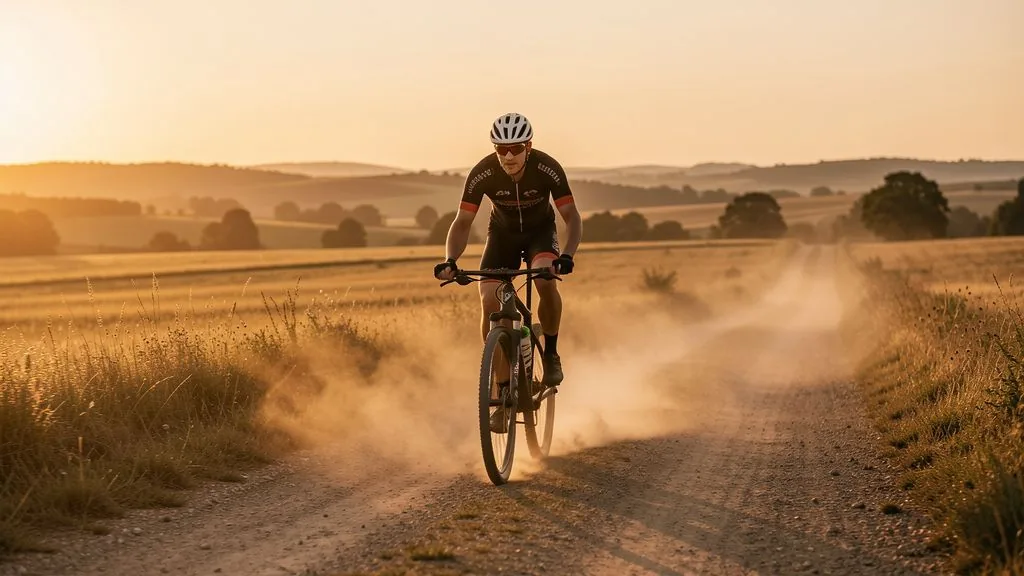
When buying a gravel bike, your satisfaction is decided not by the groupset but by tyre clearance — and by whether the geometry fits how you actually ride. Most bad purchases are not made on components but on the frame: anyone who later wants wider tyres, mudguards or luggage is locked into the wrong frame for years. So these nine criteria belong on your list before the first price comparison.
1. Tyre clearance: the most important number on the whole bike
Tyre clearance is the decisive figure because it cannot be retrofitted. As a rule of thumb: whatever maximum tyre width the manufacturer states, you can go about 4 to 6 millimetres below it with mudguards fitted in winter — and on muddy ground you additionally need at least 4 millimetres of air to the chainstays and fork so the tyre does not grind itself to a halt.
- At least 45 millimetres: that covers gravel, forest roads, farm tracks and most bikepacking tyres. Bikes with 40 millimetres clearance are cyclocross descendants and too tight for coarse terrain.
- 50 millimetres and more: worth it if you regularly bikepack, run knobbly tyres in winter, or ride a lot of coarse gravel and trails.
- Check instead of trusting: manufacturer figures often refer to a specific brand of tyre that measures narrower in reality. Measure in the shop or ask for a built-up example bike.
Why width matters that much is covered in detail in gravel training and in the guide to tyre pressure: on loose ground, 40 instead of 32 millimetres at the same comfort delivers more grip and fewer pinch flats than any component upgrade.
2. Geometry: stable rather than nervous
A gravel geometry differs from a road bike in three numbers: longer wheelbase, slacker head angle, lower bottom bracket. Together they produce a bike that tracks straight on gravel and does not twitch at 50 km/h on washboard. For mixed terrain, wheelbases around 1,020 to 1,060 millimetres and head angles between 70 and 71.5 degrees are typical.
Look at stack and reach, not at the frame size in centimetres — those numbers are not comparable between manufacturers. A gravel bike should have somewhat more stack (more upright) and somewhat more reach (longer) than your road bike. If you come from a road bike and are used to an aggressive position, do not pick the “race gravel” with road geometry if you mostly ride long, steady gravel rides — and vice versa.
3. Drivetrain: 1x or 2x
The 1× camp has conquered the gravel segment, and for good reason: no front derailleur losing the chain on rough ground, fewer parts, less maintenance. The price is coarser steps — with 1×11 and an 11-42 cassette the gaps are around 14 percent, while a 2×11 with 11-34 spaces gears more finely on the flat.
- 1×11 or 1×12: first choice for mixed terrain, bikepacking and anyone who values low maintenance. With a 40 or 42 tooth chainring and a 10-44 cassette you get up everything in low mountain ranges.
- 2×11: makes sense if you ride a lot of tarmac, ride in groups and want to hold high speeds on flat ground. With 50/34 and 11-34 you cover everything from 25 km/h uphill to 55 km/h in a group.
- Check the lowest gear: calculate your smallest ratio. On an 8 percent gradient at 3 watts per kilogram you need at least 34/34, better 34/36, to stay seated — otherwise you grind long climbs below 60 rpm and pay for it the next day.
4. Brakes: hydraulic, no discussion
On a bike ridden in mud, rain and on loose descents, the brake is not a component detail but a safety part. Hydraulic disc brakes offer a consistent bite point in the wet, noticeably less hand force and better modulation than mechanical discs. Mechanical discs are not inherently bad — but they are where manufacturers save below 1,500 euros, and they fade noticeably on long descents.
Look for at least 160 millimetres of rotor up front; above 85 kilograms of rider weight, or with luggage, 180 millimetres up front makes sense. If the bike should take mudguards and a rack, check that the mounts exist — many race gravel bikes do not have them.
5. Wheels: the underestimated cost block
Most gravel bikes between 2,000 and 3,000 euros come with solid but heavy aluminium wheelsets around 1,900 to 2,100 grams. That is not a problem — but it is the first place you will spend money later, which makes it a buying criterion: thru-axle standards (12×100 front, 12×142 rear) and tubeless-ready rims must be there, otherwise every upgrade becomes expensive.
6. Frame material: aluminium, carbon or steel
The material debate is more emotional than it needs to be. For 90 percent of riders the deciding factors are tyre clearance and geometry, not the material.
- Aluminium: best value, robust against crashes and transport, about 200 to 400 grams heavier than carbon. Chainstays and fork are carbon on good bikes — that damps the vibrations that actually matter.
- Carbon: lighter, stiffer at the bottom bracket, better damping. The advantage lies less in weight than in comfort on long gravel passages. Downside: crashes with concentrated loads can get expensive.
- Steel: damps best, lasts decades, is repairable. But 500 to 900 grams heavier and usually more expensive new than aluminium — the domain of touring bikes and custom builds.
If you travel a lot with the bike, carry it in a car or ride in winter, aluminium with a carbon fork will practically always make you happy. Carbon is worth it if you race or have to carry the bike a lot.
7. Contact points: saddle, bars, tyres
The three points where you touch the bike decide comfort more than the frame. A gravel bar typically has 12 to 16 degrees of flare (drops bent outward) — that gives control and leverage on loose descents, but feels unusually wide on the road. If you ride 80 percent tarmac, choose 6 to 10 degrees of flare.
For the saddle: width matching your sit-bone distance (usually 130 to 155 millimetres), no padding orgy. And stock tyres are almost always a compromise — a good 42 millimetre gravel tyre set up tubeless is often the single most effective upgrade, regardless of what the bike cost.
8. Everyday usability: mounts, mudguards, luggage
A gravel bike that only gets ridden in sunshine is half a gravel bike. Before buying, check whether the frame has mounts for mudguards and a rear rack, and whether clearance with guards fitted still takes 40 millimetres. If you want to train through winter — the season with the largest base-training share — you need those options.
Also check: bottle mounts on seat tube and down tube (two bottles is the minimum on long rides), an option for a top tube bag and, for bikepacking ambitions, fork mounts. Details are in bikepacking for beginners.
9. Size and position: where most bad purchases happen
A bike that is too big is the most expensive gravel buying mistake, because it cannot be fixed with a shorter stem. Signs: stretched arms, pressure on the palms after 60 minutes, saddle discomfort at the front, no feel for the front wheel on gravel. A bike that is too small, on the other hand, produces saddle-to-bar drop that loads neck and lower back on long rides.
Procedure: measure your inseam (barefoot, back against a wall, book pushed up with real pressure, three attempts, take the highest value), multiply by 0.65 — that gives seat tube length as a starting point, not the truth. More reliable is comparing stack and reach with your current bike. Sit on two sizes in the shop, ride at least 30 minutes, then have saddle height and setback set. The full procedure is in bike fitting.
Budget: what you get in which class
- 1,200–1,800 euros: aluminium frame, mechanical disc brakes, 2×9 or 2×10, often only 38–40 millimetres of clearance. Usable on farm tracks, but the brake is the weak point.
- 2,000–2,800 euros: the sweet spot. Hydraulic disc brakes, thru-axles, 1×11 or 2×10, 45 millimetres of clearance, tubeless-ready wheels.
- 3,000–4,500 euros: carbon frame, 1×12 or 2×11, lighter wheels, consistently high-quality finishing kit. Worth it for racing ambitions or very high riding volume.
- Above 5,000 euros: race gravel with carbon wheels. Performance gain per euro is smallest here — only above this level is it worth looking at watts and weight instead of durability.
Common mistakes when buying a gravel bike
- Buying for looks instead of clearance. A beautiful bike with 38 millimetres of clearance stays unsuitable for coarse gravel — and you only find out after your first race.
- Choosing road geometry for long rides. “Race gravel” is built for two-hour racing, not six-hour rides. If you want both, you need to compromise on position.
- Saving on the wheelset, then paying twice. A bike with non-standard axles makes every later upgrade impossible or expensive.
- Buying on recommendation without a test ride. Stack and reach are numbers — how a 1,040 millimetre wheelbase feels on gravel is decided by your body, not by the spec sheet.
- Overestimating the bike as a training solution. A new bike does not make you faster; it makes your training more pleasant and more varied. Fitness comes from periodisation.
Where the training plan comes from
A gravel bike is a tool, not a training plan. Once the bike is there, structure decides progress: base work on long easy rides (zone 2, roughly 55 to 75 percent of FTP), sweet spot at 88 to 94 percent for race-pace endurance, short hard efforts for VO2max — and a taper of 10 to 14 days before the race. In the Peakora cycling cluster you find the building blocks: gran fondo training for race-distance preparation and the training glossary for FTP, TSS, CTL and TSB if those numbers mean nothing to you yet.
Frequently asked questions
How much should a good gravel bike cost?
For serious gravel training the sensible entry point is around 2,000 to 2,800 euros: hydraulic disc brakes, thru-axles and a 1×11 or 2×10 drivetrain are standard in that class. Between 1,200 and 1,800 euros you get usable bikes with mechanical disc brakes — and the brake is the first place where money gets saved.
How wide should gravel bike tyres be?
40 to 45 millimetres is the best compromise for mixed terrain; for coarse gravel and bikepacking more like 45 to 50 millimetres. What matters is not the stock tyre but the frame's clearance: at least 45 millimetres with 4 millimetres of air at the chainstays and fork.
Can a gravel bike replace both a road bike and a mountain bike?
For most recreational riders, yes. A gravel bike covers tarmac, gravel, forest roads and farm tracks, which makes it the most versatile bike. It does not replace a mountain bike on technical trails with roots and steps, and in fast group rides above 35 km/h the wider tyres cost a few watts.
1x or 2x drivetrain on a gravel bike?
1×11 or 1×12 is the better choice for most gravel riders: fewer parts, no front derailleur dropping the chain on rough ground, and fine enough steps via a large cassette. 2×11 makes sense if you ride a lot of tarmac and steep climbs at high cadence, or regularly ride in groups on the road.
What frame size do I need for a gravel bike?
Measure your inseam and multiply by 0.65 as a starting value for seat tube length — but stack and reach matter more. Gravel geometries are usually a little longer and more stable than road geometries. Ride two sizes before you buy.
Plan your training with Peakora
From the first base block to your gravel race: periodisation, TSS load control and a recovery monitor in one app. Start for free, no credit card required.
Start for free