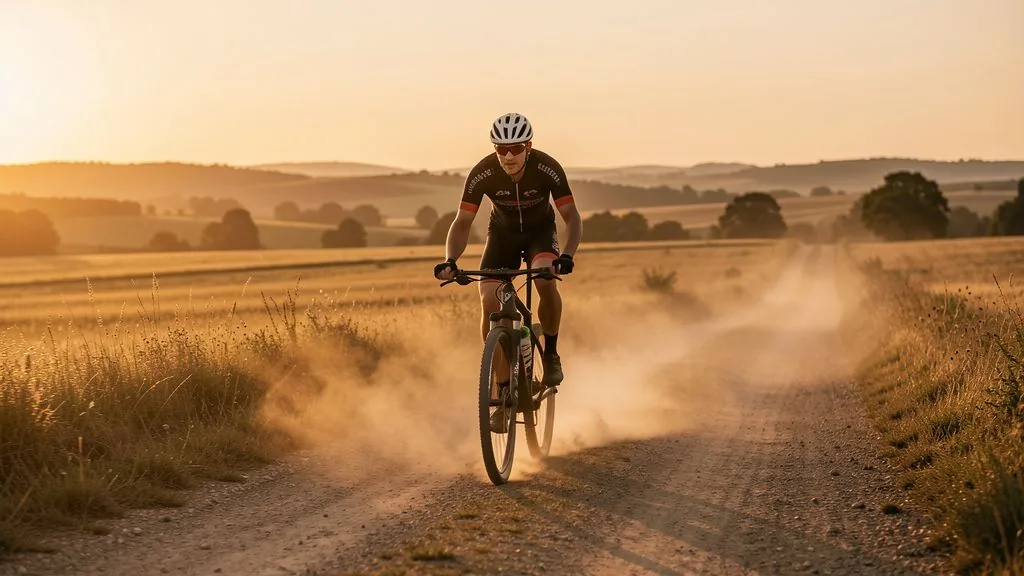
Gravel racing is the fastest-growing race format in cycling — and the most honest one: four to eight hours across gravel, farm tracks and tarmac, with no sheltered bunch phase and no team car. Finishing well takes more than a wide smile and wide tyres. This guide shows how to structure your training over 12 to 16 weeks for the specific demands of a gravel race.
What gravel races demand physiologically
A typical gravel race over 100 to 200 kilometres is physiologically neither a road race nor a marathon MTB event — it is its own kind of effort. Power data from events like Unbound Gravel or the Traka paint a consistent picture:
- Duration: Most riders are out for 5 to 9 hours. That requires an aerobic base far beyond what a two-hour road race demands.
- Average intensity: You ride for hours at 70 to 80 percent of FTP — with repeated surges above threshold on climbs, in crosswinds and on technical sectors.
- High force component: Gravel eats speed. Holding 25 km/h on loose terrain often costs 30 to 50 watts more than on tarmac — while rolling resistance and vibration load your arms, shoulders and core.
- Energy demand: Depending on weight and duration you burn 3,000 to 6,000 kilocalories. Without consistent fueling from minute 60, the late-race collapse is pre-programmed.
The training consequence: you need the endurance of a gran fondo rider, the threshold proximity of a time trialist and bike-handling skills on loose terrain — all at once.
The three pillars of gravel training
Structure your week around three types of stress instead of simply "riding a lot":
- Base endurance (Zone 1–2): Two to three easy sessions per week at 55 to 75 percent of FTP. They build the fat-metabolism capacity that keeps you pedalling in hour six. Rule of thumb: at least half your weekly volume stays easy.
- Sweet spot: One to two sessions with intervals at 88 to 94 percent of FTP — the biggest training return per unit of fatigue. More on that below.
- The long ride: Once a week, 3 to 5 hours, later in the build 5 to 7, with race simulation: target power, race tyres, race nutrition.
Sweet spot: the most important building block
If you take only one intensity seriously for gravel, make it this one: sweet spot sits at 88 to 94 percent of your FTP — hard enough for maximum aerobic adaptation, moderate enough to absorb plenty of it. That is exactly the band where you will ride long stretches of the race: on kickers, on windswept gravel tracks, chasing a group.
Dosage makes the difference. Start with 2 × 20 minutes of sweet spot per session and progress over six to eight weeks towards 3 × 20 or 2 × 30 minutes. If you do not know your FTP, establish it first — a structured FTP test and power-based training is the prerequisite for "88 to 94 percent" being more than a guess. Full details on interval lengths, progression and common mistakes are in our article on sweet spot training on the bike.
A practical tip for race specificity: ride sweet spot intervals occasionally on unpaved terrain or at least with your full race setup. On gravel, the power you can hold at the same perceived effort often drops by 5 to 10 watts — riders who only know the trainer get a rude surprise on race day.
Long rides with race simulation
The long ride is your laboratory. You are not just testing legs here, you are testing the entire race system:
- Position and contact points: After five hours, your saddle, handlebars and shoes reveal whether they are up to the job. Pain in hour three of training is a gift — in the race it would be a DNF.
- Fueling: 60 to 90 grams of carbohydrate per hour, starting no later than 45 minutes into the ride, plus 500 to 750 millilitres of fluid. This has to be trained — the gut is trainable. The same principles as in marathon fueling apply here.
- Pacing: Deliberately start your long rides too slow. If you ride the first two hours at 65 percent of FTP and can still press on in the final hour, you have understood the most important gravel skill.
- Terrain mix: Find loops with gravel sectors, forest tracks and rough tarmac. The constant rhythm changes — accelerate, hold, freewheel — are the real race load.
Build the long ride progressively: from 3 hours through 4 and 5 up to a maximum of 6 to 7 hours in your biggest week, three to four weeks out. After that, tapering begins — the final 10 to 14 days belong to freshness, not fitness.
Technique and core tension on loose terrain
On gravel, it is not just the strongest rider who wins — it is the most economical one. Three technique elements save measurable energy:
- Tyre pressure: Too much pressure bounces and brakes you on loose ground. A starting point for 40 mm tyres at 70 kg system weight: roughly 2.5 bar front, 2.8 bar rear — then adjust in 0.2 bar steps by feel.
- Line choice: The compacted line is faster than the loose edge, even if it is not the ideal cornering line. Look 10 to 15 metres ahead, not at your front wheel.
- Relaxed upper body: Arms slightly bent, grip loose. Clenching the bars transmits every vibration into your muscles and leaves your upper body finished after four hours — a classic cause of the late-race fade.
Sample week: 10 weeks before the race
Here is a typical build week with roughly 10 hours of volume — scale the durations to your current level:
- Monday: Rest day or 30 minutes of easy spinning. Recovery is training.
- Tuesday: 90 minutes with 3 × 15 minutes sweet spot (90 % FTP), 8 minutes recovery between.
- Wednesday: 60–90 minutes Zone 1–2, fully easy. Ideal for a technique focus: looking ahead, relaxed upper body.
- Thursday: 90 minutes with 6 × 4 minutes at 100–105 % FTP — short surges for the gravel climbs.
- Friday: Rest day or 40 minutes very easy.
- Saturday: Long ride of 4 hours with mixed terrain, second half 2 × 20 minutes at upper Zone 2, fueling protocol as on race day.
- Sunday: 90 minutes Zone 1–2 to close out the week.
Every three to four weeks, follow a deload block at around 60 percent of normal volume — adaptation happens during recovery, not during the load.
Common mistakes in gravel training
- Too much intensity, too little base. Three sweet spot sessions a week without the long ride makes you fast for two hours — and broken in hour five. Race duration has to be reflected in training.
- Testing fueling on race day. An untrained gut will not tolerate 90 grams of carbohydrate per hour. Build the amount gradually across your long rides.
- New equipment shortly before the race. New tyres, new saddle position, new bags — everything you use on race day must have survived at least two long rides.
- Dropping strength training entirely. Core and upper body stabilise you against vibration; two short strength sessions per week in the build, one in the specific block, pay off directly in the late race hours.
- No taper. The last big load belongs 10 to 14 days before the start. If you are still "looking for form" in race week, you have already lost it at the start line.
How Peakora plans your gravel training
Gravel events are built into the Peakora engine as their own race type — related to gran fondo training, but with longer sweet spot blocks and race-simulation rides in the specific phase. You enter race date, distance and your current level; the engine automatically periodises base, build and taper. The recovery monitor tracks your load in parallel: if your TSB values dive after a hard week, the adaptive plan adjusts the following sessions — so you hit your form peak exactly on race day, not a week early.
Frequently asked questions about gravel training
How long does it take to prepare for a gravel race?
Plan for 12 to 16 weeks of structured training if you already ride regularly. For long gravel events over 150 kilometres, 16 weeks with three to four sessions per week is a realistic frame to build base fitness, sweet spot capacity and long rides properly.
How many watts do I need for a gravel race?
The key number is not your peak power but your FTP relative to body weight: around 2.5 to 3 watts per kilogram is enough to finish a gravel race solidly. Ambitious riders sit at 3.5 to 4 watts per kilogram. More important is the ability to hold 70 to 80 percent of FTP for hours.
Do I need a dedicated gravel bike?
Not necessarily. What matters is tyre clearance and rubber: 38 to 45 millimetre wide tyres at low pressure make the biggest difference on gravel. A road bike with wide gravel tyres or a hardtail MTB works just as well for getting started.
How do I train for gravel if I only have tarmac nearby?
The physiological stimuli — base endurance, sweet spot, long rides — can be trained entirely on tarmac. Add farm tracks, forest roads or unpaved bike paths in your area for bike handling. Two to three targeted gravel rides before the race are enough to get the feel.
Plan your gravel training with Peakora
AI training plan with sweet spot blocks, race simulation and adaptive tapering — tuned to your gravel race. Start free, no credit card required.
Start for free