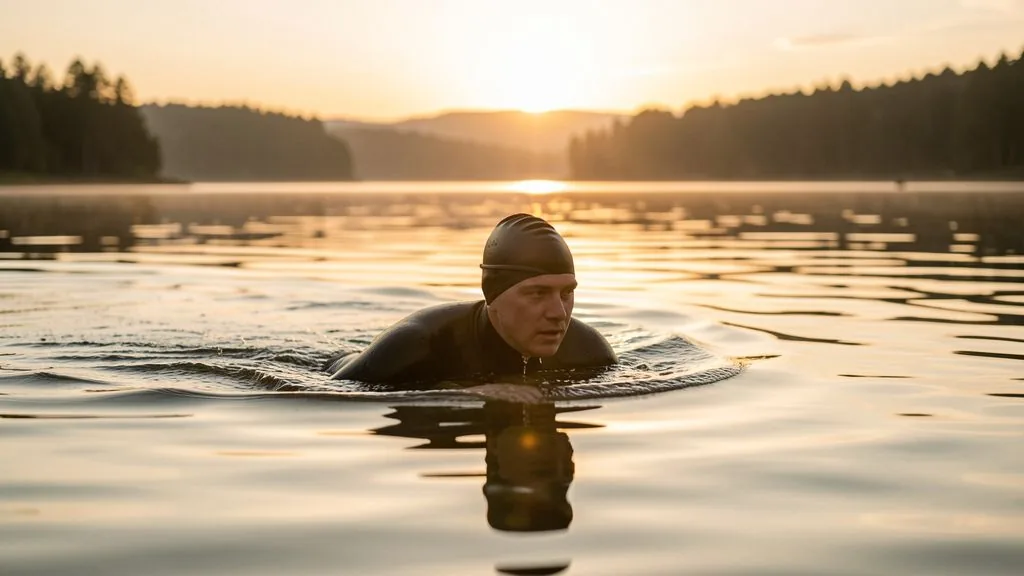
Backstroke has a poor reputation in training: too slow, too unfamiliar, too often a zigzag across three lanes. Yet it is the only stroke where breathing stays completely free, where the shoulder works in its most relaxed position, and where you train precisely what your freestyle usually lacks — a long, calm body line with rotation driven by the trunk. Anyone who masters backstroke technically doesn't just gain a second stroke. They get faster in the first one too.
Why backstroke is more than a recovery stroke
In everyday training, backstroke mostly shows up as a loosening length between hard freestyle sets. That wastes its potential, because the stroke has three properties no other stroke offers:
- Unrestricted breathing. The head lies in the water, the face is free. There is no breathing rhythm to coordinate, no time pressure, no swallowing water. That is exactly why backstroke is the best stroke for working on body position and arm stroke — you can concentrate on one thing.
- Open shoulder position. In freestyle the arm passes the narrowest point under the shoulder roof. In backstroke the upper arm stays at the side and the space under the acromion remains clear. With shoulder problems, backstroke is often the stroke that still works pain-free — more on this in shoulder pain in swimming.
- Trunk and extension. Because you lie on your back, any missing tension is instantly visible: the hips sink, the legs hang, the body folds in the middle. Backstroke is therefore a merciless test of what freestyle coaches call "body line".
The price is orientation. Without a view forward you generally don't swim where you intended to — a topic in a 25-metre pool, a real problem in open water without a lane rope. Add the neck position: tilting the head back to see behind you blocks the cervical spine and simultaneously drops the hips. Both are solvable, but both cost technique.
Body position: hips high, head neutral
The decisive difference between a fast and a slow backstroker is not the arm stroke but the body line. A body lying flat at the surface displaces water like a plank. A body with sinking feet is permanently swimming uphill.
The target position: waterline roughly at ear level, forehead and chin clear, sternum just below the surface, hips high enough that every kick produces a small boil of water over the toes. The hips are the critical point — they sink as soon as trunk tension fades or the head tilts too far back.
Two corrections almost always help immediately:
- Chin slightly toward the chest. Not exaggerated, just enough that the gaze goes diagonally up and back rather than straight at the ceiling. This brings the neck into a neutral position, and the head stops acting as a lever pushing the hips down.
- Ribs down. A slight hollowing of the lower ribs ("closing the ribs") activates the abdominals and lifts the pelvis. The feeling is not "tense the belly" but "keep length between sternum and pubic bone".
If the hips still sink, it is almost never a tension problem but a tempo problem: with too slow a kick, the lift that keeps the legs up is missing. Backstroke tolerates sluggishness less than freestyle.
The arm stroke: press backwards, don't pull downwards
The most common misconception starts with the word "pull". It leads swimmers to push the arm downwards, as if trying to pull themselves up on the water. In backstroke, as in freestyle, propulsion comes from pressing backwards against a relatively fixed mass of water. The elbow stays bent and the palm faces the direction of travel.
The arm cycle in five phases:
- Entry: The arm comes out of the air extended and enters about shoulder-width to the side of the long axis — not above the head, not behind the hip. The little finger enters first, the palm faces outwards.
- Catch: The elbow bends to roughly 90 to 100 degrees and the hand turns perpendicular to the pulling direction. Crucially, the elbow stays high and the hand no deeper than 30 to 40 centimetres. Caught too deep, the arm becomes a paddle that only pushes down.
- Press: The hand travels past the body towards the hip. Propulsion peaks when the hand is level with the shoulder through to the hip — not at the start of the stroke.
- Finish: Just before leaving the water, the arm pushes once more back and down. Thumb first out, palm towards the thigh.
- Recovery: The arm returns extended above the water, relaxed, with a quiet shoulder. A high arc is unnecessary — a nearly straight arm costs less energy than a wide swing.
One detail rarely explained in courses: the arm stroke is not symmetric. Both arms work in opposition, and precisely in the transition phase — one arm pressing while the other recovers — is where most force is lost. Use trunk rotation here and you keep the pressure constant instead of "pumping".
Kick: from the hip, not from the knee
The backstroke kick is a flutter kick with six beats per arm cycle — three per arm. It originates at the hip; the knee bends as a consequence, not as a driver.
The mechanics: the leg kicks up to just below the surface so the toes briefly break through and throw a small boil. Downwards it travels to about 30 to 40 centimetres deep, then back up. The motion is short and quick, not long and powerful. Toes pointed, ankles loose — a flexed foot acts like a brake.
Two typical errors:
- Cycling. If you look like you're riding a bicycle from behind or from the side, the motion comes from the knee. That costs a lot of energy and produces almost no propulsion. Fix: short fins (not long ones) and the deliberate feeling of moving the whole leg as one stiff unit.
- Too slow. A slow kick lets the hips sink and the body swims in a "sitting angle". In backstroke, kick 20 percent faster than feels necessary, but smaller.
Rotation: the engine that connects everything
Backstroke is not a flat stroke. As the right arm enters, the right upper body rotates slightly down to the right and the right hip follows. The head stays still throughout — it is the anchor of the rotation, not part of it.
Rotation serves two purposes. First, it lengthens the arm stroke: a swimmer who rotates can carry the arm further back and move more water. Second, it links kick and arm stroke — without rotation both work independently and the body swims in two halves.
How much rotation? As a guide: 30 to 45 degrees of shoulder roll, with the shoulder about 10 to 15 centimetres lower during the press than during the recovery of the same arm. Too much rotation tips the body sideways and costs body line; too little shortens the stroke. The test is simple: if your hips stay still while swimming and only the shoulders move, it's too little.
Five drills that make the difference
- Kick with arms extended overhead (4 × 25 m). Arms long behind you, head between the upper arms, kick only. The body-line test: if the arms or head sink under water, trunk tension is missing. This is the single most important drill in the stroke.
- Single-arm backstroke (4 × 25 m per side). One arm stays long at the side while the other swims the full cycle. You immediately see whether one side catches differently or presses later. Asymmetries of 10 to 20 percent are normal; anything beyond that costs you metres in zigzags.
- Fingertip drill (4 × 25 m). During recovery the palm brushes across the water surface as if wiping it. This corrects the overly wide arc and brings the shoulder into a quieter position.
- 3-3-3 switch (6 × 50 m). Three backstroke strokes, three freestyle, three backstroke — without stopping at the wall. The switch forces you to carry the body line from your back into freestyle, and that transfer is the whole point.
- Backstroke with breath held (4 × 25 m). One inhale, face in the water, full back position without breathing. Sounds simple but is the fastest way to find a stable head position — because the head can no longer be misused as a breathing aid.
These drills don't only work for backstrokers. Anyone with a freestyle body-line weakness will find the matching freestyle drills in improve your freestyle technique — but backstroke is the fastest diagnostic route.
How backstroke fits into triathlon training
In triathlon, backstroke is not a race stroke, but it is an excellent tool. Three applications are practically relevant:
- As a technique block at the start of every session. 400 to 600 metres of backstroke with drills before you move into freestyle sets. You then swim automatically taller, because backstroke calibrates extension.
- As active recovery between hard sets. Instead of 100 metres easy freestyle: 100 metres backstroke. The shoulder unloads, breathing stays calm, and you still collect metres. In practice, heart rate often drops faster on your back than in easy freestyle.
- As an alternative with shoulder trouble. When freestyle pulls, backstroke is usually the way to stay in the water instead of stopping entirely. How to sensibly reduce swim volume with symptoms is covered in shoulder pain in swimming.
For beginners who don't yet have a second stroke, backstroke is also the least intimidating option: no water in the face, no breathlessness, no need to sight forward. What the overall entry into swimming looks like is described in learning to swim as an adult, and how the three disciplines are built across a season is covered in the triathlon training guide.
Sample session: 45 minutes of backstroke with a technique focus
- Warm-up: 200 m easy freestyle, 200 m alternating backstroke and freestyle (25 m each).
- Technique block: 4 × 25 m extended kick, 4 × 25 m fingertip drill, 4 × 25 m single-arm per side — 20 seconds rest each.
- Main set: 6 × 100 m backstroke with 30 seconds rest. The goal is not speed but a constant stroke count per length. Count your strokes and try to hold the number across all six.
- Transfer: 4 × 50 m in the 3-3-3 switch, then 200 m easy freestyle.
- Cool-down: 150 m backstroke with no arm stroke, kick only, arms at the sides.
The session totals just under 1,900 metres and takes 40 to 50 minutes depending on pace. It doesn't replace a freestyle session, it complements one — and in weeks with high running load it is the perfect second session of the day, because it doesn't stress the musculoskeletal system. How such extra sessions fit into the weekly plan without blowing up recovery is covered in training twice a day.
Common mistakes
- Head tilted back. The classic, usually born from wanting to see more. Blocks the cervical spine and pushes the hips down. Fix: chin slightly toward the chest.
- Catch too deep. Anyone catching 60 centimetres deep presses down instead of backwards. Keep the elbow high and the hand just below the surface.
- Kicking from the knee. Looks like cycling, costs energy and achieves nothing. Short fins as a correction, then without.
- Too few metres. Backstroke feels foreign, so many swimmers stop at 100 metres per session. To see an effect you need 400 to 800 metres per week, spread over two or three sessions.
- No reference point. Swimming into the swimmer in the next lane or into the wall. Use pools with a line on the floor, and in open water only with company and a visual check every six to eight strokes.
- Judging backstroke by the clock. Anyone swimming for time will always be disappointed. Backstroke is scored on technique, not on time.
How Peakora schedules swimming
In the Peakora plan, swimming is not a side discipline but its own load block with its own control. The engine counts swim metres through training stress — a hard freestyle session loads differently from 2,000 easy metres — and keeps the week's total load in range so that run and bike quality don't suffer. Technique blocks like backstroke deliberately run as low-intensity stimulus: they improve body line without blowing the recovery budget. How the three disciplines are weighted depends on the goal — Olympic distance follows a different distribution than long distance — and the core training terms are defined in the glossary.
Frequently asked questions
How fast should I swim backstroke?
As a technique and recovery set, 1:50 to 2:30 minutes per 100 metres is entirely normal. At the same effort, backstroke is about 10 to 15 percent slower than freestyle — so never compare times across strokes, only your own progress.
Why do I zigzag when swimming backstroke?
Usually because of an asymmetric arm entry or a rotation that only happens on one side. Check the centre line: the hand enters about shoulder-width apart, not above the head, and the head stays still. A line on the pool floor makes the error immediately visible.
Is backstroke good for your shoulders?
Yes, with clean technique. Because the arm never passes close to the head, the narrow space under the shoulder roof stays open — backstroke is often the stroke that still works with impingement. The only real mistake is tilting the head far back.
How do I breathe during backstroke?
Continuously, without turning your head. Inhale while one arm is above water, exhale under water — the rhythm follows the arm cycle, not the kick. Tilting the head back to get more air blocks the cervical spine and drops your hips.
Can backstroke improve my freestyle?
Yes. Backstroke trains exactly what freestyle usually lacks: a long body line, rotation from the trunk and steady pressure backwards. Many swimmers get faster in freestyle after a few weeks of backstroke work without a single extra freestyle session.
Plan your training with Peakora
Swim, bike and run in one periodisation — with load control that counts your technique sessions too. Start free, no credit card required.
Start free